Archive for April, 2010

h1

Time for cut our losses?

April 25, 2010

I’m not sure how it happened but I ended up on a mailing list for the British magazine The Spectator last year. Luckily, their messages are infrequent.

Several weeks ago, I got a message which caught my attention. It contained the image and text below.

Debate: Too Late for Britain?

Tuesday 22 June 2010

Spiralling debt, a City in crisis, and unemployment is on the rise – Britain has faced crises before but is this time different? Are we beyond salvation? Is the really sensible move to pack up and clear off?

FOR the motion:
Rod Liddle, columnist, The Spectator
Catherine Mayer, London bureau chief, Time
David Selbourne, Political philosopher

AGAINST the motion:
Daniel Hannan, Conservative MEP
Tristram Hunt, historian
Bonnie Greer, playwright and author

Join The Spectator debate, chaired by Andrew Neil, at the Royal Geographical Society, 1 Kensington Gore, London SW7 between 6.45pm and 8.30pm.

I know that a debate in Britain is something roughly like a Chautauqua meeting here in the States; an opportunity to hear people talk about, or to discuss with others, a variety of topics. So I expect that this particular debate is something they’d do as much for entertainment as for other reasons.

Nonetheless, I found it a spooky topic. Has it come to this? I wondered.

And, what’s worse, the description of the problems is one that fits the United States all too well. Should we be considering the question too?
h1

People have responsibilities

April 18, 2010

When my sons were young boys, I took the time to acquaint them with the U.S. Constitution and with the idea that there are rules and limits for the government’s behavior just as there are rules and limits for individual behavior. By ‘acquaint’, I mean we read the U.S. Constitution aloud and discussed each article and amendment.

But I also was also careful to point out that if the government doesn’t try to make a safety net – and I don’t think it should try to – then someone else needs to that. And that someone else is all of us.

Bad things happen to people that they can’t control. Courage in the face of adversity is admirable but isn’t always enough for survival; sometimes folks need a hand. It can happen to any of us.

I like to live in a society where there’s some "social surplus": one where, if you happen to fall on hard times, other people have the means, the time and the willingness to give you a hand voluntarily.

When I was near to graduating high school Boyd Goldsworthy, my friend’s dad, offered to help with my college tuition. He assumed (rightly) that paying tuition might be a problem for my family. I didn’t accept his offer since I didn’t go straight from high school to university but I’ve always remembered that he made it.

If we’re all living in penury, we can’t lend a hand. If we’re all so focused on ourselves that we don’t pay attention to what’s going on around us, we won’t lend a hand. But it’s a task reasonable people don’t shirk in my view.

I thought James Lileks made a good point once when he said he’d never seen a hospital called "Libertarian General" – which caused me to recall that the two largest and most respected hospitals where I live are St. John’s Mercy and Missouri Baptist.

All that said, you’ll see why I liked this clip from one of Milton Friedman’s speeches at Stanford back in the 70s.

h1

Social injustice

April 10, 2010

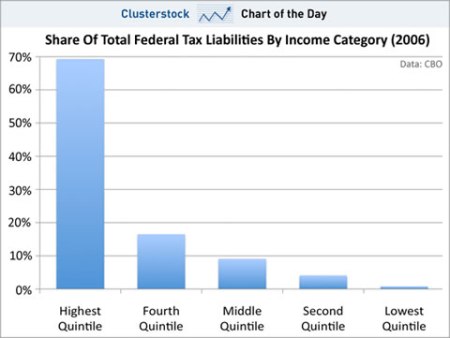
On the day my wife spent preparing our 1040, I came across two articles about who pays federal taxes (via TigerHawk). This chart comes from ClusterStock.

Taxes by quintile (ClusterStock)

The accompanying article begins:

Here’s why government spending is really out of control.

First of all, half of Americans don’t even pay income taxes, but it gets worse. If we look at total federal taxes, 20% of Americans pay 70% of taxes, as shown above. 40% of Americans pay 95% of federal taxes.

And this is from the second article at Yahoo! Finance.

Nearly half of US households escape fed income tax

WASHINGTON (AP) — Tax Day is a dreaded deadline for millions, but for nearly half of U.S. households it’s simply somebody else’s problem.

About 47 percent will pay no federal income taxes at all for 2009. Either their incomes were too low, or they qualified for enough credits, deductions and exemptions to eliminate their liability. That’s according to projections by the Tax Policy Center, a Washington research organization.

Are we to the point of bread and circuses yet? Why wouldn’t someone who pays little or no tax vote for those who are good at increasing government spending? Why not?

As they say: If you want peace, work for justice. An equitable tax code would be a good place to start.