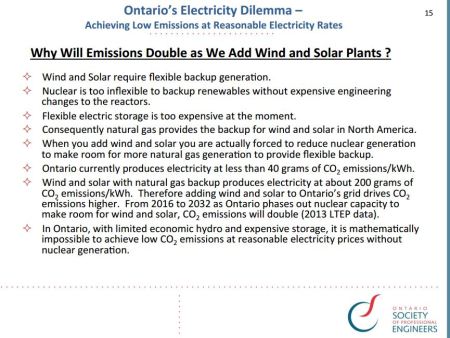
I enjoyed this report from the Ontario Society of Professional Engineers, which is a nice nuts and bolts summary of the electricity challenges facing developed nations in the next 30 years. Here is the slide most people would simply reject out of hand:
The engineers’ report is a year old. If you’re interested in reading it, you can find it here. (It’s a PDF that looks to have been made from a slide deck.)
Just last night at dinner I was wondering aloud what Apple (and Apple iPhone owners) thought of the FBI’s claims that someone had hacked the phone used by Farook & Malik in San Bernadino. It wasn’t a concern to me since I don’t own an iPhone, but if I did own one I’d be wondering whether (a) the FBI really had hacked the phone and, if so, (b) what that implied about security on my iPhone.
And speak of the Devil… today’s Wall Street Journal ran this article about a newer case. (It’s behind their paywall, of course).
WASHINGTON—The Justice Department on Friday night dropped a court case trying to force Apple Inc. to help authorities open a locked iPhone, adding new uncertainty to the government’s standoff with the technology company over encryption.
In a one-page letter filed with a Brooklyn federal court Friday night, the government said an individual had recently come forward to offer the passcode to the long-locked phone. The filing means that in both of the high-profile cases pitting the Justice Department against Apple, the government first said it couldn’t open the phone, only to suddenly announce it had found a way into the device as the case proceeded in court. […]
The case involves an iPhone 5s that was seized from suspect Jun Feng as part of a 2014 drug investigation in New York. Mr. Feng pleaded guilty last year, but both sides agreed the legal dispute surrounding the phone still needs to be resolved.
After he was arrested, Mr. Feng told agents that he didn’t remember the phone’s passcode, leading investigators eventually to seek Apple’s help. The Wall Street Journal reported last week that Mr. Feng only recently learned his phone had become an issue in a high-stakes legal fight between prosecutors and Apple. Mr. Feng, who has pleaded guilty and is due to be sentenced in the coming weeks, is the one who provided the passcode to investigators, according to people familiar with the matter. […]
Earlier this week, James Comey, the director of the Federal Bureau of Investigation, told a London security conference audience that the government paid more than $1 million for an unidentified third-party to help open the San Bernardino work phone of Syed Rizwan Farook.
Mr. Farook and his wife killed 14 people and wounded 22 in a Dec. 2 shooting rampage at a holiday gathering of county employees, before being killed later that day in a shootout with police.
Earlier this week I ran across this video on Darrell Issa’s Twitter feed.
It makes the point about security on network devices pretty well, I think. The question’s not as simple as people putting their privacy ahead of the common good (as the FBI and politicians would have it). It’s not just about Snapchat and Twitter. It’s about all the data on what have become our personal computers — the bank passwords, or the business data that you don’t want made public, or your Ashley Madison account maybe.
So that makes this an issue about introducing weaknesses in devices on an open network that already has its share of security risks. Anyone work for the OPM? Do you think the Feds should dictate security measures for everyone?
But getting back to what I was wondering about, I couldn’t find that there’d been any answer to that question. Here’s a three-week-old article in the Los Angeles Times.
Apple Inc. refused to give the FBI software the agency desperately wanted. Now Apple is the one that needs the FBI’s assistance.
The FBI announced Monday that it managed to unlock an iPhone 5c belonging to one of the San Bernardino shooters without the help of Apple. And the agency has shown no interest in telling Apple how it skirted the phone’s security features, leaving the tech giant guessing about a vulnerability that could compromise millions of devices.
“One way or another, Apple needs to figure out the details,” said Justin Olsson, product counsel at security software maker AVG Technologies. “The responsible thing for the government to do is privately disclose the vulnerability to Apple so they can continue hardening security on their devices.”
But that’s not how it’s playing out so far. The situation illuminates a process that usually takes place in secret: Governments regularly develop or purchase hacking techniques for law enforcement and counterterrorism efforts, and put them to use without telling affected companies.
I’d be very surprised if Mr. Olsson’s suggestion that the government disclose its method to Apple ever happens.
Update 4/26/16
Well, that easy prediction was quickly confirmed. Here’s more news from today’s Wall Street Journal (and behind its paywall, naturally). My emphasis below.
The FBI is preparing to send a formal notification to the White House in the coming days saying that while the agency bought a hacking tool from a third party to unlock the San Bernardino shooter’s iPhone, officials aren’t familiar with the underlying code that runs it.
The Federal Bureau of Investigation doesn’t plan to tell Apple Inc. how it cracked a San Bernardino, Calif., terrorist’s phone, said people familiar with the matter, leaving the company in the dark on a security vulnerability on some iPhone models.
The FBI knows how to use the phone-hacking tool it bought to open the iPhone 5c but doesn’t specifically knows how it works, allowing the tool to avoid a White House review, the people said, The FBI plans to notify the White House of this conclusion in the coming days, they added.
Any decision to not share details of the vulnerability with Apple is likely to anger privacy advocates who contend the FBI’s approach to encryption weakens data security for many smartphone and computer owners in order to preserve options for federal investigators to open locked devices. […]
And if you believe the FBI’s claim that it "doesn’t specifically know how it works" then please call me about the bridge I have for sale.
While it’s a Federal crime for us to lie to Federal law enforcement agents, it’s not a crime (of any sort) for them to lie to us.
Update 5/19/16
Here’s probably the most persuasive response to the government’s demands for backdoors in phone security. If a government has access, it will be abuse that access sooner or later.
14ymedio, Generation Y, Yoani Sanchez, Washington, 5 March 2016 — When they returned his mobile phone all his contacts had been erased and the card with the photos was gone. Stories like this are repeated among activists who have been detained, over whom an iron vigilance is maintained with the complicity of the Telecommunications Company (ETECSA), the technology arm of repression in Cuba. An entity that should take note of the rebuff Apple has dealt the FBI in the United States, by refusing to access its clients’ data.
For decades, Cuban society has become accustomed to the government’s failing to respect individuals’ private spaces. The state has the power to delve into personal correspondence, to display medical records in front of the cameras, to air private messages on television, and to broadcast phone conversations between critics of the system. In such a framework, intimacy doesn’t exist, one’s personal space has been invaded by power.
People see as “normal” that the phones are tapped and that in the homes of opponents hidden microphones capture even the smallest sigh. It has become common practice for ETECSA to cut off dissidents’ phone service during certain national events or visits from foreign leaders, and to block the reception of messages whose contents upset them. This Orwellian situation has gone on for so long, that few take note any more of the illegality involved and the violation of citizens’ rights it entails.
"There are 1011 stars in the galaxy," [Richard] Feynman once said. "That used to be a huge number. But it’s only a hundred billion. It’s less than the national deficit! We used to call them astronomical numbers. Now we should call them economical numbers."
An efficient way to make carbon nanofibers is pretty cool, even if you’re not all that concerned about atmospheric CO2 concentration.
But will this process scale? That’s the question.
Now if they could only do this to make graphene. I’m waiting to see an electric car powered by graphene super-capacitors which are the car’s body panels. You’d have to add weight to make it stable.
BOSTON, Aug. 19, 2015 — Finding a technology to shift carbon dioxide (CO2), the most abundant anthropogenic greenhouse gas, from a climate change problem to a valuable commodity has long been a dream of many scientists and government officials. Now, a team of chemists says they have developed a technology to economically convert atmospheric CO2 directly into highly valued carbon nanofibers for industrial and consumer products. […]
“We have found a way to use atmospheric CO2 to produce high-yield carbon nanofibers,” says Stuart Licht, Ph.D., who leads a research team at George Washington University. “Such nanofibers are used to make strong carbon composites, such as those used in the Boeing Dreamliner, as well as in high-end sports equipment, wind turbine blades and a host of other products.”
Previously, the researchers had made fertilizer and cement without emitting CO2, which they reported. […]
Licht calls his approach “diamonds from the sky.” That refers to carbon being the material that diamonds are made of, and also hints at the high value of the products, such as the carbon nanofibers that can be made from atmospheric carbon and oxygen.
Because of its efficiency, this low-energy process can be run using only a few volts of electricity, sunlight and a whole lot of carbon dioxide. At its root, the system uses electrolytic syntheses to make the nanofibers. CO2 is broken down in a high-temperature electrolytic bath of molten carbonates at 1,380 degrees F (750 degrees C). Atmospheric air is added to an electrolytic cell. Once there, the CO2 dissolves when subjected to the heat and direct current through electrodes of nickel and steel. The carbon nanofibers build up on the steel electrode, where they can be removed, Licht says. […]
Licht estimates electrical energy costs of this “solar thermal electrochemical process” to be around $1,000 per ton of carbon nanofiber product, which means the cost of running the system is hundreds of times less than the value of product output.
“We calculate that with a physical area less than 10 percent the size of the Sahara Desert, our process could remove enough CO2 to decrease atmospheric levels to those of the pre-industrial revolution within 10 years,” he says. […]
Paul sends a link to an interesting paper by Jonathan Mayer which appears at Social Science Research Network.
Abstract:
The United States government hacks computer systems, for law enforcement purposes. According to public disclosures, both the Federal Bureau of Investigation and Drug Enforcement Administration are increasingly resorting to computer intrusions as an investigative technique. This article provides the first comprehensive examination of how the Constitution should regulate government malware.
When applied to computer systems, the Fourth Amendment safeguards two independent values: the integrity of a device as against government breach, and the privacy properties of data contained in a device. Courts have not yet conceptualized how these theories of privacy should be reconciled.
Government malware forces a constitutional privacy reckoning. Investigators can algorithmically constrain the information that they retrieve from a hacked device, ensuring they receive only data that is — in isolation — constitutionally unprotected. According to declassified documents, FBI officials have theorized that the Fourth Amendment does not apply in this scenario. A substantially better view of the law, I conclude, is that the Fourth Amendment’s dual protections are cumulative, not mutually exclusive.
Applying this two-stage framework, I find that the Fourth Amendment imposes a warrant requirement on almost all law enforcement malware. The warrant must be valid throughout the duration of the malware’s operation, and must provide reasonable ex post notice to a computer’s owner. In certain technical configurations, the Constitution goes even further, requiring law enforcement to satisfy an exacting “super-warrant” standard. Reviewing public disclosures, I find that the government has a spotty record of compliance with these foundational privacy safeguards.
I don’t think this quite reaches the level of civil disobedience but it would certainly be good for civil annoyance. (And maybe give TSA folks a clue that they should find productive work.)
In any case, I think I’ll buy a few because I like the idea.
Mr Jillette and a friend of his got the idea to make playing card size copies of the Bill of Rights printed on metal. It sets off the metal detectors and you get to hear the security person say, “I’m going to have to take away your Bill of Rights.” Well, it’s not going to actually work like that very often, but the idea is there. They’re light and go right into a breast pocket. Purchase 1 or 100 and hand em out to your friends.
Everything about the Cat 797 mining truck is huge. It has 4,000 horsepower, the engine displacement is nearly 6,500 cubic inches, it weighs more than a million pounds, and it has a payload capacity of 400 tons. “Big” barely does it justice.
What does it take to build such a monster? Caterpillar shows us in the Cat 797 assembly video. It starts at the plant in Decatur, IL, but the pieces aren’t assembled into a mammoth machine until they get out to the job site.
The second reason is memories: my dad spent all his working life at Caterpillar and my sister works there now. In fact, I think sis has been up inside one of these monsters (though they didn’t let her drive, as I recall).
I recall stories from the 60s about the Scottish woodcarvers Caterpillar had "imported" whose job it was to carve the masters for sand casting. Imagine carving a full-scale wooden crankshaft or cylinder head for a large diesel engine. (Not the engines used in the 797, I should add.)
Here’s a video that highlights something I think most people take for granted.
All that work to generate the electricity that costs me about 2/10 of a cent. How many Roberts for a penny’s worth of current? 5.
He’s lucky he only had to power a toaster. One of my grandmothers had no toaster. Instead, she toasted bread using the broiler in her electric oven – one side at a time. (And was that slow.) I’d like to see Robert toast bread that way.
As for granny, it gets worse: on cool mornings in spring or autumn, she’d turn the oven on with its door open to take the chill out of her kitchen.
Looking at the #toasterchallenge hashtag, I imagine that the video makers’ point is that we should all conserve energy as much as possible.
But I don’t regard energy as some finite resource that we’re likely to completely consume in the near future. We hadn’t run out of coal when we switched to oil. We hadn’t run out of trees when we switched to coal. I doubt that we’ll have run out of oil when we switch to… whatever.
As one of Carl Sagan’s sons (I don’t recall which one) said: life is possible because the Earth exists in the sun’s energy gradient. That gradient – that waterfall of energy we live within – is what drives it all. And I think we’ve got a few billion years to go before we’ll need another star.
Update 6/6/15: Now here’s a way to toast bread that wastes even more energy than granny’s method, I think. I hate to think how many ‘Roberts’ this would take.
The renewable-energy boom is here. Trillions of dollars will be invested over the next 25 years, driving some of the most profound changes yet in how humans get their electricity. That’s according to a new forecast by Bloomberg New Energy Finance that plots out global power markets to 2040.
Here are six massive shifts coming soon to power markets near you: […]
Prices are coming down for rooftop solar and — more importantly — for home energy storage. (See Tesla’s Powerwall.)
Dry battery storage is still a little spendy; the Powerwall unit’s not cheap when you start looking at its lifetime and replacement costs. But when I can store 30-40 kWh in my basement for 10¢/kWh (counting maintenance & replacement), I’ll be all over that.
Who needs reaction mass? And who understands the physics behind this?
I ran across a mention of testing an EM drive in vacuum a couple of weeks ago but didn’t pay it much attention because of where I found it. Then Paul sent a link to this article at a NASA site which makes me take it more seriously.
If you’re interested in space flight, RTWT. It could be a game-changer.
A group at NASA’s Johnson Space Center has successfully tested an electromagnetic (EM) propulsion drive in a vacuum – a major breakthrough for a multi-year international effort comprising several competing research teams. Thrust measurements of the EM Drive defy classical physics’ expectations that such a closed (microwave) cavity should be unusable for space propulsion because of the law of conservation of momentum.
EM Drive:
Last summer, NASA Eagleworks – an advanced propulsion research group led by Dr. Harold “Sonny” White at the Johnson Space Center (JSC) – made waves throughout the scientific and technical communities when the group presented their test results on July 28-30, 2014, at the 50th AIAA/ASME/SAE/ASEE Joint Propulsion Conference in Cleveland, Ohio.
Those results related to experimental testing of an EM Drive – a concept that originated around 2001 when a small UK company, Satellite Propulsion Research Ltd (SPR), under Roger J. Shawyer, started a Research and Development (R&D) program.
The concept of an EM Drive as put forth by SPR was that electromagnetic microwave cavities might provide for the direct conversion of electrical energy to thrust without the need to expel any propellant.
This lack of expulsion of propellant from the drive was met with initial skepticism within the scientific community because this lack of propellant expulsion would leave nothing to balance the change in the spacecraft’s momentum if it were able to accelerate.
What amazes me (and apparently many others) is that you don’t need to haul along a bunch of reaction mass to throw away behind you in order to accelerate.
Heinlein wrote an article about interplanetary travel at constant acceleration. (He and many others have written novels based on that assumption, of course.) The travel times are remarkably shorter than building up an initial velocity and then coasting – which is how we do it now. The critical factor in using constant acceleration has always been carrying the reaction mass you needed to expel in order to get the acceleration.
Even a constant acceleration of 0.1G (0.98m/sec2) makes a huge difference in travel time.
And now – maybe – that’s not necessary after all? Wow. I don’t know if Larry Niven would classify this as an example of his reaction-less drive but I think it’s pretty close.
The debate over Net Neutrality reminds me of the time 20 years back when voice-over-IP (VoIP) was just becoming A New Thing. What I remember most is the Pie-in-the-Sky attitude that many folks had about VoIP. It opened up a lot of alternatives for carrying voice calls and there was this attitude of "We’re free of the Phone Company now!"
But we weren’t free of reality. Somebody still had to finance the infrastructure no matter whether you were switching circuits on a T1 line or you were routing packets over a TCP/IP connection. Somebody had to pay for the copper, or for the fiber, or for the radio towers. The Follow-The-Money rule still applied.
I think something very similar is happening today in the debate over Net Neutrality. Subscribers want unlimited access to whatever source they choose for a flat fee. They’re thinking, "We’re free of the Phone company/Cable company now!" Meanwhile, ISPs want to be paid based on the traffic they have to carry since the Internet is no more an unlimited resource for video than it was for voice calls. Somebody still has to pay for the copper… etc.
Netflix and (Google’s) YouTube accounted for half of peak-time traffic at the end of last year. As of last May, Netflix accounted for over 1/3 of downstream bandwidth by itself. Maybe you’ve said good-bye to your cable company, but you’ll never say good-bye to the need to finance the infrastructure.
Net Neutrality is one of those Orwellian words that mean exactly the opposite of what they sound like. There is a battle that goes on in the marketplace in virtually every communication medium between content creators and content deliverers. We can certainly see this in cable TV, as media companies and the cable companies that deliver their product occasionally have battles that break out in public. But one could argue similar things go on even in, say, shipping, where magazine publishers push for special postal rates and Amazon negotiates special bulk UPS rates. […]
What “net neutrality” actually means is that certain people, including apparently the President, want to tip the balance in this negotiation towards the content creators (no surprise given Hollywood’s support for Democrats). Netflix, for example, takes a huge amount of bandwidth that costs ISP’s a lot of money to provide. But Netflix doesn’t want the ISP’s to be be able to charge for this extra bandwidth Netflix uses – Netflix wants to get all the benefit of taking up the lion’s share of ISP bandwidth investments without having to pay for it. Net Neutrality is corporate welfare for content creators. […]
Don’t believe me? Well, AT&T and Verizon have halted their fiber rollout. Google has not, but Google is really increasingly on the content creation side. And that is one strategy for dealing with this problem of the government tilting the power balance in a vertical supply chain: vertical integration.
Postscript: There are folks out there who always feel better as a consumer if their services are heavily regulated by the Government. Well, the Internet is currently largely unregulated, but the cable TV industry is heavily regulated. Which one are you more satisfied with?
And I also ran across an interview with Mark Cuban this week. He had similar thoughts. (My emphasis below.)
Mark Cuban is not a fan of President Obama’s plan for the internet.
He’s been bashing plans to regulate the internet, and questioning other people who support it.
Over email we asked him about the potential for small companies to be stifled by internet providers.
His reponse: “I’m more concerned the government will f— it up.”
Obama thinks the internet should be reclassified to be considered a utility like telephone lines. This would allow it be regulated, and protect consumers and companies that rely on the internet. […]
The fear is that internet providers like Comcast are going to prioritize the traffic of certain companies over the traffic of other companies. In this scenario, it’s harder for a young company to take on older, more monied companies.
Cuban thinks this is an idiotic concern. We asked him if he was worried that internet providers would hurt startups.
“Hell no,” he said. “Since when have incumbent companies been the mainstays for multiple generations?”
He believes that startups blow up older companies despite an unregulated internet that allows internet providers to prioritize certain traffic streams.
Overall, he thinks the current debate is too narrow and short sighted.
“There will be so much competition from all the enhancements to wireless that incumbent ISPs will have to spent their time fighting cord cutting,” he said. […]
As Coyote and Cuban point out, what it comes down to is how this industry grows and who should be trusted to regulate it.
It’s an easy call in my opinion. No matter how limited my choices for ISPs, I can find a better ISP easier than I can find a better FCC. I remember the days before telephone deregulation.
I’m taking this report at face value. Assuming it’s correct, this is an amazing show of chutzpah. What do you think that solar plant is, Google, a sports stadium maybe? (My emphasis below.)
Struggling solar thermal plant seeks huge taxpayer bailout
After already receiving a controversial $1.6 billion construction loan from U.S. taxpayers, the wealthy investors of a California solar power plant now want a $539 million federal grant to pay off their federal loan.
“This is an attempt by very large cash generating companies that have billions on their balance sheet to get a federal bailout, i.e. a bailout from us – the taxpayer for their pet project,” said Reason Foundation VP of Research Julian Morris. “It’s actually rather obscene.”
The Ivanpah solar electric generating plant is owned by Google and renewable energy giant NRG, which are responsible for paying off their federal loan. If approved by the U.S. Treasury, the two corporations will not use their own money, but taxpayer cash to pay off 30 percent of the cost of their plant, but taxpayers will receive none of the millions in revenues the plant will generate over the next 30 years.
Can we get the government out of the habit of picking "winners" and let the market decide what projects get financed? It’s time for some of that Separation of Market and State that I go on about.
Here’s one certain sign that something is very wrong with our collective mind: Everybody uses a word, but no one is clear on what the word actually means.
One of those words is “science.”
Everybody uses it. Science says this, science says that. You must vote for me because science. You must buy this because science. You must hate the folks over there because science.
Look, science is really important. And yet, who among us can easily provide a clear definition of the word “science” that matches the way people employ the term in everyday life?
So let me explain what science actually is. Science is the process through which we derive reliable predictive rules through controlled experimentation. That’s the science that gives us airplanes and flu vaccines and the Internet. But what almost everyone means when he or she says “science” is something different.
To most people, capital-S Science is the pursuit of capital-T Truth. It is a thing engaged in by people wearing lab coats and/or doing fancy math that nobody else understands. The reason capital-S Science gives us airplanes and flu vaccines is not because it is an incremental engineering process but because scientists are really smart people.
In other words — and this is the key thing — when people say “science”, what they really mean is magic or truth.
Starting Wednesday, Windows XP users will face a new world with no more technical support or OS updates. That world could prove hazardous to the health of their PCs, which why Microsoft is advising diehards to kick the XP habit.
Okay, so let’s say you still run Windows XP. Exactly what will happen now that Microsoft is cutting off support? First off, your installation of XP won’t mysteriously vanish or suddenly stop working. You’ll still be able to use XP just as always with all of the same features and programs you know and love.
What end of support does mean is that after today you will no longer be treated to bug fixes, security patches, and other updates from Microsoft to defend and protect XP. In fact, today’s Patch Tuesday marks the last round of updates for XP. If any new security issues or vulnerabilities are discovered in XP, Microsoft will no longer be in the job of patching them.
Here’s a video from Honda about its Smart Home concept house.
If (like me) you’re not very worried about your "carbon footprint" then it will seem a little like a lot of to-do about nothing.
But on the other hand, if you’re interested in decentralization and self-sufficiency (again, like me) it will pique your interest. A 10 KWH battery is sort of intriguing by itself, since I’ve been making back-of-the-envelope calculations on how to store 20-30 KWH in a flywheel.
What I’d like to know, though, is what the carbon footprint is to ship volcanic ash around to make cement as well the answers to similar questions that occurred to me as I watched.
A few weeks ago, Jeff sent a link to this video about a quadrotor drone equipped with a 100-round machine gun. It can also self-destruct, as you’ll see in the clip.
The video comes from FPSRussia, who’s been making videos about small arms for a few years now. (And has 5,000,000 subscribers to his YouTube channel.)
Jeff’s comment was, "Just because you’re paranoid doesn’t mean they’re not out get you."
Then today I ran across this hexarotor drone called CUPID via Gizmag.
That guy acting as the crash test dummy has an amazing confidence in technology, doesn’t he?
The comments for CUPID describe it this way.
Chaotic Moon built CUPID to raise awareness of technology that’s outpacing everything from regulatory agencies to social norms.
So now I’m wondering when I’ll see one of these or read about one of them being used here in the U.S.


 No Truce With Kings