Archive for the ‘Libertarianism’ Category

h1

Why repeal drug laws?

October 14, 2015

One of the most concise statements I’ve seen recently of anti-prohibitionist arguments.

Being of a practical turn of mind, I can imagine all manner of horror stories from full legalization: parents neglecting their children, people bankrupting their families, victims killed by stoned drivers – or worse, by stoned doctors(!) – all the typical appeals to fear that prohibitionists like to make.

And I’ve seen some tragedies first hand. I once lost a contract employee due to his crystal meth habit. He was fired from the best gig he’d ever had and he ended up serving some time. Luckily he had no children.

But all those evils happen today due to other factors. I had an alcoholic uncle who was found shot dead in an alley. It was a nasty death but I don’t believe he was ever involved with drugs.

More importantly, all those evils happen today due to drug abuse and that’s in spite of the current drug laws.

And others evils happen because of drug laws. Can you say roadside cavity search? What if that happened to one of your relatives or close friends?

So live free or die, even if living free means that some will die from bad habits. Ain’t nobody’s business but their own.

Via Carpe Diem

h1

People without borders

October 13, 2015

Why not? We’ve got Doctors Without Borders, Clowns Without Borders, Teachers Without Borders, Engineers Without Borders, and Reporters Without Borders.

So why have borders for anyone, regardless of his or her occupation? That’s the gist of this article by Alex Tabarrok at The Atlantic. (My emphasis below.)

The Case for Getting Rid of Borders—Completely
No defensible moral framework regards foreigners as less deserving of rights than people born in the right place at the right time.

To paraphrase Rousseau, man is born free, yet everywhere he is caged. Barbed-wire, concrete walls, and gun-toting guards confine people to the nation-state of their birth. But why? The argument for open borders is both economic and moral. All people should be free to move about the earth, uncaged by the arbitrary lines known as borders. […]

Even relatively small increases in immigration flows can have enormous benefits. If the developed world were to take in enough immigrants to enlarge its labor force by a mere one percent, it is estimated that the additional economic value created would be worth more to the migrants than all of the world’s official foreign aid combined. Immigration is the greatest anti-poverty program ever devised. […]

Kudos, Mr. Tabarrok. Well said.

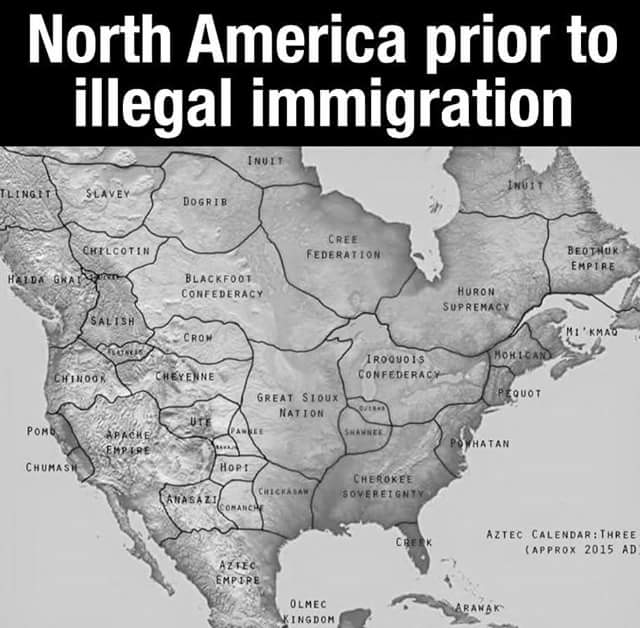
And while we’re on the topic of immigration here’s a map of North America before all the illegal immigrants began pouring in (courtesy of Steve F, whose timing was perfect).

Before-illegal-immigrants

I’m still trying to figure out how this works. I mean the part where descendants of some European immigrants on the north side of a river demand that descendants of other European immigrants on the south side stay on the south side of the river. And what makes it especially puzzling is that the northern group was gifted with a statue of Liberty Enlightening the World.

I’m confused.

h1

Why we need limited government

October 4, 2015

Jeff sends a link to this documentary and writes, "I have to wonder how many examples there are across the nation where politicians and other guvmint [sic] officials illegally use the IRS to harass U.S. Citizens?"

It’s just shy of 30 minutes long.

I invite your attention to the 8:00 minute mark when an attorney named Mark Fitzgibbons says, "It started out as a good thing as you want local control over local issues. But you have people in county government who have all this power and no checks on their power. Of course they’re going to abuse it." (My emphasis.)

Well said, Mr. Fitzgibbons. Well said.

h1

More evidence for the limited-government argument

October 3, 2015

When government doesn’t have the power to "pick winners", it can’t practice cronyism. To use a recent example, how about Solyndra?

Why some billionaires are bad for growth, and others aren’t
Not all inequality is created equal

Over the past few decades, wealth has become more concentrated in the hands of a few global elite. Billionaires like Microsoft founder Bill Gates, Mexican business magnate Carlos Slim Helú and investing phenomenon Warren Buffett play an outsized role in the global economy.

But what does that mean for everyone else? Is the concentration of wealth in the hands of a select group a good thing or a bad thing for the rest of us?

You might be used to hearing criticisms of inequality, but economists actually debate this point. Some argue that inequality can propel growth: They say that since the rich are able to save the most, they can actually afford to finance more business activity, or that the kinds of taxes and redistributive programs that are typically used to spread out wealth are inefficient.

Other economists argue that inequality is a drag on growth. They say it prevents the poor from acquiring the collateral necessary to take out loans to start businesses, or get the education and training necessary for a dynamic economy. Others say inequality leads to political instability that can be economically damaging.

A new study that has been accepted by the Journal of Comparative Economics helps resolve this debate. Using an inventive new way to measure billionaire wealth, Sutirtha Bagchi of Villanova University and Jan Svejnar of Columbia University find that it’s not the level of inequality that matters for growth so much as the reason that inequality happened in the first place.

Specifically, when billionaires get their wealth because of political connections, that wealth inequality tends to drag on the broader economy, the study finds. But when billionaires get their wealth through the market — through business activities that are not related to the government — it does not. […]

(My emphasis.)

I think we should to be a lot more jealous of our Constitutional prerogatives. How about enforcing the Tenth Amendment:

The powers not delegated to the United States by the Constitution, nor prohibited by it to the States, are reserved to the States respectively, or to the people.

To put perhaps-too-fine a point on it: constitutionally, the US government has no business concerning itself with funding basic scientific research, or with wealth inequality, or with any number of other things it does when those aren’t directly related to its role has protector and defender of the people.

And it shouldn’t matter what the policy wonks or special interests might think the government ought to be doing.

Via the always readable Coyote blog

h1

When things get politicized

September 6, 2015

What a great object lesson on why the government should have as little power as possible.

Because most things it touches get handled the way Tom Harkin handled health care.

The Alternative Medicine Racket: How the Feds Fund Quacks

James Randi, call your office.

H.T. Jeff G

h1

Tell us what you really think

August 4, 2015

Here are a couple of interesting videos about free speech, political correctness, and all like that. This first one is a comedy routine by Steve Hughes.

I liked his comparison of political correctness to health & safety rules. That’s another "Mother, may I?" category.

This second clip in an interview by Reason.TV with Jim Doti, president of Chapman University.

h1

Sounds like my kind of place

June 14, 2015

While meandering the web one day, I came across the Smoking Policy statement for The Vortex. I’ve never been there but I gather it’s a bar/grill kind of place with a couple of locations in Atlanta, Georgia. (My emphasis below.)

SMOKE ‘EM IF YOU GOT ‘EM

We allow the smoking of cigarettes and e-cigarettes on our premises. If you decide to smoke either one, please only do so in our designated smoking area. Be advised, we do not allow the smoking of cigars, pipes, clove cigarettes or anything forbidden by our Statist overlords.

WE LOVE FREEDOM OF CHOICE

While we’re happy to welcome smokers and non-smokers alike, we will never tolerate crybabies. So if your personal preference is to avoid being around any amount of smoke, then this may not be the place for you. That’s okay. Don’t be sad. We’re not. There are many “smoke-free” establishments in town that will gladly welcome your business. We believe that freedom of choice should always be celebrated, as it’s a rare commodity these days.

THE REAL DANGER

Ultimately, we feel that matters of personal risk assessment are best left to the individual, not the State. We believe that sovereign individuals must have supreme authority over their personal choices with regard to their own body, life and behavior, without the interference of governing powers. As advocates for this kind of freedom, we are deeply concerned that more citizens do not seem to understand the real dangers of coercive legislation. Any time you create a State apparatus capable of repression, it will inevitably fall into the hands of bullies, busy-bodies and tyrants. History has proven this time and time again.

Second-Hand Smoke is better than Second-Hand Fascism.

An establishment with a sensible policy like this one – plus the declaration that The Vortex is an "Official Idiot-Free Zone" is my kind o’ place. If & when I get to Atlanta, I believe I’ll stop by.

h1

Brawl for Liberty

May 29, 2015

Stand with Rand.

h1

More unnecessary spending

February 21, 2015

I spotted this Jeep in west St. Louis county recently and found the sign pretty funny. After the obvious “Jeeps are awesome” angle, I took it as a joke about libertarians. But I thought it was amusing nonetheless.

At the very least, it might make people think about government spending. And maybe some thoughtful ones will think about who builds roads and how they’re financed.

Paved-roads

Mark Major at The Outlaw Urbanist used the sticker as a starting for point for an editorial. (I haven’t read the whole piece so have no opinion about it.)

h1

LEAP’s Top Ten

October 17, 2014

A nicely done post (with good graphics). RTWT – it won’t take long.

10 Shocking Reasons To End The Drug War

This is not your ordinary Top 10 Buzzfeed list. Law Enforcement Against Prohibition, a group of law enforcement officials opposed to the war on drugs, created this list to show why the War on Drugs has been one of the most disastrous policies in American history. From mass incarceration and tremendous loss of life to billions of dollars seized from citizens every year, drug prohibition is a colossal failure. We need you to share this list to help get the word out. Help grow the number of people in this country and around the globe demanding legalization, regulation and control.

andy-griffith-2014

Via Carpe Diem

h1

Another one bites the dust

September 27, 2014

Paul sends a link to this article at Vice about a utopian settlement project called Galt’s Gulch Chile. Has any utopian settlement ever lasted for more than a couple of decades?

Based on this article, it sounds as though this project didn’t fall apart so much as it never got started.

ATLAS MUGGED: HOW A LIBERTARIAN PARADISE IN CHILE FELL APART

It was a good idea, in theory anyway. The plan was to form a sustainable community made up of people who believed in capitalism, limited government, and self-reliance. The site was already picked out: 11,000 acres of fertile land nestled in the valleys of the Chilean Andes, just an hour’s drive away from the capital of Santiago, to the east, and the Pacific Ocean, to the west. Residents could make money growing and exporting organic produce while enjoying Chile’s low taxes and temperate climate. This was no crackpot scheme to establish a micronation on a platform floating in the middle of the ocean (a common libertarian dream)—this was a serious attempt to build a refuge where free marketers and anarcho-capitalists could hole up and wait for the world’s fiat currencies to collapse. They called it “Galt’s Gulch Chile” (GGC), naming it for the fictional place where the world’s competent capitalists flee to in Ayn Rand’s Atlas Shrugged.

The project was conceived in 2012 by four men: John Cobin, an American expat living in Chile who once ran unsuccessfully for Congress in South Carolina; Jeff Berwick, the globe-trotting founder of the Dollar Vigilante, a financial newsletter that preaches the coming end of the current monetary system; Cobin’s Chilean partner; and Ken Johnson, a roving entrepreneur whose previous investment projects included real estate, wind turbines, and “water ionizers,” pseudoscientific gizmos that are advertised as being able to slow aging.

That initial group quickly fell apart, though today the principals disagree on why. Now, two years after its founding, the would-be paradise is ensnared in a set of personal conflicts, mainly centered on Johnson. Instead of living in a picturesque valley selling Galt’s Gulch–branded juice, the libertarian founders are accusing one another of being drunks, liars, and sociopaths. GGC’s would-be inhabitants have called Johnson a “weirdo,” a “pathological liar,” “insane,” a “scammer,” and other, similar things. Some shareholders are pursuing legal action in an effort to remove him from the project, a drastic measure for antigovernment types to take. Johnson, who remains the manager of the trust that controls the land, claims all the allegations against him are false. So what happened?

h1

An official protection racket

September 13, 2014

Matt Ridley gives us a lesson in the history of governments – think of it as Civics 101 – while he writes about the militarization of police in the United States.

Government begins as a monopoly on violence
It’s an official protection racket

My Times column last week was on the historical roots of government: […]

The deal implicit in being governed is at root a simple one: we allow the people who govern us to have an exclusive right to commit violence, so long as they direct it at other countries and at criminals. In almost every nation, if you go back far enough, government began as a group of thugs who, as Pope Gregory VII put it in 1081, “raised themselves up above their fellows by pride, plunder, treachery, murder — in short by every kind of crime”.

Was Canute, or William the Conqueror, or Oliver Cromwell really much different from the Islamic State? They got to the top by violence and then violently dealt with anybody who rebelled. The American writer Albert Jay Nock in 1939 observed: “The idea that the state originated to serve any kind of social purpose is completely unhistorical. It originated in conquest and confiscation — that is to say, in crime . . . No state known to history originated in any other manner, or for any other purpose.” […]

One of the great peculiarities of the United States is that it never quite managed to impose a state monopoly on powerful weaponry. The right to bear arms was a reaction to the presence of redcoats as an occupying army before 1783. The government got to own the tanks and aircraft carriers, but never pointed them at its own people, who were allowed to own guns much more freely than in other countries.

This is what makes the kit that the police displayed in Ferguson, Missouri, this month so alarming. With their camouflage uniforms, armoured vehicles and heavy-calibre machine guns, “law enforcement” cops looked less like a constabulary and more like an occupying army. In recent years, largely by exploiting the “war” on terror and the “war” on drugs, the American police have indeed been radically militarised. […]

h1

Where there’s a will, there’s a way

August 10, 2014

Here’s some interesting news from Bath (in southwest England).

Rolling in money: Man makes toll road to get around roadworks

A grandfather sick of roadworks near his home defied his council and built his own toll road allowing people to circumvent the disrupted section.

Opened on Friday, it’s the first private toll road built since cars became a familiar sight on British roads 100 years ago. Motorists pay £2 [$3.30 USD] to travel each way and bypass the 14 miles diversion.

Mike Watts, 62, hired a crew of workmen and ploughed £150,000 [~$250,000 USD] of his own cash into building a 365m [0.23 mi.] long bypass road in a field next to the closed A431. He reckons it will cost another £150,000 in upkeep costs and to pay for two 24 hour a day toll booth operators.

Speaking from the road in Kelston, Somerset, Mike said: “Too many people are displaced by the road closure, their daily lives have been so disrupted by this.”

The A431 between Bristol and Bath was closed in February after a landslip caused huge cracks to appear in the road.

Quickly businesses in the area began to suffer – including the cafe and party supplies shop Mike runs with wife Wendy Rice, 52, in Bath.

Naturally, the local bureaucracy wasn’t pleased.

But a spokesman for the council said it was not happy about the bold build.

“It is not just the planning, it’s the legal aspect of drivers using the road, and also safety – the area around the road where the landslip occurred has only just stopped moving, which is why work has only just been able to begin.”


Update 10/13/14:

Here’s a video about Mr. Watts’ toll road; he backed the cost of construction with his house.

h1

What he said (3)

May 18, 2014

Tim Moen is running for a seat in the Canadian Parliament.

tim-moen-campaign-ad

h1

It’s the police

April 8, 2014

Last week, one of my sons sent me a link to The New Yorker column mentioned below. I thought it was mildly amusing, though it was a pretty cliched view of libertarians. Yeah, yeah… we have to put a quarter into the two-way radio to use it. (Seriously? You couldn’t even work a good tech angle into the column?)

What it sort of reminded me of was Neal Stephenson’s novel Snow Crash — except that Snow Crash was more interesting to read.

So I was glad to see Conor Friedersdorf’s response to that column in The Atlantic yesterday. His response is just chock full of examples of how not to Serve & Protect. (My emphasis below.)

N.L.P.D.: Non-Libertarian Police Department
Law enforcement in America, brought to you by liberals and conservatives

On March 31, The New Yorker published an item in its humor vertical, Shouts & Murmurs, titled “L.P.D.: Libertarian Police Department.” At least 31,000 people liked it.

I can laugh along with parodies of libertarian ideology. But shouldn’t a reductio ad absurdum start with a belief that the target of the satire actually holds? Tom O’Donnell proceeds as if libertarians object to the state enforcing property rights—that is to say, one of the very few state actions that virtually all libertarians find legitimate! If America’s sheriffs were all summarily replaced by Libertarian Party officials selected at random, I’m sure some ridiculous things would happen. Just not any of the particular things that were described. 

That isn’t to say that there weren’t parts of the article that made me laugh. It got me thinking too. If the non-libertarian approach to policing* was the target instead, would you need hyperbole or reductio ad absurdum? Or could you just write down what actually happens under the officials elected by non-libertarians? It is, of course, hard to make it funny when all the horrific examples are true.

h1

The Kidney Sellers

March 22, 2014

Here’s an interesting video from Reason.tv.

And here are details about Ms Fry-Revere’s book.