Archive for the ‘Political economy’ Category

h1

What’s going on in Venezuela

February 19, 2014

I’m a little surprised at how many posts I’ve written about Venezuela. It’s not as though I have any special interest in the country, but it’s certainly a textbook example of how things can go wrong under a Socialist government.

I don’t believe that the leaders of Venezuela are all socialists in good faith. I suspect that many of them are just thugs using socialism to legitimize the take-over of their country. It wouldn’t be the first that had happened.

There are peaceful, law-abiding socialist governments after all, so I don’t assume that the violence in Venezuela is solely due to socialism. And there are plenty of fascist tyrannies on the right; the left has no monopoly on civil violence.

But socialist or fascist, they’re all statists of one stripe or another. A leopard may change his politics daily but he never changes his spots.


It has mystified me since I was a teenager why people would give up control of anything else to the social agent which controls the guns — i.e., to a government which controls the police and military.

Why in the world would you trust that supreme armed authority in any country with controlling public media, or controlling an economy, or with managing the health care system? The temptations to corruption are so much stronger when the power is concentrated in the government.

That’s why I think socialist governments tend to encourage strong men and tyrants to take power. As I told a socialist friend of mine a few years ago, "When you go to bed with Karl, you’re likely to wake up with Uncle Joe."

Let’s look at the alternative: is the market always fair and even-handed? Hell no, it’s not. Some will rob you with a six-gun, and some with a fountain pen. Business people are no more angels than bureaucrats are. We’re always dealing with the crooked timber of humanity.

But dealing with a market at least leaves you with more alternatives than dealing with a government. Some particular business may give you ‘the business’, but it won’t send you to prison and it won’t conscript you (or your child) to fight in an unjust war.
h1

Venezuelan car markets, part 2

February 13, 2014

My last post about Venezuela concerned how the statists running the country were planning to micro-manage the used car market.

Here’s an article in USA Today about what they’ve done to the new car market (via Carpe Diem).

Venezuela car industry slips into idle

CARACAS, Venezuela — Leonardo Hernandez had hoped to buy a new car this year, ending nearly two years of waiting on various lists at different dealerships throughout the country.

Those hopes were dashed last week when Toyota Motor Co. said it would shut down its assembly operations in Venezuela due to the government’s foreign exchange controls that have crippled imports and made it impossible to bring in parts needed to build its vehicles.

The country’s other car manufacturers, including General Motors and Ford, haven’t even started operations this year, while waiting for needed parts to arrive.

“I desperately need a new car for work,” said Hernandez, who works as a salesman. “I have been waiting and waiting, and now this. I have no idea what I am going to do. And I can’t even find spare parts for the old car I have.”

Toyota joins a long list of companies saying they are having to curtail or stop operations in the South American country thanks to the government’s foreign exchange regime, which the late President Hugo Chavez created in 2003 to fight capital outflow.

h1

Things That Make You Go Hmmm… (2)

February 9, 2014

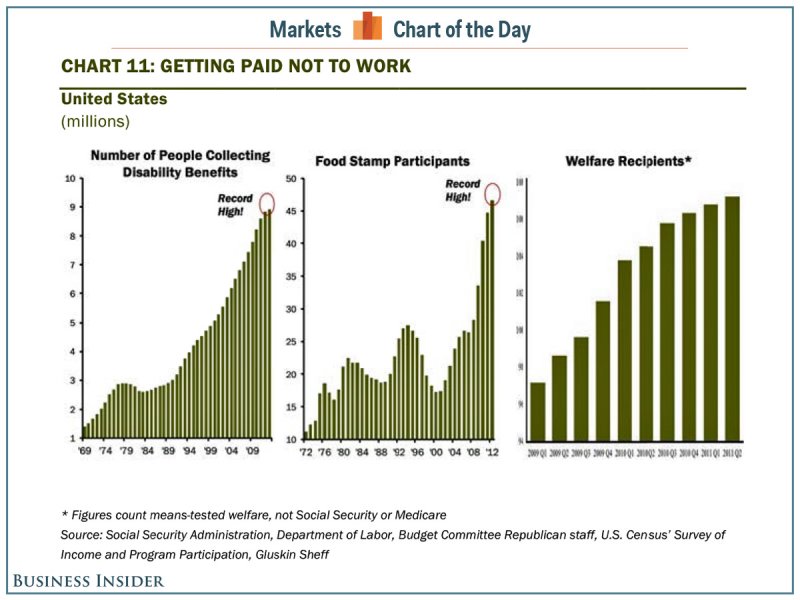
From Business Insider’s "Chart of the Day" post on February 6.

business-insider-disability-welfare-food-stamps

The Stunning Rise Of Disability, Food Stamp And Welfare Benefits

In the wake of the financial crisis and great recession, the U.S. unemployment rate has tumbled precipitously from 10.0% to 6.7% in just four years.

“Only three other times in the past six decades has the unemployment rate fallen this far this fast: in the early 1950s, when growth averaged 6.7% per annum; in the late 1970s when GDP growth averaged 4.8%, and in the mid-1980s when growth averaged 5.2%,” said Gluskin Sheff’s David Rosenberg to the U.S. Senate Budget Committee.

“Today we accomplished this feat with only 2.4% growth which is disturbing because it means that it is not taking much in the way of incremental economic activity to drain valuable resources out of the labor market.”

Much of the decline in the unemployment rate has been due to the drop in the labor force participation rate (LFPR). And the drop in the LFPR has been due to a combination of aging demographics and an expanding group of discouraged workers walking away from the job market.

h1

Want a progressive tax system?

February 4, 2014

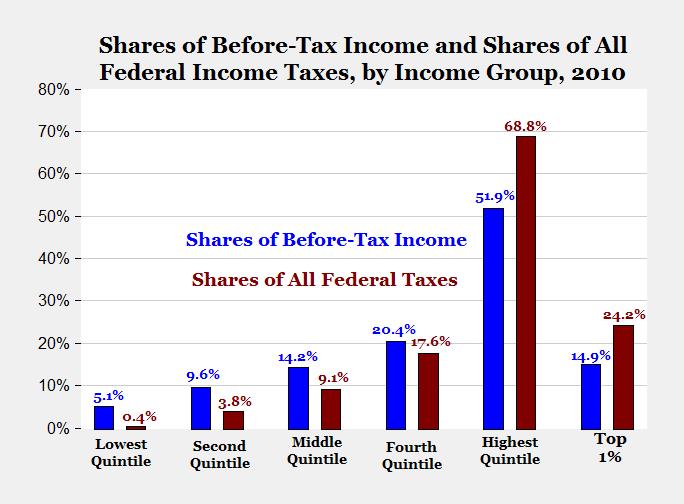
The good news is you’ve already got one.

This bar graph comes from Mark Perry’s Carpe Diem blog and shows both the taxes paid by quintile and the incomes for those quintiles. I believe the chart’s based on data from the Congressional Budget Office.

us-taxes-and-income

Also see No Country Leans on Upper-Income Households as Much as U.S. for what the OECD reported a couple of years ago (via Greg Mankiw).

h1

Incentives (2)

January 5, 2014

Here’s an interesting article from today’s Post-Dispatch:

Missouri Democrats seek minimum wage hike

Missouri’s minimum-wage workers received a small bump in pay at the turn of the calendar, but a larger one could arrive next year from lawmakers in Jefferson City.

House Bill No. 1098 would raise the state’s minimum wage to $8.25 an hour, effective Jan. 1, 2015.

The state’s minimum wage rose to $7.50 an hour Wednesday, just above the federal minimum wage of $7.25 an hour.

Pat Conway, D-St. Joseph, was among the 27 representatives — all Democrats — who signed on as co-sponsors for the bill when it was pre-filed in December.

Existing legislation will remain in place to allow for adjustments to the minimum wage each year, relative to the Consumer Price Index (CPI). Last year, an increase in the cost of living raised the minimum wage from $7.35 an hour to $7.50. However, such increases came few and far between, according to Conway. […]

Mr. Conway said such increases are needed because many people draw more in unemployment benefits than they would make at a minimum wage job, so instead of rejoining the work force, they stay home.

“We’ve got to get the minimum wage up to a point where it gives people an incentive to take jobs at minimum wage,” Conway said. […]

Where to start…?

First, maybe, with how politicians never seem to get price elasticity? Since we have politicians setting market prices, why don’t they set the minimum wage to $25 an hour? If you think that’s crazy (and it is), then you should think about the effects of any minimum wage law.

Second, what will a minimum wage increase do to unemployment among young, unskilled workers? That is, to the people who have the hardest time finding a first job?

In this vein, I’m reminded of Mark Twain’s advice to job seekers: to get the job you want, offer to work for nothing. But Twain’s out-of-date these days because the state has made that illegal.

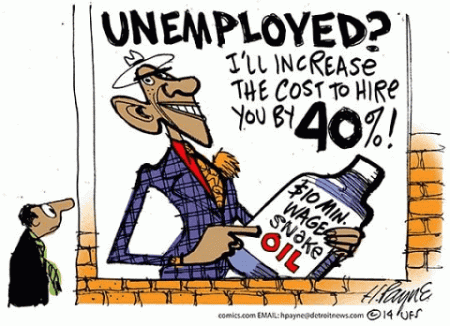
Third, you have to love how the newspaper reports this action. "but a larger one [bump in pay] could arrive next year from lawmakers in Jefferson City." Wait just a minute, Mr. Editor… The lawmakers in Jefferson City aren’t the folks paying those higher wages. There’s a more accurate way to state what will happen if you take a minute to think about it: "but a larger increase in costs could arrive next year when lawmakers in Jefferson City force some Missouri businesses to pay 10% more for labor."

And, last but hardly least, Mr. Conway admits that his unemployment insurance is providing too good an incentive. Gee, who’d have thought, huh?

So he and his comrades plan to give people a different incentive by raising the cost of labor across the state. What the…?!

Historically, employers pay taxes to fund unemployment benefits. (My company used to pay them when it had employees.) But the amount and duration of the benefits are set by the state government. So having made those benefits so attractive that people have no incentive to work low-wage jobs, the state now wants to increase the cost to businesses by raising the low wages.

Why don’t we limit the attractiveness of the unemployment benefits by decreasing their amount or duration – instead of imposing another cost on the business that fund the system?


I can imagine situations where unemployment provides assistance that is badly needed.

On the other hand, it’s too easy to game the system. I know a couple of people who’ve done that, including a former employee. And I’ve met too many cases where people know it will be available so they collect all they can even in a good job market. People without children or who have an employed spouse sometimes treat their eligibility period as a paid vacation. This is hardly news to any employer.

Plus the unemployment system presents the moral hazard of encouraging people to live paycheck-to-paycheck. I’m talking about people who could afford to save for the proverbial rainy day, but who don’t because they expect to collect unemployment benefits.

What we need is separation of Market and State (as I’ve said before).


Update (3/1/14): Here’s a recent cartoon in the Friday Funnies at Hit & Run.
min-wage-snake-oil

h1

How to manage health care

December 22, 2013

I’ve mentioned price transparency for health care before. This article in The Freeman describes a surgeon who’s making it happen. And he confirms my long-held idea that what makes medical care so expensive is all the paperwork and overhead.

Can This Man Save Healthcare?

While the country focuses its attention on the sputtering implementation of the Affordable Care Act (ACA), one man is quietly revolutionizing American medicine. Dr. Keith Smith, founder of the Surgery Center of Oklahoma (SCO) in Oklahoma City, is bringing market forces to healthcare by posting his prices online.

Healthcare costs in the United States have increased at an average rate of 7.7 percent per year since 1980, compared to 4.6 percent for the consumer price index. Smith believes price wars and other market mechanisms, not increased government control, are the best way to stem and reverse this inflation. With the ACA’s implementation, the prospects for formal healthcare policy changes are limited. Smith hopes, however, that he and a handful of other transparent fee-for-service providers will be the vanguard of a free-market movement that runs parallel to the ACA. “The price transparency and price deflation,” Smith says, “aims at the soft underbelly of the beast.” […]

Healthcare Doesn’t Cost That Much

According to Smith, “Healthcare doesn’t cost that much, but what healthcare professionals charge is another matter.” By cutting out hospital administrators and the bureaucracy involved with third-party payers, the SCO is able to offer healthcare services at deep discounts. For example, for a patient with a bad back, the SCO was able to perform a two-level disc decompression for $8,500. That paid for the surgeon, anesthesia, and supply costs as well as an overnight stay. The patient’s next-closest bid was $60,000, saving his company’s health plan $51,500. While few would argue that high four- to low five-figure treatment costs are cheap in absolute terms, in relative terms they are. For major spine surgery, the SCO charges $16,500, which Smith admits “is a lot of money, but people are flying here from Alaska and Massachusetts to get this price because in their home states it’s not uncommon for this surgery to cost $175,000.” […]

h1

Seasonal humor 2013

December 21, 2013

I take the candy, you keep the Keynes

h1

You’d still be wrong

December 9, 2013

…if you thought "the lessons from letting governments mismanage economies would be apparent to people by now and that they wouldn’t let their governments try that" (as I wrote six months ago).

This article from The Christian Science Monitor reports that the Venezuelan government is still trying to micro-manage the country’s economy in the usual statist manner. That is, by force and the threat of force: "levying hefty fines and even jail time on venders who don’t comply with government-approved prices." (My emphasis below.)

Venezuela: where used car salesmen are king?

For the past nine months, Luis Medina, a building caretaker, has scoured new car listings, searching for a light truck or SUV. Despite having the cash in hand, he’s regularly turned away from dealerships due to years-long waiting lists.

“At this point it’s whatever’s available,” he says.

New cars in Venezuela have become something of a rarity, yet many like Mr. Medina balk at the thought of buying used. “They’re far too expensive for what they’re worth,” he says.

The premise may leave car enthusiasts in other parts of the world scratching their heads, but vehicles actually gain in value in Venezuela – as soon as they’re driven off the new or used lot. Shortages and government-mandated currency controls have led to higher preowned car prices, as many consumers are desperate to find a vehicle.

On TuCarro.com, a popular used car website, a secondhand 2012 Jeep Grand Cherokee is more than double the price of a new one. Similarly, five-year-old Ford Fiestas and Explorers easily match factory sticker prices.

But in a move to protect consumers, Venezuela’s National Assembly has sought to throw the brakes on soaring car costs. Last month, a bill was passed that, if signed into a law by President Nicolás Maduro, would attempt to regulate both new and used car prices, levying hefty fines and even jail time on venders who don’t comply with government-approved prices.

As though the poor citizens of Venezuela don’t have it bad enough with 45% inflation, now they’re probably facing price caps when selling used cars — as though the boys in Caracas have all the used car angles figured already.

When do you think the Venezuelan government will figure out that citizens are both consumers (buyers) and producers (sellers) in a used goods market? I haven’t met many people who’ve bought used cars but never sold any. Have you?

Will the Venezuelan government ever make that connection? Or will it be too proud of its new law to ‘protect consumers’ to notice that today’s buyer is tomorrow’s seller?

Speaking of the Venezuelan government, I wonder how its campaign against that nasty toilet paper conspiracy turned out?

h1

The health care special (1)

November 10, 2013

A former workmate sent the letter below about someone he knows with an attitude. (I’m keeping him anonymous for obvious reasons.)

I think he’s a little over the top predicting an economic death spiral, especially from one observation. Anecdotes aren’t data, after all. On the other hand, who knows how prevalent this attitude is? It certainly applies to other things than health care benefits. So he may be right that it’s a harbinger of disaster.

In any event, the attitude he describes is bad cultural juju. Taking ‘free’ government benefits that you could buy for yourself strikes me as a violation-by-proxy of the Golden Rule. Give your fellow citizens a break, people (even if some of them are wealthier than you).

I have to add that I’d feel a lot better if his acquaintance with the attitude were a 20-something rather than a 50-something. That’s the scariest part IMO.

I have a close acquaintance who shall remain nameless. Single and in his/her mid 50s. While s/he seems to be in good health, s/he is a functional alcoholic; drinks all day long, every day.

S/he had several jobs in IT in Silicon Valley area back in the ‘80s and 90’s but decided it wasn’t his/her cup of tea. Now s/he supposedly run a seasonal small business in the northern Midwest. S/he hires day laborers only and pays them in cash each day. S/he only buys business insurance when required to show a active policy to bid on bigger commercial jobs.

In the winter s/he closes down the operation up north and heads to the south to spend winter. The winter business apparently is not as productive (due to lack of demand) so s/he does all sorts of odd jobs to supplement income. I have no idea what his/her annual income is and suspect that s/he operates on cash basis as much as possible to avoid paying FICA, Medicare, state and federal income tax. And of course s/he has no medical insurance.

A few days ago I was watching the news and of course the segment was on the Obamacare debacle.

S/he walked in and stated that s/he was looking forward to Obamacare so s/he could afford medical insurance. S/he then described how the high deductible medical insurance s/he retained for a few years was “a complete waste of money.” So apparently s/he did not get sick or injured often/seriously enough to meet the deductible. S/he said “This was a total waste of $10,000.” I asked if the medical plan was $10000/year (which seemed extraordinarily high). “No. That’s what I paid over 8 or so years.” So when s/he had insurance s/he paid about $105/month for coverage. S/he went on about how greedy insurance companies are and how much better the Obamacare exchange plans will be. Note I said “will be” as s/he had not yet bothered to try and sign up.

And part of the reason s/he had not explored his/her options under Obamacare was the extensive reports of the web interface failure. The other stated reason was s/he wanted to know where s/he would get the “best deal.” In the northern mid-western state or in the southern state (that also has no income tax).

So I asked why s/he had not at least checked to see what the cost/options were as there are plenty of other resources, short of signing up, where s/he could get preliminary estimates? Answer: Website problems (missing my point) and the fact that the deadline is weeks/months away. I dropped the discussion at that point.

A week or so later the subject came up again and s/he stated “Well its most likely I’ll just pay the $95 fine.” When I asked if s/he got monthly cost estimates, s/he just reiterated s/he would “go with the fine and then pick up insurance if/when s/he needs it or just file bankruptcy like everyone else does.”

So my acquaintance enjoys a life where s/he can afford to spend the winter in the south, in an apartment loaded with electronic toys (LCD TV, PCs, iPad, iPhone), drink all day long, and work when it is convenient or perhaps necessary when cash flow tightens.

And s/he wants everyone else to pay their medical care going forward because doing paying their own way would effectively deny him/her the lifestyle they have selected.

I am betting my friend’s approach is going to be replicated by millions of other folks.

The ‘sick’ may get better deals and they’ll likely take advantage of them.

Many of the able will remain uninsured until the last minute, because they can.

An economic death spiral is inevitable.

h1

Nitwittery nailed again

November 6, 2013

The New York Times published this last Sunday:

Under Health Care Act, Millions Eligible for Free Policies
By REED ABELSON and KATIE THOMAS
Published: November 3, 2013

Millions of people could qualify for federal subsidies that will pay the entire monthly cost of some health care plans being offered in the online marketplaces set up under President Obama’s health care law, a surprising figure that has not garnered much attention, in part because the zero-premium plans come with serious trade-offs. […]

Don Boudreaux nails them in his typical fashion in a post at Cafe Hayek:

Here’s a letter to the New York Times:

Your headline today reads “Under Health Care Act, Millions Eligible for Free Policies.”

More accurate wording would be “Under Health Care Act, Millions Eligible to Free Ride at Other People’s Expense.” That the people actually paying for all this “free” health insurance are faceless does not make them unreal – only invisible. And being invisible, the people footing the bill are ignored by Pres. Obama and other politicians preening publicly over their faux-generosity in spending other people’s money to bribe voters with promises of “free” health insurance. […]

Seriously, what are these people (Abelson and Thomas) thinking? That there’s such a thing as Money For Nothin’?

H.T. Jeff G.

h1

Branches of economics

September 20, 2013

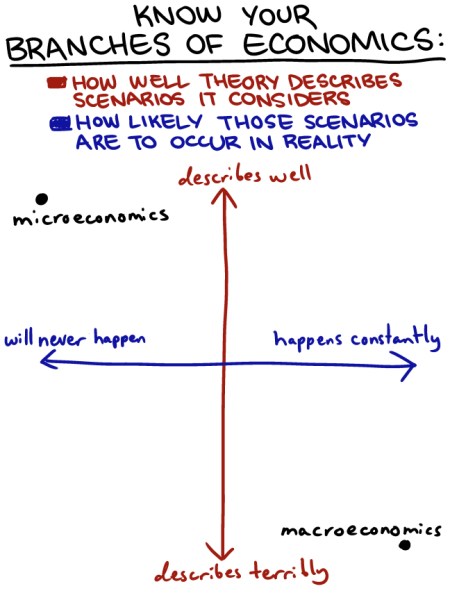
Here’s an amusing cartoon from SMBC.com:

branches-of-economics

Via Carpe Diem

h1

What we need is separation of Market and State

August 14, 2013

Via Coyote blog, here’s an NBC News report about how the PPACA (Obamacare) is affecting the job market.

Businesses claim Obamacare has forced them to cut employee hours

Employers around the country, from fast-food franchises to colleges, have told NBC News that they will be cutting workers’ hours below 30 a week because they can’t afford to offer the health insurance mandated by the Affordable Care Act, also known as Obamacare.

“To tell somebody that you’ve got to decrease their hours because of a law passed in Washington is very frustrating to me,” said Loren Goodridge, who owns 21 Subway franchises, including a restaurant in Kennebunk. “I know the impact I’m having on some of my employees.”

Goodridge said he’s cutting the hours of 50 workers to no more than 29 a week so he won’t trigger the provision in the new health care law that requires employers to offer coverage to employees who work 30 hours or more per week. The provision takes effect in 16 months. […]

The White House dismisses such examples as “anecdotal.” Jason Furman, chairman of the president’s Council of Economic Advisors, said, “We are seeing no systematic evidence that the Affordable Care Act is having an adverse impact on job growth or the number of hours employees are working. … [S]ince the ACA became law, nearly 90 percent of the gain in employment has been in full-time positions.”

But the president of an influential union that supports Obamacare said the White House is wrong.

“It IS happening,” insisted Joseph Hansen, president of the United Food and Commercial Workers union, which has 1.2 million members. “Wait a year. You’ll see tremendous impact as workers have their hours reduced and their incomes reduced. The facts are already starting to show up. Their statistics, I think, are a little behind the time.”

Read Coyote’s post for more on the whole topic. He’s a small business owner himself and knows what the costs of Obamacare will be.


Update (8/23/13)
In the same vein, here’s an interesting post at Reason’s Hit & Run site: Obamacare Will Cost Delta Airlines $100 Million Next Year.

h1

Two views on growth

July 24, 2013

Jeff G sent links to a couple of interesting TED talks about economic growth. Each is about 12 minutes long.


h1

Back to basics (2)

July 11, 2013

As I mentioned last month, "You’d think the lessons from letting governments mismanage economies would be apparent to people by now and that they wouldn’t let their governments try that. But you’d be wrong."

Here’s Ron Bailey writing at Reason’s blog about the demagogues on the Washington DC City Council, who’re fixing to shoot themselves (and everyone else) in the foot.

Again.

DC City Council Shake Down of Walmart Epic Fails

Yesterday, I marvelled at the chutzpah of the Washington, DC City Council’s effort to shake down retailers like Walmart by boosting the city’s minimum wage by nearly 50 percent just for them. As I opined:

The economic ignorance of the city mothers and fathers of Washington, DC never ceases to flabbergast me. Years ago, the city’s solons decided that not enough people were choosing to work at house-cleaning and other domestic chores, so they sought to solve this “shortage” by voting to boost the minimum wage for such work. Surely, increasing the price of an activity will increase the demand for it.

In another boneheaded move, the city council voted earlier this year for legislation, the Large Retailer Accountabliity Act, that would hike the minimum wage for workers at “big box” stores to $12.50 per hour. This is a big increase over the city’s $8.25 minimum wage. Evidently the city council believes that this is the way to entice retailers like Walmart, Target, and Wegmans to open businesses in the city.

The amazing part is that such a group of economic illiterates thinks it can fine tune the local economy with laws for business-specific minimum wages. Their schemes remind me of Wile E. Coyote’s – i.e., they’re hilariously impractical.

But even if this crew were economic geniuses, and their schemes worked as planned, those laws would still be a violation of economic freedom in DC. The laws would be wrong in principle even if they were practical. But back to the news…

When Walmart wrote about re-evaluating its plan to build six stores in DC – due to the friendly reception it got from the City Council, councilman Vincent Orange responded (“its” and “them” refer to Walmart):

What does Orange say now? From today’s Post:

Vincent B. Orange (D-At Large), a backer of the bill, said the announcement revealed its “true character.”

“For them to now stick guns to council members’ heads is unfortunate and regrettable,” he said.

Who is sticking what gun to whose head? In this case, it is Orange who has revealed his true character as an economically ignorant demagogue. Let’s hope that DC’s voters will hold Orange and the other seven council members accountable for the loss of jobs, convenience, and affordable shopping.

Bailey asks the right question about that remark: Who’s the thug in this picture?

h1

iPencil

June 26, 2013

iPencil is a very good article by Kevin Williamson, taking off on Leonard Read’s essay I, Pencil.

It’s difficult to excerpt since it makes so many good points, so RTWT. I liked this ‘graph but there are several others I liked just as well.

When I am speaking to students, I like to show them a still from the Oliver Stone movie Wall Street in which the masterful financier Gordon Gekko is talking on his cell phone, a Motorola DynaTac 8000X. The students always — always — laugh: The ridiculous thing is more than a foot long and weighs a couple of pounds. But the revelatory fact that takes a while to sink in is this: You had to be a millionaire to have one. The phone cost the equivalent of nearly $10,000, it cost about $1,000 a month to operate, and you couldn’t text or play Angry Birds on it. When the first DynaTac showed up in a movie — it was Sixteen Candles, a few years before Wall Street — it was located in the front seat of a Rolls-Royce, which is where such things were found 25 or 30 years ago. By comparison, an iPhone 5 is a wonder, a commonplace miracle. My question for the students is: How is it that the cell phones in your pockets get better and cheaper every year, but your schools get more expensive and less effective? (Or, if you live in one of the better school districts, get much more expensive and stagnate?) How is it that Gordon Gekko’s ultimate status symbol looks to our eyes as ridiculous as Molly Ringwald’s Reagan-era wardrobe and asymmetrical hairdos? That didn’t just happen.

h1

Back to basics

June 2, 2013

You’d think the lessons from letting governments mismanage economies would be apparent to people by now and that they wouldn’t let their governments try that. But you’d be wrong.

Hope springs eternal in the socialist breast, to paraphrase Pope. (I’ll be charitable and call it hope, though blind faith is a better description.)

This article’s from The Guardian.

Venezuela hopes to wipe out toilet paper shortage by importing 50m rolls

First milk, butter, coffee and cornmeal ran short. Now Venezuela is running out of the most basic of necessities – toilet paper.

Blaming political opponents for the shortfall, as it does for other shortages, the government says it will import 50m rolls to boost supplies.

That was little comfort to consumers struggling to find toilet paper on Wednesday.

“This is the last straw,” said Manuel Fagundes, a shopper hunting for tissue in Caracas. “I’m 71 years old and this is the first time I’ve seen this.”

One supermarket visited by the Associated Press in the capital on Wednesday was out of toilet paper. Another had just received a fresh batch, and it quickly filled up with shoppers as the word spread.

“I’ve been looking for it for two weeks,” said Cristina Ramos. “I was told that they had some here and now I’m in line.”

Economists say Venezuela’s shortages stem from price controls meant to make basic goods available to the poorest parts of society and the government’s controls on foreign currency.

“State-controlled prices – prices that are set below market-clearing price – always result in shortages. The shortage problem will only get worse, as it did over the years in the Soviet Union,” said Steve Hanke, professor of economics at Johns Hopkins University.

I found the idea of blaming political opponents for the shortage particularly funny. There’s a toilet paper conspiracy in Venezuela? Heh.

h1

Maggie in the House

April 8, 2013

RIP, the Right Honourable the Baroness Thatcher.

h1

And I’m calling BS on that

March 1, 2013

Via Facebook.

sequester-catastrophe-2


The White House is fear-mongering.

Noonan: Obama Is Playing a New Game

Everyone has been wondering how the public will react when the sequester kicks in. The American people are in the position of hostages who’ll have to decide who the hostage-taker is. People will get mad at either the president or the Republicans in Congress. That anger will force one side to rethink or back down. Or maybe the public will get mad at both.

The White House is, as always, confident of its strategy: Scare people as much as possible and let the media take care of the rest. Maybe there will be a lot to report, maybe not, but either way the sobbing child wanting to go to Head Start and the anxious FAA bureaucrat worried about airplane maintenance will be found.


Why we’re doomed.

All Of This Whining About The Sequester Shows Why America Is Doomed

If we can’t even cut federal spending by 2.4 percent without much of the country throwing an absolute hissy fit, then what hope does America have? All of this whining and crying about the sequester is absolutely disgraceful. The truth is that even if the sequester goes into effect, the U.S. government will still take in more money than ever before in 2013 and it will still spend more money than ever before in 2013. So it is a bit disingenuous to call what is about to happen “a spending cut”, but for the sake of argument let’s concede that point. Even if the budget really was being “cut” by 85 billion dollars, that only would only amount to a “cut” of 2.4 percent to federal spending. It would barely make a dent in the federal budget deficit for 2013.

h1

Counting the cost

February 21, 2013

A bit long but worth the time.

Via Coyote Blog

h1

Labels

February 12, 2013

I try to limit the number of Milton Friedman clips here, lest they overwhelm everything else. (I don’t see many I don’t like, in other words.) This one’s worth making an exception.