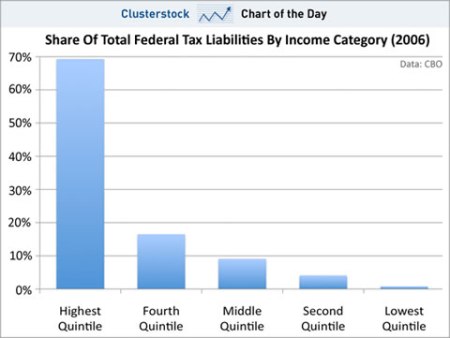
On the day my wife spent preparing our 1040, I came across two articles about who pays federal taxes (via TigerHawk). This chart comes from ClusterStock.
First of all, half of Americans don’t even pay income taxes, but it gets worse. If we look at total federal taxes, 20% of Americans pay 70% of taxes, as shown above. 40% of Americans pay 95% of federal taxes.
And this is from the second article at Yahoo! Finance.
WASHINGTON (AP) — Tax Day is a dreaded deadline for millions, but for nearly half of U.S. households it’s simply somebody else’s problem.
About 47 percent will pay no federal income taxes at all for 2009. Either their incomes were too low, or they qualified for enough credits, deductions and exemptions to eliminate their liability. That’s according to projections by the Tax Policy Center, a Washington research organization.
Are we to the point of bread and circuses yet? Why wouldn’t someone who pays little or no tax vote for those who are good at increasing government spending? Why not?
As they say: If you want peace, work for justice. An equitable tax code would be a good place to start.
PARKERSBURG, W.Va. – The retirement nest egg of an entire generation is stashed away in this small town along the Ohio River: $2.5 trillion in IOUs from the federal government, payable to the Social Security Administration.
It’s time to start cashing them in.
For more than two decades, Social Security collected more money in payroll taxes than it paid out in benefits — billions more each year.
Not anymore. This year, for the first time since the 1980s, when Congress last overhauled Social Security, the retirement program is projected to pay out more in benefits than it collects in taxes — nearly $29 billion more.
Sounds like a good time to start tapping the nest egg. Too bad the federal government already spent that money over the years on other programs, preferring to borrow from Social Security rather than foreign creditors. In return, the Treasury Department issued a stack of IOUs — in the form of Treasury bonds — which are kept in a nondescript office building just down the street from Parkersburg’s municipal offices.
The problem of Social Security holding only IOU’s instead of assets is hardly news. People have been pointing it out for years now. And if – like me – you nurtured some small hope about GWB’s move to reform Social Security, then you’ll be disappointed – but unsurprised – to see that we’re still standing in the middle of tracks while the locomotive bears down on us.
Social Security is only part of the problem. Medicare’s another; state pension funds are still another.
We can’t blame this wreck on the train. Many countries that have similar programs have faced similar crises and solved them: Chile and Australia come to mind. Why can’t we?
So it was a bit of a coincidence that a friend sent me a link to a video at Real Clear Politics yesterday. It’s a clip of Rep. Tom Perriello (D-VA) talking about entitlement spending. In the clip he says, “[…] if you don’t tie our hands, we will keep stealing.” See for yourself.
To hear a member of the majority party say this tells you all you need to know about its being a matter of fact. It’s straight from the horse’s mouth, folks: ain’t no "Republican name calling" going on here. (Not that it would matter; there are plenty of Republicans who supported the status quo that got us in this position.)
Say you’re a world leader and you want your country’s economy to prosper. According to this Clark Medal winner from MIT, there’s a simple solution: start with free elections.
We are the rich, the haves, the developed. And most of the rest — in Africa, South Asia, and South America, the Somalias and Bolivias and Bangladeshes of the world — are the nots. It’s always been this way, a globe divided by wealth and poverty, health and sickness, food and famine, though the extent of inequality across nations today is unprecedented: The average citizen of the United States is ten times as prosperous as the average Guatemalan, more than twenty times as prosperous as the average North Korean, and more than forty times as prosperous as those living in Mali, Ethiopia, Congo, or Sierra Leone.
The question social scientists have unsuccessfully wrestled with for centuries is, Why? But the question they should have been asking is, How? Because inequality is not predetermined. Nations are not like children — they are not born rich or poor. Their governments make them that way.
This seems to be pretty factual and non-partisan. My only question is whether the dollars-per-household numbers are in nominal dollars or are inflation-adjusted.
I don’t know anything about the outfit that produced this (Commonwealth Foundation) but I think it’s very well done.
This is one of the most succinct statements regarding markets vs. government that I’ve heard. It’s hardly new and it’s been widely seen but it bears repeating.


 No Truce With Kings