Archive for the ‘US government’ Category

h1

In a nutshell

March 14, 2013

On Tuesday this week, I was reading an article in the Post-Dispatch: Missouri motorcyclists could go helmet-free in August under proposal. State Rep. Delus Johnson (R-St. Joseph) was proposing a "helmet holiday" during the month of August, primarily to avoid discouraging motorcycle tourists from visiting Missouri.

Like 19 other states in the U.S., Missouri requires all motorcycle riders to wear a helmet. The only two states that don’t require any riders to wear helmets are our neighbors, Illinois and Iowa. (The other 29 states require helmets based on the rider’s age.) I remember riding my first motorcycle in Illinois without a helmet. It was fun.

The article piqued my interest since I still ride a bike. It would be nice to ride without a helmet occasionally even though I appreciate the increased risk. There’s always the hope the "helmet holiday" might become year-long.

But what caught my eye in this article was a comment by another state representative. Mike Colona (D-St. Louis) countered: “There is no constitutionally guaranteed right not to wear a helmet.”

There’s the problem in a nutshell. Mr. Colona seems to believe that the Constitution is intended to govern the behavior of citizens. Worse, he seems to think that if it’s not called out in the Constitution, then it can’t be allowed. A sort of "Everything that isn’t forbidden is compulsory" type of system.

Here’s a news flash, Representative: the Constitution is intended to govern the behavior of the government. Back to Civics class, dude.

It was a really lame argument. He’d might as well have said, “There is no constitutionally guaranteed right to jaywalk” for all the sense that makes. There are no constitutional questions regarding the vast majority of state laws.

This is Missouri, Rep. Colona, and you need to show me why the state should be able to regulate its citizens in some way. It won’t do to say that we "have no right" to avoid some regulation.

h1

And I’m calling BS on that

March 1, 2013

Via Facebook.

sequester-catastrophe-2


The White House is fear-mongering.

Noonan: Obama Is Playing a New Game

Everyone has been wondering how the public will react when the sequester kicks in. The American people are in the position of hostages who’ll have to decide who the hostage-taker is. People will get mad at either the president or the Republicans in Congress. That anger will force one side to rethink or back down. Or maybe the public will get mad at both.

The White House is, as always, confident of its strategy: Scare people as much as possible and let the media take care of the rest. Maybe there will be a lot to report, maybe not, but either way the sobbing child wanting to go to Head Start and the anxious FAA bureaucrat worried about airplane maintenance will be found.


Why we’re doomed.

All Of This Whining About The Sequester Shows Why America Is Doomed

If we can’t even cut federal spending by 2.4 percent without much of the country throwing an absolute hissy fit, then what hope does America have? All of this whining and crying about the sequester is absolutely disgraceful. The truth is that even if the sequester goes into effect, the U.S. government will still take in more money than ever before in 2013 and it will still spend more money than ever before in 2013. So it is a bit disingenuous to call what is about to happen “a spending cut”, but for the sake of argument let’s concede that point. Even if the budget really was being “cut” by 85 billion dollars, that only would only amount to a “cut” of 2.4 percent to federal spending. It would barely make a dent in the federal budget deficit for 2013.

h1

Happy Anniversary

February 3, 2013

Here’s the start an op-ed piece by Ryan Ellis, tax policy director at Americans for Tax Reform. There’s some interesting history in it.

The income tax: A century of bigger government

On February 3, 2013, taxpayers will celebrate a very dubious centennial: the 100th anniversary of the Sixteenth Amendment’s ratification. The Sixteenth Amendment gives Congress the power to levy income taxes.

We can derive a couple of lessons from this somber occasion.

First, taxes which are foisted upon us by politicians with the promise that they will only be assessed on “the rich” will eventually fall on much of the population, including the poor.

Second, higher taxes lead to more government spending and even more and higher taxes.

Update (2/4/13). Dan Mitchell chimes in

The 100th Anniversary of the Income Tax…and the Lesson We Should Learn from that Mistake

[…] Let’s not get bogged down in details. The purpose of this post is not to re-hash history, but to instead ask what lessons we can learn from the adoption of the income tax.

The most obvious lesson is that politicians can’t be trusted with additional powers. The first income tax had a top tax rate of just 7 percent and the entire tax code was 400 pages long. Now we have a top tax rate of 39.6 percent (even higher if you include additional levies for Medicare and Obamacare) and the tax code has become a 72,000-page monstrosity.

But the main lesson I want to discuss today is that giving politicians a new source of money inevitably leads to much higher spending.

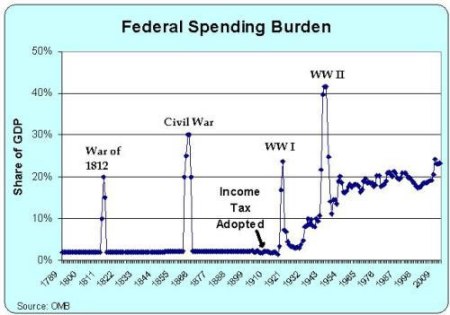
Here’s a chart, based on data from the Office of Management and Budget, showing the burden of federal spending since 1789.

Since OMB only provides aggregate spending data for the 1789-1849 and 1850-190 periods, which would mean completely flat lines on my chart, I took some wild guesses about how much was spent during the War of 1812 and the Civil War in order to make the chart look a bit more realistic.

But that’s not very important. What I want people to notice is that we enjoyed a very tiny federal government for much of our nation’s history. Federal spending would jump during wars, but then it would quickly shrink back to a very modest level – averaging at most 3 percent of economic output.

US-spending-vs-GDP

So what’s the lesson to learn from this data? Well, you’ll notice that the normal pattern of government shrinking back to its proper size after a war came to an end once the income tax was adopted.

h1

If you want peace, work for justice

December 27, 2012

Here’s Nolan Finley writing in The Detroit News about a note from a reader named Jon Taub. (As a side note, I’d like to know where they can get milk for $2.50/gallon. It’s a dollar more where I live.)

Tax code milking cash cow dry

[…] Taub applies that same formula to a purchase of a gallon of milk, which currently sells for $2.49 at Kroger, to see what would happen.

“If every U.S. taxpayer purchased a gallon of milk, each person would pay $2.49, and the total cost would be 140.5 million times $2.49 — or $349 million.

“Now let’s assume the government treated milk like government services and determined its price the same way it determines tax rates. The pricing would change as follows:

“When the bottom 40 percent of earners buy their milk, they won’t pay a dime for it. In fact, the government would give them $1 in reverse payments for every gallon of milk they purchase. The total cost of providing one gallon of milk to each person in this group would be $196.1 million.

“The cost of providing milk to the remaining 60 percent of the taxpayers would be $209.9 million, bringing the total cost burden of all taxpayers’ milk to $406 million.

“Under our existing tax rates, instead of paying $2.49 a gallon, the top 1 percent of earners would pay 38 percent of the total milk burden or $109.81 for a gallon of milk.” […]

Taub urges everyone to think about that example whenever they hear President Barack Obama talk about tax fairness, as they will incessantly over the next few weeks.

The current tax system is unfair, but not because the wealthy don’t pay enough.

It’s out of whack because it doesn’t acknowledge that the rich are paying more for their government milk than it’s worth so most others can pay less. And instead of saying thank you, we’re milking those cash cows dry.

As we’ve noted here more than once, the US tax code doesn’t tax the rich too lightly — it taxes the everyone else too lightly. I believe most European countries are more equitable in taxing lower income earners, though their tax rates are no more "progressive" than the US tax rates.

That’s not to say that wealthy US citizens can not or do not hire accountants and lawyers (and some times lobbyists) to work the loopholes or to make new loopholes. But what loopholes in tax code indicate is a corrupt government. To be equitable, the income tax code should be across-the-board, simple and without loopholes.

Ask your congressman why it’s not.

h1

Ron Paul’s farewell address

November 17, 2012

Long, but worth your time I think.

h1

Because it will feel so good when we stop

October 12, 2012

Source

If you look closely, you’ll see that the dollar amounts do not add up to the sum in the label. Comment on/explanation of that at Hit & Run.

h1

A history lesson

July 28, 2012

An interesting interview with John Barry, who wrote Roger Williams and the Creation of the American Soul: Church, State and the Birth of Liberty. (Quite a mouthful, eh?)

h1

Hear, hear!

July 27, 2012

Via Maggie’s Farm

h1

Tick, tick, tick…

July 22, 2012

28 minutes.

Via Breitbart’s Big Government

h1

Six charts

July 15, 2012

From James Pethokoukis at the American Enterprise Institute site: 6 charts that show the Welfare State run amok. These charts and graphics come from […] Gary Alexander, secretary of public welfare for Pennsylvania. (Mileage in your state may vary, of course.)

Here’s one.

I suppose the spike at the left edge is due to the low number of Medicaid recipients when the program was launched.

h1

Today’s lesson

July 7, 2012

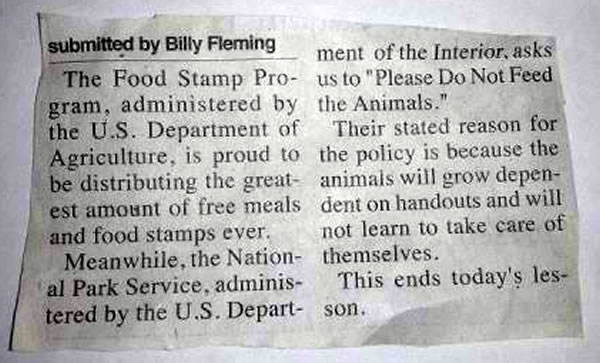
The appearance of this makes me wonder whether it was really printed in some newspaper and then clipped and copied. But maybe I’m too suspicious; it may have come from the Miller County Liberal in Colquitt, Georgia.

It’s a good reminder, regardless of its source.

And, no, the point is not that we’re treating poor people like animals. The point is that all animals, including people, respond to incentives.

For example, I know a woman who worked for years and made good money – over $100,000 per year in her last job. She’s married to man who’s doing very well in his engineering career. (He earns more than she was earning.) Their children are grown. So when she lost her last job, it was a loss of income but couldn’t be considered a hardship by any means. Nonetheless, she collected unemployment compensation while she was eligible just because it was available. (I don’t believe she was actually planning to return to work but I may be wrong about that.)

And another point is that the USDA seems to be in overdrive these days about enrolling as many as possible in its food stamp programs. To me, that looks more like a bureaucracy trying to expand its empire than a compassionate agency taking care of needy people.

Penn Jillette wrote, "Helping poor and suffering people is compassion. Voting for our government to use guns to give money to help poor and suffering people is immoral self-righteous bullying laziness." In other words, people have responsibilities.

So Amen, Mr. Fleming.

Tip o’ the hat to Jeff G.

h1

You lose some, you win some (2)

June 29, 2012

Here’s an interesting article about jury nullification, prompted by a new law in New Hampshire, the Live Free or Die state. (Is that the best state motto or what?)

Jury nullification, like many things, is a two-edged sword. My guess is that O.J. Simpson’s acquittal for the murder of his wife was a case of jury empathy — the flip side of white juries in the Deep South which refused to convict those who assaulted or murdered blacks.

But on the whole, I think it’s good for juries to keep their options in mind. They can judge the law and its application as well as the case against the accused people.

Jury Nullification Law Signed by New Hampshire Governor

June 27, 2012 @ 4:27 PM by Tim Lynch

With all the buzz and anticipation surrounding the final rulings by the U.S. Supreme Court the past week, there has been little attention to an interesting legal development in New Hampshire: On June 18, Governor John Lynch (no relation) signed HB 146 into law and it becomes effective on January 1, 2013. HB 146 concerns “the right of a jury to judge the application of the law in relationship to the facts in controversy.” It’s popularly known as “the jury nullification bill.” In this post, I will try to explain what impact this new law may have in the New Hampshire courts.

By way of background, Cato co-published the most comprehensive book on this subject back in 1998, Jury Nullification: The Evolution of a Doctrine by Clay Conrad. So pick that up if you’re interested in the full legal and historical treatment. If you’re not ready for the book, do check out this book review by University of Tennessee law professor Glenn Reynolds.

For purposes of this post, I am going to sidestep the question of whether or not jury nullification is a good idea. My purpose is not to “make the case for HB 146.” Rather, my purpose is to briefly explain what jury nullification is, provide a very brief history of the law on that subject, and, finally, explain how the recently enacted statute in New Hampshire may alter existing law and practices there.

h1

Exchange strategy

June 20, 2012

An interesting clip by Michael Cannon at Cato giving reasons why states should not establish Obamacare exchanges.

h1

En la república bananera del norte

June 16, 2012

I’ve mentioned before that it seems obvious the Obama administration is paying off its union backers with political favors. So this article from the Wall Street Journal wasn’t much of a surprise, though it still shocks me that the Executive branch interceded in judicial proceedings in such a transparent and heavy-handed way. How in the world did it get away with that?

Sherk and Zywicki: Obama’s United Auto Workers Bailout
If the administration treated the UAW in the manner required by bankruptcy law, it could have saved U.S. taxpayers $26.5 billion.

President Obama touts the bailout of General Motors and Chrysler as one of the signature successes of his administration. He argues that the estimated $23 billion the taxpayers lost was worth paying to avoid massive job losses. However, our research finds that the president could have both kept the auto makers running and avoided losing money.

The preferential treatment given to the United Auto Workers accounts for the American taxpayers’ entire losses from the bailout. Had the UAW received normal treatment in standard bankruptcy proceedings, the Treasury would have recouped its entire investment. Three irregularities in the bankruptcy case resulted in a windfall to the UAW.

My father was a member of the UAW for several decades though he never worked for one of the Big Three auto companies. (He worked at Caterpillar, building engines for dozers and graders and the like.) So the UAW had some influence on my raising, though I’m not sure how much or what kind. But this deal still stinks, Mr. King.

Indiana State Treasurer Richard Mourdock had this to say about the lawlessness of the Chrysler bailout back in 2009.

h1

Canada did it

June 2, 2012

Here’s an interesting article by Chris Edwards at Cato that’s worth a read.

We Can Cut Government: Canada Did

Two decades ago Canada suffered a deep recession and teetered on the brink of a debt crisis caused by rising government spending. The Wall Street Journal said that growing debt was making Canada an “honorary member of the third world” with the “northern peso” as its currency. But Canada reversed course and cut spending, balanced its budget, and enacted various pro-market reforms. The economy boomed, unemployment plunged, and the formerly weak Canadian dollar soared to reach parity with the U.S. dollar.

[…]

America needs to get its fiscal house in order, and Canada has shown how to do it. Our northern neighbor still has a large welfare state, but there is a lot we can learn from its efforts to restrain the government and adopt market-oriented reforms to spur strong economic growth.

h1

George Carlin on the law

May 9, 2012

I thought this was pretty hilarious, particularly the part about legal traditions and how the State (i.e., police) abuse them.

Via Simple Justice

h1

In a New York minute

April 27, 2012

Here’s an interesting proposal at the American Enterprise Institute’s The American. It’s not much longer than this excerpt so RTWT.

Would You Settle Your Claims on Social Security for 80 Cents on the Dollar? (I Would)

Current headlines read: “Social Security’s Financial Forecast Gets Darker”; “Stress Rises on Social Security.”

Well, yes: but who is surprised?

Certainly not young people, who are rightly skeptical about whether Social Security in the future will be able to give them back the money it takes from them today.

The problem is pretty basic: According to the new calculations of the Social Security Trustees’ 2012 Report, Social Security’s future costs are a lot bigger than its future income. […]

Many observers, considering this insolvency, quickly conclude that you must force Americans to either pay more in Social Security taxes or mandate a cut in their benefits.

But there is another, voluntary alternative. Give people a choice? Imagine that!

I have previously asked, “Would you settle your claims on Social Security for 83 cents on the dollar?”—and answered, “I would—in a heartbeat.”


And here’s another interesting alternative for reforming Social Security. This one’s longer but packed with interesting details so it’s worth your time too.

Social Security by Choice: The Experience of Three Texas Counties

Stock market volatility remains one of the primary objections to switching from the current pay-as-you-go method of funding Social Security benefits to a system of prefunded personal retirement accounts. However, three Texas counties that opted out of Social Security 30 years ago have solved the risk problem.

Galveston County opted out of Social Security in 1981, and Matagorda and Brazoria counties followed suit in 1982. County employees have since seen their retirement savings grow every year, including during the recent recession. Today, county workers retire with more money, and have better supplemental benefits in case of disability or an early death. Moreover, the counties face no long-term unfunded pension liabilities.

If state and local governments — and Congress — are really looking for a path to long-term sustainable entitlement reform, they might consider what is known as the “Alternate Plan.”

The Alternate Plan. The Alternate Plan does not follow the traditional defined-benefit or defined-contribution model. Rather, employee and employer retirement contributions are pooled and actively managed by a financial planner — in this case, First Financial Benefits, Inc., of Houston, which both originated the plan and has managed it since inception.

Like Social Security, employees contribute 6.2 percent of their income, with the county matching the contribution (Galveston has chosen to provide a slightly larger share). Once the county makes its contribution, its financial obligation is done. As a result, there are no long-term unfunded liabilities.

h1

We’re Number 1!

April 1, 2012

A post at the Heritage Foundation’s The Foundry blog.

No Fooling: U.S. Now Has Highest Corporate Tax Rate in the World

This April Fool’s Day, the joke is on all of us. That’s because as of April 1, the U.S. now has the highest corporate tax rate in the developed world.

Remember this the next time you hear some political genius going on about the patriotism of companies that don’t "invest in America."

h1

What if? (the video)

February 13, 2012

In December of last year, I had a post that linked to an essay by Andrew Napolitano full of “What if?” statements. In this video, he asks many of the same questions on his Freedom Watch show.

h1

A title that’s too long

January 28, 2012

This title of this post at Uncrunched.com could have stopped after the third word. (And follow the link to read Mr. Bridges’ article, too.)

Big Government Sucks Tech Industry Into Their Reality

SOPA/PIPA is on the ropes. Senator Reid postponed a vote on the Senate’s version of the bill next Tuesday, and MPAA CEO Chris Dodd is backtracking and humbled.

Yay. We did it, or nearly have.

But Hollywood still has dozens of laws on the books criminalizing file sharing (read this post by attorney Andrew Bridges pointing out how ridiculous the laws are compared to things like jumping the turnstile on the subway.

Congress is the real winner here. They showed that they can and will pass bills that will cause irreparable harm to the tech industry just because Hollywood is willing to pay them off with huge lobbying dollars. And while SOPA/PIPA may be stalled for now, a big part of the reason is that tech companies got into the lobbying game, too. […]

This is how criminal organizations run protection rackets. Congress is doing just that, only it’s completely legal.