h1

12 Years a Slave (2)

November 30, 2013

I took the family to see 12 Years a Slave Wednesday evening. The theater entrance was packed with people; we assumed they were there to see the new Hunger Games movie (Catching Fire).

When we were seated, though, there were only 2 other people watching 12 Years a Slave with us and I was surprised the theater will still screening it. An audience of 6 is a mighty small one.

If you have an interest in history and haven’t read the book yet, you can find it in eBook form here or in HTML form here.

The film showed more violence than I recalled, but it’s been several years since I’ve read the book. Clayton Cramer has a good review at PJMedia: We Need Movies That Tell the Truth About Slavery.

It boggles imagination these days to see gratuitous violence inflicted on slaves and I had to wonder why people would act so. It was contrary to both their economic self-interest and to their (nominal) religion; wrong both pragmatically and morally, in other words.

Then I recall the Stanford Prison Experiment and similar psychological studies demonstrating that very effect: humans will act that way. And I recall my father (who’s from Virginia) telling me that his grandfather believed that slaves had no souls.

Sobering thoughts of social dangers that are still all too likely.

h1

Curious

November 29, 2013

Here’s the start of an interesting article from The Telegraph.

The internet mystery that has the world baffled

For the past two years, a mysterious online organisation has been setting the world’s finest code-breakers a series of seemingly unsolveable problems. But to what end? Welcome to the world of Cicada 3301

One evening in January last year, Joel Eriksson, a 34-year-old computer analyst from Uppsala in Sweden, was trawling the web, looking for distraction, when he came across a message on an internet forum. The message was in stark white type, against a black background.

“Hello,” it said. “We are looking for highly intelligent individuals. To find them, we have devised a test. There is a message hidden in this image. Find it, and it will lead you on the road to finding us. We look forward to meeting the few that will make it all the way through. Good luck.”

The message was signed: “3301”.

A self-confessed IT security “freak” and a skilled cryptographer, Eriksson’s interest was immediately piqued. […]

Sleepily – it was late, and he had work in the morning – Eriksson thought he’d try his luck decoding the message from “3301”. After only a few minutes work he’d got somewhere: a reference to “Tiberius Claudius Caesar” and a line of meaningless letters. Joel deduced it might be an embedded “Caesar cipher” – an encryption technique named after Julius Caesar, who used it in private correspondence. It replaces characters by a letter a certain number of positions down the alphabet. As Claudius was the fourth emperor, it suggested “four” might be important – and lo, within minutes, Eriksson found another web address buried in the image’s code.

Feeling satisfied, he clicked the link.

It was a picture of a duck with the message: “Woops! Just decoys this way. Looks like you can’t guess how to get the message out.” […]

h1

Early adopter story

November 27, 2013

I’ve mentioned previously that my family & I are subscribers to Republic Wireless‘ low-cost, no-commitment cellular service. Overall, it’s worked out well for us. Everyone got more service features and we cut our monthly bill in half. It’s been a great deal and I still recommend it.

In fact, four of my friends & extended family have bought Republic phones on my recommendation and they’re pretty happy with them.

But all that said, my experience with Republic hasn’t been without its vexations. It seems to be a universal truth that early adopters of anything will have their regrets as they learn the shortcomings of their adoptees.

The first wart I found was when I started the Republic enrollment process and read their Terms of Service. Yeah, I know… who does that? To be blunt, their Acceptable Use Policy scared me so much that I decided against enrolling. It took several days before I changed my mind and decided to sign up.

I had to agree to their ToS again recently and here’s the latest and greatest version, all 20 pages of it.

But what really bothers me — still — is Republic’s Acceptable Use Policy. It’s much worse than Sprint’s. Republic’s Use Policy is so open-ended that another subscriber can get your service terminated simply by complaining about harassment, inappropriate language, or similarly vague and poorly-defined matters. I know from experience with Google’s AdWords how that type of system works: the service provider will typically defend the complainer’s "Right Not To Be Offended" because that’s the easy way for the provider to deal with the problem.

Put another way, the squeaky wheel is very likely to get the grease regardless of the merits of the squeaking.

So read Republic’s Acceptable Use Policy carefully and think about how you’ll be using your phone. Republic will have the right to cancel your service if some Mrs. Grundy somewhere decides that your latest Facebook post, or Tweet, or e-mail is offensive.

Since I have other venues for my crazy and offensive ideas (hi, reader!) and since I never plan to publish those from my phone, I decided Republic’s A.U.P. wouldn’t affect me much.


The next pitfall was due to how we ordered our four Defy XTs. We ordered two at first, to check them out, and ordered two more later when we decided the first two worked OK.

But the wrinkle in this was that the first two phones we got were ‘single band’ phones, meaning that they could only use a single frequency range in Sprint’s cellular spectrum. (Sprint is the cellular carrier for Republic customers when the VoIP feature can’t be used.) The two phones we bought later were ‘dual band’ and could use two frequency ranges in Sprint’s spectrum.

The difference in coverage areas for these two types of phone is pretty striking. The dual-band phones work practically anywhere in the lower 48 states but that’s not true for the single-band phones. After getting my single-band Defy phone last year, I made a couple of trips to the Mississippi delta and as soon as I got about 25 miles south of Memphis, I had no signal. I didn’t even have roaming capability. The only way I could make a call was to find a hotspot in a hotel or restaurant where the phone could connect over WiFi.

"No problem," I thought. "I’ll just swap my single-band phone for one of the dual band phones." Then I discovered that Republic wouldn’t let me transfer my number to another phone, even though they were provisioning both phones.

Digging into it a little at Republic’s Community forum, I found that swapping number assignments on active phones wasn’t possible. Nice… very nice, guys.

I should add that Republic was upfront about the difference in coverage from the start, so I knew what I was getting into. I was just pushing my luck a little too far. What good is luck if you never push it?


As I said, overall it’s been a good deal and I’m a happy customer despite the drawbacks. Last week, Republic started selling the Moto X, running Android 4.2.2 (almost the latest version), and I upgraded. The Moto X is much nicer than the Defy XT and I’m liking it.

Upsides to the new deal:

  • Republic now supports call hand-off between media. That is, a call that originates on WiFi can now be switched to the cellular network when you walk out of WiFi range. With the Defy XT, when you walked away from the WiFi hotspot your VoIP call was simply dropped. That sort of sucked if your weren’t prepared for it or when you forgot about it. (T-Mobile used to offer this media-switching feature a few years ago, I’ve learned.)
  • The Moto X supports MMS; the Defy XT was limited to SMS only.
  • The hands-free control feature works better than I expected and is actually useful. It’ll do arithmetic by voice command.
    I’ve never used Siri, so I can’t compare the two but I like what I’ve seen on the Moto X so far.
  • The Moto X’s weight and thickness are the same as the Defy XT’s but the Moto X’s display is 25% larger and has a higher pixel density, so it’s much easier to read and type on. For me it’s the difference between needing my glasses or not. Huzzah! for more pixels.
  • Republic offers variable service plans for the Moto X. They’ll sell me text/voice/4G (LTE) data service for $40/month. Or they’ll sell me text/voice/data over WiFi only for $5/month. Or they offer other plans between those extremes. At the moment I have text/voice/3G data service at $25/month because the 4G coverage isn’t great in my area. (C’mon, Sprint! Git-R-Done!)
  • Republic sells the Moto X at a great price: $300 with a $100 rebate for Defy XT returns (mine’s already on its way back to Motorola). That’s not bad at all — but my Moto X is not an unlocked phone.

Downsides to the new deal (so far):

  • The Moto X battery can’t be removed. The Moto X seems to go easier on its battery than the Defy XT, but I can’t always charge the phone’s battery overnight. I kept spare batteries for my Defy XT so I could swap them when needed. Since I can’t do that with the Moto X, I bought an external battery pack.
    Luckily, those battery packs are fairly cheap on eBay and, better yet, I think they’ll charge an iPad too.
  • Since the Moto X has Republic’s proprietary VoIP code on its ROM, the phone is locked to Republic’s service. You can walk away from Republic’s service agreement at any time but you can’t get your Moto X provisioned by another carrier unless you want to root the phone.
  • There’s no place for a microSD card. Like the battery deal, this isn’t something Republic can change. Still, SD storage sure would be nice. The phone comes with 50GB at Google’s Drive (cloud storage) and that’s free for 2 years. If you don’t mind relying on a network connection for your data, that’s an alternative. Personally, I’ll get some local USB storage before I’ll gamble on always having a high-speed connection to cloud storage.
  • The internal memory on Republic’s Moto Xs is limited to 16GB. I’ll spare you the old-timer stories about what we used to run in only 512KB and just say that 16GB is too little by today’s standards. 32GB ought to be standard and 64GB ought to be an option.
  • Finally, Motorola offers a wide variety of colors for the Moto X (including a funky wood grain finish). But your only color choices from Republic are black and white.

In short, I like the Republic deal and it’s definitely improving. But, as always, your mileage may vary.


h1

The cost of affordable care

November 25, 2013

As I’ve mentioned, I think the problems with the Affordable Care Act are (a) it does nothing to increase price transparency and (b) it entrenches and subsidizes the current health insurance-based structure for paying for medical care (insurance companies and all).

So I thought Coyote nailed it with his post about the opportunity costs of PPACA, as shown by a study at The Manhattan Institute. RTWT.

Health Care Lost Opportunities

One of the real frustrations I have with Obamacare is that I believe we were on the cusp of a revolution in health care costs and payment systems, which the PPACA will likely kill. As more and more of us adopted high-deductible health insurance plans, there was an increasing transparency in pricing, and new delivery models were emerging to serve this consumer-based, non-third-party payer health niche.

I think this even more as I read about the CMS revising its future health care cost inflation numbers to take into account a flattening of medical price inflation that has been occurring over the last few years. The Left has hilariously claimed credit for this cost reduction via some kind of time-travelling effect of not-yet-implemented PPACA measures. But Charles Blahous reads the CMS report more carefully and finds that the PPACA has nothing to do with these inflation reductions, and in fact is if anything slowing the cost reduction progress.

h1

Policing for Profit

November 24, 2013

This snippet comes from the latest article in a series of reports on Policing for Profit by reporter Phil Williams with WTVF in Nashville, Tennessee. Mister Williams has done quite a job reporting on this topic.

There’s video at the link (and for all of his reports, I believe).

Task Force Head Claims ‘Terrorism’ Behind $160,000 Seizure

NASHVILLE, Tenn. — There was stunning testimony Wednesday before a state Senate committee as a local drug task force found itself facing tough questions.

The director of the 23rd Judicial District Drug Task Force responded to those questions — about whether his agency was “policing for profit” — with new claims that agents are really taking money out of the hands of terrorists.

While there’s absolutely no evidence that the terrorism claim is true, the task force director ended up inadvertently conceding that interstate interdiction units do indeed have a profit motive.

“You said if the money is not there they could potentially lose their jobs or they could potentially lose those bonuses,” observed Sen. Stacey Campfield, R-Knoxville, toward the end of the hearing. […]

Via The Agitator

h1

Fourth Amendment dissed yet again

November 19, 2013

Paul sends a link to this story from station KXAS in Dallas-Fort Worth. There’s video at the site (which starts with an obnoxious, unavoidable 10-second ad).

North Texas Drivers Stopped at Roadblock Asked for Saliva, Blood

Some drivers in North Fort Worth on Friday were stopped at police roadblock and directed into a parking lot, where they were asked by federal contractors for samples of their breath, saliva and even blood. The request was part of a government research study aimed at determining the number of drunken or drug-impaired drivers.

Some drivers along a busy Fort Worth street on Friday were stopped at a police roadblock and directed into a parking lot, where they were asked by federal contractors for samples of their breath, saliva and even blood.

It was part of a government research study aimed at determining the number of drunken or drug-impaired drivers.

“It just doesn’t seem right that you can be forced off the road when you’re not doing anything wrong,” said Kim Cope, who said she was on her lunch break when she was forced to pull over at the roadblock on Beach Street in North Fort Worth.

The National Highway Traffic Safety Administration, which is spending $7.9 million on the survey over three years, said participation was “100 percent voluntary” and anonymous.

But Cope said it didn’t feel voluntary to her — despite signs saying it was.

“I gestured to the guy in front that I just wanted to go straight, but he wouldn’t let me and forced me into a parking spot,” she said.

I understand why Ms Cope didn’t tell these folks to take their ‘voluntary participation’ and stuff it. But how great would it have been if she had?

Remember to ask: Am I being detained?

h1

Super Zips

November 17, 2013

The Washington Post has an interesting interactive site showing demographics by zip code. I think the thrust of its article is about the concentration of income and college degrees around Washington, D.C. but it’s an interesting widget to explore with.

super-zips

Washington: A world apart

This map highlights in yellow the nation’s Super Zips — those ranking highest on income and college education. The largest collection of Super Zips is around Washington, D.C. Learn more about this metric.

These are the top ten areas where "Super Zips" are clustered: Washington, D.C., E. Manhattan, San Jose, Boston, Oakland, Bridgeport, Newark, Chicago, N. of Los Angeles, Long Island.

Wow, Newark edged out Chicago? That’s gotta sting.

Via Carpe Diem (IIRC)

h1

Thanks a lot, Jenny

November 17, 2013

A not-too-long essay about a woman’s experience with whooping cough and why she thinks she contracted it. RTWT.

I’ve Got Whooping Cough. Thanks a Lot, Jenny McCarthy.
BY JULIA IOFFE

At this writing, I have been coughing for 72 days. Not on and off coughing, but continuously, every day and every night, for two and a half months. And not just coughing, but whooping: doubled over, body clenched, sucking violently for air, my face reddening and my eyes watering. Sometimes, I cough so hard, I vomit. Other times, I pee myself. Both of these symptoms have become blessedly less frequent, and I have yet to break a rib coughing—also a common side effect. […]

How responsible are these non-vaccinating parents for my pertussis? Very. A study recently published in the journal Pediatrics indicated that outbreaks of these antediluvian diseases clustered where parents filed non-medical exemptions—that is, where parents decided not to vaccinate their kids because of their personal beliefs. The study found that areas with high concentrations of conscientious objectors were 2.5 times more likely to have an outbreak of pertussis. […]

So thanks a lot, anti-vaccine parents. You took an ethical stand against big pharma and the autism your baby was not going to get anyway, and, by doing so, killed some babies and gave me, an otherwise healthy 31-year-old woman, the whooping cough in the year 2013. […]

As a follow-up to the essay above, Ms Ioffe wrote another brief post about her illness: Yes, I Got Vaccinated for Whooping Cough. I Shouldn’t Need a Booster, Too. That second post includes this graph (compiled from CDC data).
whooping-cough.

Via The Dish

h1

Incentives

November 16, 2013

I don’t listen to talk radio and I don’t live in Texas, so I don’t know whether this call really happened. But I take the recording at face value because it’s so easily believable. When you subsidize something, you get more of it.

The part of the call that was most ludicrous was the caller ranting about illegal aliens being free riders on the American system. That really pegged the old Irony Meter; has she heard of "the pot calling the kettle black"?

Plus she implied that migrants are as shiftless as she is. As I said, I don’t live in Texas. But in these parts migrant workers are some of the hardest-working people I see.

Via David Thompson

h1

The Health care special (3)

November 10, 2013

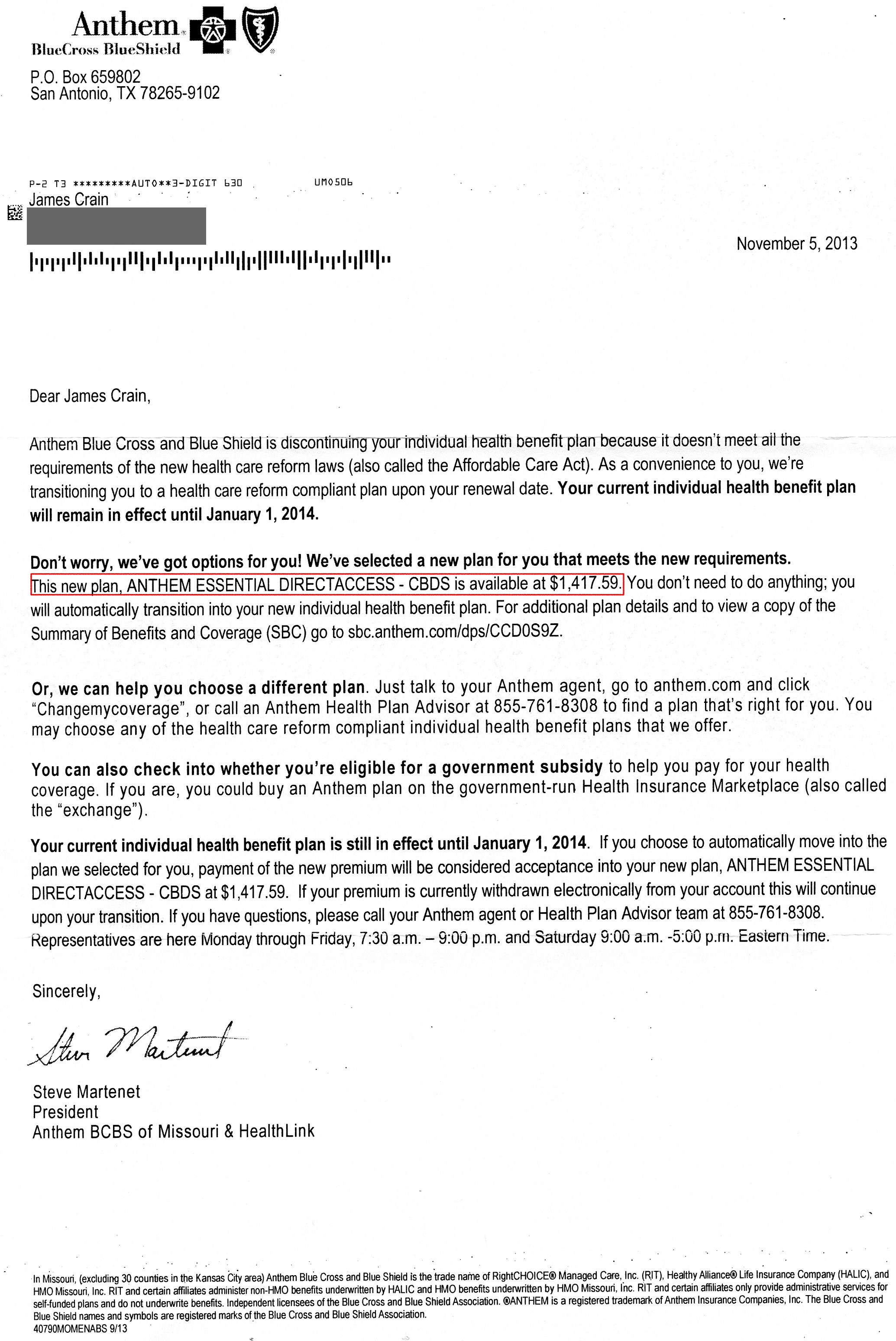
Like many other people, we got a cancellation letter from our health insurance carrier. It contains the same news people all over the country are getting.

Anthem Blue Cross and Blue Shield is discontinuing your individual health benefit plan because it doesn’t meet all the requirements of the new health care reform laws (also called the Affordable Care Act).

anthem-cancellation-letter
(Click for a larger, readable view.)

Are we upset? You bet!

1. Did the President and his administration lie about "if you like your plan, you can keep it"? That’s what NBC News reports.

And the Obama administration is still claiming that at this writing. I like the part on that page about how they’ll "debunk the myth that reform will force you out of your current insurance plan or force you to change doctors" since those are exactly the problems my family faces now.

Thanks, Obama!

2. The "Affordable Care Act" name is blackly humorous because this new plan we’re offered would cost more than twice what we currently pay for a plan with the same deductible. That $1,417.59 number in the letter would be our monthly cost.

A health care plan for three of us, for only $17,000 per year? What a deal!

3. I expected that a Federal bureaucracy would put itself in the business of deciding for the entire country what constitutes an "acceptable" health care plan and would then force everyone to buy one like that. And so it happened. At our ages, my wife and I don’t need maternity and newborn care but those "must be included on all non-grandfathered plans at no out-of-pocket limit."

I get the principle of pooling risk behind insurance. And it’s obvious that forcing everyone to pay for maternity and newborn care is a way to lower the cost for those who actually need it. Plus, the Democrats get the political advantage of saying that they’ve addressed "Womens Health" issues (by plundering everyone else).

The point is that the decision used to be taken freely; now it’s a compulsory action decided by a bureaucracy.

I’m sure that many would say, "But now young people will be sharing the risk of your age-related care too." That’s likely true as well. But I don’t think the young folks should be compelled to do that. If I had my way, I wouldn’t be forcing my sons (and their peers) to pay my bills.


The fix that the US health care system needed was more price transparency so patients could make better-informed decisions. Just try asking your doctor or dentist what the costs will be beforehand. If your experience is like mine, you’ll get blank looks and people who ask "Why do you care? You’re not paying for it."

It’s a fact that my dentist charges me only half of what he charges an insurance company for a check-up and cleaning. Those days are gone now.

I don’t expect that transparent prices will be a panacea. Transparency won’t solve cases of life-and-death urgency nor will it make everyone medically literate when shopping for a doctor. But I don’t think there’s any perfect solution for all cases. Remember: hard cases make bad law.

Price transparency is what’s needed to allow the market to work despite those counter factors. Why do prices for procedures not typically covered by insurance plans ("elective procedures") keep falling? Markets at work.

But PPACA goes in the opposite direction. Not only does it fail to fix the pricing problem, it entrenches and effectively subsidizes the current system of hiding price information. Welcome to the one-size-fits-all-means-it-fits-nobody world.


4. But what has me most angry is not President Obama nor the Democratic Party congressmen who saddled us with this disaster. They only did what they’ve been saying for years that they’d do. Instead, I’m upset with all of those people who voted to put Obama and his party in power.

So instead of sarcastically saying, "Thanks, Obama!" what I’ll say sarcastically is, "Thanks a lot, Fellow Voters!" Thank you so very much for forcing us all to join a health care buyers’ club whether we wanted it or not.

Do not blame Caesar, blame the people of Rome who have so enthusiastically acclaimed and adored him and rejoiced in their loss of freedom and danced in his path and gave him triumphal processions and laughed delightedly at his licentiousness and thought it very superior of him to acquire vast amounts of gold illicitly. Blame the people who hail him when he speaks in the Forum of the ‘new, wonderful good society’ which shall now be Rome’s, interpreted to mean ‘more money, more ease, more security, more living fatly at the expense of the industrious.

I don’t know who said this but it describes the state of affairs all too well. It’s often attributed to Cicero (but there’s some dispute about that).

h1

The health care special (2)

November 10, 2013

Frankly, I’d find this a lot funnier if I weren’t the fish who will soon own a bicycle.

fish-on-bike

h1

The health care special (1)

November 10, 2013

A former workmate sent the letter below about someone he knows with an attitude. (I’m keeping him anonymous for obvious reasons.)

I think he’s a little over the top predicting an economic death spiral, especially from one observation. Anecdotes aren’t data, after all. On the other hand, who knows how prevalent this attitude is? It certainly applies to other things than health care benefits. So he may be right that it’s a harbinger of disaster.

In any event, the attitude he describes is bad cultural juju. Taking ‘free’ government benefits that you could buy for yourself strikes me as a violation-by-proxy of the Golden Rule. Give your fellow citizens a break, people (even if some of them are wealthier than you).

I have to add that I’d feel a lot better if his acquaintance with the attitude were a 20-something rather than a 50-something. That’s the scariest part IMO.

I have a close acquaintance who shall remain nameless. Single and in his/her mid 50s. While s/he seems to be in good health, s/he is a functional alcoholic; drinks all day long, every day.

S/he had several jobs in IT in Silicon Valley area back in the ‘80s and 90’s but decided it wasn’t his/her cup of tea. Now s/he supposedly run a seasonal small business in the northern Midwest. S/he hires day laborers only and pays them in cash each day. S/he only buys business insurance when required to show a active policy to bid on bigger commercial jobs.

In the winter s/he closes down the operation up north and heads to the south to spend winter. The winter business apparently is not as productive (due to lack of demand) so s/he does all sorts of odd jobs to supplement income. I have no idea what his/her annual income is and suspect that s/he operates on cash basis as much as possible to avoid paying FICA, Medicare, state and federal income tax. And of course s/he has no medical insurance.

A few days ago I was watching the news and of course the segment was on the Obamacare debacle.

S/he walked in and stated that s/he was looking forward to Obamacare so s/he could afford medical insurance. S/he then described how the high deductible medical insurance s/he retained for a few years was “a complete waste of money.” So apparently s/he did not get sick or injured often/seriously enough to meet the deductible. S/he said “This was a total waste of $10,000.” I asked if the medical plan was $10000/year (which seemed extraordinarily high). “No. That’s what I paid over 8 or so years.” So when s/he had insurance s/he paid about $105/month for coverage. S/he went on about how greedy insurance companies are and how much better the Obamacare exchange plans will be. Note I said “will be” as s/he had not yet bothered to try and sign up.

And part of the reason s/he had not explored his/her options under Obamacare was the extensive reports of the web interface failure. The other stated reason was s/he wanted to know where s/he would get the “best deal.” In the northern mid-western state or in the southern state (that also has no income tax).

So I asked why s/he had not at least checked to see what the cost/options were as there are plenty of other resources, short of signing up, where s/he could get preliminary estimates? Answer: Website problems (missing my point) and the fact that the deadline is weeks/months away. I dropped the discussion at that point.

A week or so later the subject came up again and s/he stated “Well its most likely I’ll just pay the $95 fine.” When I asked if s/he got monthly cost estimates, s/he just reiterated s/he would “go with the fine and then pick up insurance if/when s/he needs it or just file bankruptcy like everyone else does.”

So my acquaintance enjoys a life where s/he can afford to spend the winter in the south, in an apartment loaded with electronic toys (LCD TV, PCs, iPad, iPhone), drink all day long, and work when it is convenient or perhaps necessary when cash flow tightens.

And s/he wants everyone else to pay their medical care going forward because doing paying their own way would effectively deny him/her the lifestyle they have selected.

I am betting my friend’s approach is going to be replicated by millions of other folks.

The ‘sick’ may get better deals and they’ll likely take advantage of them.

Many of the able will remain uninsured until the last minute, because they can.

An economic death spiral is inevitable.

h1

Traffic stop leads to forced colonoscopy

November 6, 2013

How many more times do events like this need to happen before we put a stop to them? This comes from station KOB in Albuquerque; the video of their TV news report can be seen at the link.

4 On Your Side investigates traffic stop nightmare

[…] The incident began January 2, 2013 after David Eckert finished shopping at the Wal-Mart in Deming. According to a federal lawsuit, Eckert didn’t make a complete stop at a stop sign coming out of the parking lot and was immediately stopped by law enforcement.

Eckert’s attorney, Shannon Kennedy, said in an interview with KOB that after law enforcement asked him to step out of the vehicle, he appeared to be clenching his buttocks. Law enforcement thought that was probable cause to suspect that Eckert was hiding narcotics in his anal cavity. While officers detained Eckert, they secured a search warrant from a judge that allowed for an anal cavity search. […]

What Happened

While there, Eckert was subjected to repeated and humiliating forced medical procedures. A review of Eckert’s medical records, which he released to KOB, and details in the lawsuit show the following happened:

1. Eckert’s abdominal area was x-rayed; no narcotics were found.

2. Doctors then performed an exam of Eckert’s anus with their fingers; no narcotics were found.

3. Doctors performed a second exam of Eckert’s anus with their fingers; no narcotics were found.

4. Doctors penetrated Eckert’s anus to insert an enema. Eckert was forced to defecate in front of doctors and police officers. Eckert watched as doctors searched his stool. No narcotics were found.

5. Doctors penetrated Eckert’s anus to insert an enema a second time. Eckert was forced to defecate in front of doctors and police officers. Eckert watched as doctors searched his stool. No narcotics were found.

6. Doctors penetrated Eckert’s anus to insert an enema a third time. Eckert was forced to defecate in front of doctors and police officers. Eckert watched as doctors searched his stool. No narcotics were found.

7. Doctors then x-rayed Eckert again; no narcotics were found.

8. Doctors prepared Eckert for surgery, sedated him, and then performed a colonoscopy where a scope with a camera was inserted into Eckert’s anus, rectum, colon, and large intestines. No narcotics were found.

Throughout this ordeal, Eckert protested and never gave doctors at the Gila Regional Medical Center consent to perform any of these medical procedures. […]


Update
Orin Kerr writes at The Volokh Conspiracy (my emphasis in the penultimate sentence).

A Preliminary Legal Analysis of Eckert v. City of Deming, the “Clenched Buttocks” Case

A lot of folks in the blogosphere have been writing about this story on Eckert v. City of Deming, a Fourth Amendment civil case involving a routine traffic stop that turned into the government forcing a suspect to undergo invasive medical procedures looking for drugs. I thought I would run through some of the allegations as well as the major legal issues they raise. Unfortunately, the case is too complicated to give a full and complete picture of all the legal issues in the time I have. But I hope to at least hit some major points.

The facts alleged in the case are complicated and filled with many allegations, but here’s the gist of it. […]

Finally, the officers came to the conclusion that Eckert had no drugs in him, and they returned him home. To add insult to injury, the medical center then billed Eckert for the medical procedures that they forced him to undergo. (Not relevant to the Fourth Amendment issues, I realize. But damn, that’s cold.)

This sounds like another case of injustice becoming law. I believe the medical people billed Mr. Eckert somewhere in the neighborhood of $6.000 for their services to the police.

Ignoring the Fourth Amendment issues and looking only at the money trail, where’s the downside for the police? There is no downside: they could do this to anyone. By forcing the victim to pay for medical procedures he doesn’t consent to in their search for drugs, all the police lose is their time.


Update from KOB (1/12/14)

City, county settle in controversial anal probing case

In November, a KOB 4 On Your Side investigation outraged the nation and the story of David Eckert went viral.

From coast to coast, people wanted justice for the New Mexico man who was anally probed and forced to undergo a colonoscopy after police suspected he had drugs in his rectum.

Sunday, Eckert tells KOB that he is finding some justice after a major court decision in his case. […]

In December, Hidalgo County and the City of Deming settled.

Through a records request, 4OYS learned that settlement amount is set at $1.6 million.

“The gratifying aspect of this case is the media attention that it has gotten and the opportunity for discussions in the law enforcement and medical communities about how to deal with these opportunities and what to do with requests from law enforcement about medical exams for people in custody,” Eckert’s attorney Joseph Kennedy said.

Here is the settlement breakdown: Hidalgo County will pay $650,000 and the City of Deming will pay $950,000.

h1

Nitwittery nailed again

November 6, 2013

The New York Times published this last Sunday:

Under Health Care Act, Millions Eligible for Free Policies
By REED ABELSON and KATIE THOMAS
Published: November 3, 2013

Millions of people could qualify for federal subsidies that will pay the entire monthly cost of some health care plans being offered in the online marketplaces set up under President Obama’s health care law, a surprising figure that has not garnered much attention, in part because the zero-premium plans come with serious trade-offs. […]

Don Boudreaux nails them in his typical fashion in a post at Cafe Hayek:

Here’s a letter to the New York Times:

Your headline today reads “Under Health Care Act, Millions Eligible for Free Policies.”

More accurate wording would be “Under Health Care Act, Millions Eligible to Free Ride at Other People’s Expense.” That the people actually paying for all this “free” health insurance are faceless does not make them unreal – only invisible. And being invisible, the people footing the bill are ignored by Pres. Obama and other politicians preening publicly over their faux-generosity in spending other people’s money to bribe voters with promises of “free” health insurance. […]

Seriously, what are these people (Abelson and Thomas) thinking? That there’s such a thing as Money For Nothin’?

H.T. Jeff G.

h1

Paranoia strikes deep

October 19, 2013

Via Reason, here’s the opening of an interesting article at the ACLU blog wondering whether Congressional representatives are being blackmailed by the NSA.

On the Prospect of Blackmail by the NSA

Sometimes when I hear public officials speaking out in defense of NSA spying, I can’t help thinking, even if just for a moment, “what if the NSA has something on that person and that’s why he or she is saying this?”

Of course it’s natural, when people disagree with you, to at least briefly think, “they couldn’t possibly really believe that, there must be some outside power forcing them to take that position.” Mostly I do not believe that anything like that is now going on.

But I cannot be 100% sure, and therein lies the problem. The breadth of the NSA’s newly revealed capabilities makes the emergence of such suspicions in our society inevitable. Especially given that we are far, far away from having the kinds of oversight mechanisms in place that would provide ironclad assurance that these vast powers won’t be abused. […]

There has already been prominent speculation about this threat. David Sirota explicitly mulled the subject in this (paywalled) piece, as have writers at Firedoglake and TechDirt. Whistleblower Russell Tice has also alleged that while at the agency he saw wiretap information for members of Congress and the judiciary firsthand. Such fears explain why it is considered an especially serious matter any time elected or judicial officials are eavesdropped upon. The New York Times reported in 2009 that some NSA officials had tried to wiretap a member of Congress without a warrant. Members of Congress (and perhaps the judiciary) surely also noted a Washington Post report based on Snowden documents that the NSA had intercepted a “large number” of calls from the Washington DC area code due to a “programming error.”

For what it’s worth.

h1

Uncle Sam wants you!

October 4, 2013

A little political humor from Reason.TV:

h1

Close the parks first!

October 2, 2013

The always worth reading Coyote blog has an open letter from Warren Meyer (the blogger) to his Congressional representatives. Mr. Meyer runs Recreation Resource Management, a company that operates state and national parks on a private basis, replacing government management and staff. You probably won’t be surprised to learn that some states actually save money by letting a private company collect the fees and operate the park.

Meyer’s letter is about the National Park Service shutting down sites that cost it nothing to run. Seems purely punitive, doesn’t it? Naturally, that type of action doesn’t do Mr. Meyer’s business (or his competitors’) any good.

Read the letter My Plea to Stop the White House From Closing Privately-Funded, Privately-Operated Parks. Then scroll on for more recent posts about how the government is dealing with its shutdown and about how the mainstream media are describing it.

For years, Meyer has been pointing out that when government is publicly forced to make cuts, it starts by cutting the highly-visible, popular services like parks while avoiding little-known expenses that no one would care about.


Update: Coyote’s not the only unhappy park operator. From Reason’s blog:

Privately Run Park Director Again Calls Out Feds Over “Illegal” Closure

Anna Eberly, Managing Director of the privately run, funded and staffed Claude Moore Colonial Farm is taking no prisoners in her war with the National Park Service over the politicized closure of a park on which the federal government spends not a penny and with which it is involved in no way other than the ownership of the land. Eberly’s first email on the subject referred to the NPS’s position as “utter crap.” Her latest elaborates. It reads, in part:

[…] We are critical of the National Park Service because we think they have closed us down illegally according to the terms of the agreement we signed with them in 1981. The agreement states that we will operate the Farm and open it to the public and the only thing they will provide is police protection if needed. Many years ago, we decided that calling the Fairfax County Police if needed (they have joint jurisdiction) worked better for our situation. And because of our proximity to the Central Intelligence Agency, we have probably the best security on earth. The CIA has also treated us with great decency and respect and we value them highly as our neighbors.

The reason that it is so important that we remain open is because of the income we receive from Pavilion rentals, admissions, sales and program fees. We have had to cancel every event at the Farm this week so we have already lost more than $15,000 in operating income because October is the busiest month of the year for us. When the Federal government reopens, as it inevitably will, they will be funded by all of us. The Farm may never reopen again if we cannot open soon because we don’t have any other source of revenue except that which we earn for ourselves.

h1

Misplaced priorities

October 2, 2013

Here’s a good video about the practical effects of the War On Drugs. It seems like a good argument to me, even for those who disagree with legalizing drugs on principle.

Via Carpe Diem

h1

When injustice becomes law (1)

September 26, 2013

The IRS seized Mr. Dehko’s cash because he was suspected of the crime of "structuring." He wasn’t charged or convicted, mind you — only suspected. So the Feds didn’t sue Mr. Dehko; instead they sued his $35,651.11. I’m sure that makes sense to some lawyer somewhere. To me it just sounds like a license to steal.

Thank Heaven for the Institute for Justice. If you want to lend a hand, here’s how.

United States v. $35,651.11
Feds Seize Family Grocery Store’s Entire Bank Account

Can the government use civil forfeiture to take your money when you have done nothing wrong—and then pocket the proceeds? The IRS thinks so.

For over 30 years, Terry Dehko has successfully run a grocery store in Fraser, Mich., with his daughter Sandy. In January 2013, without warning, the federal government used civil forfeiture to seize all of the money from the Dehkos’ store bank account (more than $35,000) even though they’ve done absolutely nothing wrong. Their American Dream is now a nightmare.

Federal civil forfeiture law features an appalling lack of due process: It empowers the government to seize private property from Americans without ever charging, let alone convicting, them of a crime. Perversely, the government then pockets the proceeds while providing no prompt way to get a court to review the seizure.

On September 25, 2013, Terry and Sandy teamed up with the Institute for Justice to fight back in federal court. A victory will vindicate not just their right to be free from abusive forfeiture tactics, but the right of every American not to have their property wrongfully seized by government.


Update from the Institute:

IRS Backs Down:
Michigan Forfeiture Cases Voluntarily Dismissed
Government Will Return Seized Money to Small-Business Owners; Federal Lawsuit Continues Over Right to Prompt Hearing

WEB RELEASE: November 15, 2013

Arlington, Va.—Just hours after the Institute for Justice announced it was joining another civil forfeiture lawsuit in Michigan against the federal government, the IRS filed motions to voluntarily dismiss two forfeiture actions against innocent Detroit-area small-business owners. Terry Dehko of Fraser, Mich., and Mark Zaniewski of Sterling Heights, Mich., will each get back all of the money seized without warning from their business’s bank accounts (over $100,000 in total) by the federal government.

While today’s victories vindicate the property rights of Dehko and Zaniewski, they do not solve the nationwide forfeiture problem. […] A separate federal lawsuit filed in September by the Institute for Justice on behalf of Terry Dehko and his daughter, Sandra Thomas, seeks to reform civil forfeiture law to protect the constitutional rights of property owners. That lawsuit will continue.

“The IRS should not be raiding the bank accounts of innocent Americans, and it should not take a team of lawyers to put a stop to this behavior,” said IJ Senior Attorney Clark Neily. “We are thrilled that Terry, Sandy, and Mark will finally get their money back, but their fight does not end today. Our constitutional lawsuit against the federal government seeks to rein in the shameful practice of civil forfeiture.”

h1

When injustice becomes law (2)

September 26, 2013

Paul B. sent me this picture of a house in his neighborhood; it’s just a couple of blocks from his house. The quote at the top is attributed (apparently wrongly) to Jefferson. (Click for a larger view.)

It was an odd coincidence that Paul sent this the day before I learned about Terry Dehko becoming a victim of los Federales and their civil forfeiture laws.

Sign-in-Eureka-Mo

This isn’t the first sign to appear at that house. The odd part is that there’s a police cruiser from the St. Louis County Police Dept. frequently parked at that house. Naturally, we’ve speculated that a County policeman lives there. But since we don’t know the residents, that’s just a guess. Maybe the policeman is only a frequent visitor or a close relative.