h1

Seasonal humor

December 7, 2012

Unless maybe you’re a Keynesian.

h1

Bully!

November 29, 2012

This was posted yesterday, November 28th

Why The Spectator will take no part in state licensing of the press

Lord Justice Leveson reports at 1.30pm tomorrow and David Cameron has blocked out 90 minutes in parliament to respond. The big question is this: will he introduce state licensing of the media? A group of 42 Tory MPs wants him to, and No.10 apparently thinks they will rebel if he doesn’t. But this would mean revoking Britain’s 317-year history of press freedom, and give Parliament power to set the parameters under which the press operates. If the state seeks to compel publications to join the government scheme, then they face a choice: sign up, or defy the new law. In tomorrow’s Spectator, we make our choice.

We say in our leading article that we would happily sign up to any new form of self-regulation which the industry proposes, no matter how onerous. But we would have no part in any regulatory structure mandated by the state. That is to say: we would not attend its meetings, pay its fines nor heed its menaces. To do so would simply betray everything that The Spectator has stood for since 1828.

I would say that we thought long and hard about this, but it wasn’t a tough decision. For anyone who works at The Spectator, it’s a no-brainer

Via Samizdata.net

h1

Surprise!

November 22, 2012

I found this interesting, even though I’m skeptical about many AGW claims. Total global CO2 emissions were up, even though US emissions were down.

Shhh, U.S. Leads World In Carbon Emissions Reductions
Technology, market forces credited for reductions

Over the past six years, the United States has reduced its carbon emissions more than any other nation in the world.

Efforts to curb so-called man-made climate change had little or nothing to do with it. Government mandated “green” energy didn’t cause the reductions. Neither did environmentalist pressure. And the U.S. did not go along with the Kyoto Protocol to radically cut CO2 emissions. Instead, the drop came about through market forces and technological advances, according to a report from the International Energy Agency.

Breakthroughs in how natural gas is extracted from underground shale formations were the key factors that led to the reductions, the report said. Natural gas has a low carbon footprint and is widely available in the United States. As a result, entrepreneurs are flocking to extract it from new areas.

h1

Ron Paul’s farewell address

November 17, 2012

Long, but worth your time I think.

h1

A cult that works; a gang that’s lawful

November 10, 2012

One for the Marines I know: Happy anniversary, gentlemen.

And if you’re thinking of that quote often attributed to George Orwell, you’re reading my mind.

h1

Because it will feel so good when we stop

October 12, 2012

Source

If you look closely, you’ll see that the dollar amounts do not add up to the sum in the label. Comment on/explanation of that at Hit & Run.

h1

Principles of economics

September 2, 2012

Amusing

h1

A history lesson

July 28, 2012

An interesting interview with John Barry, who wrote Roger Williams and the Creation of the American Soul: Church, State and the Birth of Liberty. (Quite a mouthful, eh?)

h1

Hear, hear!

July 27, 2012

Via Maggie’s Farm

h1

This American life

July 27, 2012

The first third or so of a post at AlarmingNews.com:

34 glorious, American years

(Every year on July 20th, I celebrate the day my mother and I arrived in America. […])

In 1977, the year I was born and the year my father and many other Jews left the Soviet Union (my mother and I left in 1978, my grandmother and great-aunt left in 1976), the Soviet propaganda machine began circulating a rumor. It went, roughly: life in America is so terrible that the old people eat cat food.

This was… perplexing.

People didn’t quite get it: they have food specifically made for cats in America? What a country!

A lot of things about America remained beyond their comprehension.

A week after my father arrived in New York, he and a friend were walking around Manhattan in pure wonder. They got to midtown and stood in front of Bloomingdale’s watching well-dressed people come in and out. They discussed it amongst themselves that they would obviously have to show evidence that they had money, or proof of income, or some other paperwork to get inside. Surely this store for the wealthy wouldn’t just let them in. They watched and watched but didn’t see people getting stopped. They walked slowly through the doors and found no one gave them a second look.

Via Q & O

h1

The right to keep and bear cameras

July 27, 2012

On the one hand, I think this is good advice. On the other, I think it’s a pity that distrust of police has become so widespread. That’s the impression I have, at least; not that I’ve ever experienced any police brutality. (The worst encounter I’ve had was a cop who tried to shake me down. He wasn’t abusive, he was just annoyingly persistent.)

The Best Way to Protect Your Rights is to Exercise Them

You have Constitutional rights by virtue of being a citizen of the United States of America. They have been bought and paid for with the blood of patriots who understood that freedom is anything but free. These rights do not depend on your income, race, religion, the clothes you wear or the car you drive. […]

Citizens should arm themselves with existing inexpensive audio/video recording equipment. This is what some term, “the right to keep and bear cameras.” When dealing with abusive law enforcement, proof of events is an absolute must if your rights are to be preserved. If you are arrested and charged with the typical quota-induced misdemeanor and choose to fight the relatively inexpensive charge, you need proof. While the state bears the burden of proof, according to the legal books, in reality the word of a police officer often trumps the word of the citizen regardless of the lack of evidence. The reality is today the citizen is guilty until proven innocent. Recording devices are helping curb this injustice.

This guy’s vehicle is definitely a ‘Project Car’. But there are some good suggestions in the clip without going whole hog and armoring your ride.

h1

Tick, tick, tick…

July 22, 2012

28 minutes.

Via Breitbart’s Big Government

h1

Five out of six isn’t bad

July 22, 2012

Here’s an interesting topic from NPR’s Planet Money: Six Policies Economists Love (And Politicians Hate).

Here’s the short list of policies; there’s explanation for each in the post so Read The Whole Thing. (Or listen to the epsiode here.)

    One: Eliminate the mortgage tax deduction.
    Two: End the tax deduction companies get for providing health-care to employees.
    Three: Eliminate the corporate income tax.
    Four: Eliminate all income and payroll taxes.
    Five: Tax carbon emissions.
    Six: Legalize marijuana.

I’d argue against #5 since I’m not convinced carbon emissions are the negative externality that many others think they are. But the rest of the list makes a lot of sense.

The corporate income tax in particular has never made any sense to me. What do we think we’re taxing? It’s either (a) investment capital that’s used for taxes so it can’t be re-invested or (b) it’s a cost that’s passed on to customers or (c) it’s individual income being taxed (i.e., lower dividends)… yet again. WTH?

Does anyone honestly think the government is better at making capital investments than the market is? And if you do think so, have you checked your Social Security account balance lately?

The economists on the show were an interesting mix.

Dean Baker, co-director of the Center for Economic and Policy Research in Washington, D.C., and widely published blo “You could probably describe me as left of center. It’d be fair.”

Russ Roberts, George Mason University economics professor. “In the grand spectrum of economic policy, I’m a pretty hard core free market guy. I’m probably called a libertarian.”

Katherine Baicker, professor of health economics at Harvard University’s Department of Health Policy and Management. We simply called her a centrist on the show.

Luigi Zingales, professor of entrepreneurship and finance and the University of Chicago’s Booth School of Business. “What I like to say is that I’m pro-market, but not necessarily pro-business.”

Robert Frank, professor of management and economics at Cornell University’s Johnson Graduate School of Management. “I’m a registered Democrat. I think of myself as a radical pragmatist.”

h1

Working in America

July 15, 2012

Here’s an interesting 8 minutes of opinion from the guy who does Discovery Channel’s show Dirty Jobs.

h1

Six charts

July 15, 2012

From James Pethokoukis at the American Enterprise Institute site: 6 charts that show the Welfare State run amok. These charts and graphics come from […] Gary Alexander, secretary of public welfare for Pennsylvania. (Mileage in your state may vary, of course.)

Here’s one.

I suppose the spike at the left edge is due to the low number of Medicaid recipients when the program was launched.

h1

Today’s lesson

July 7, 2012

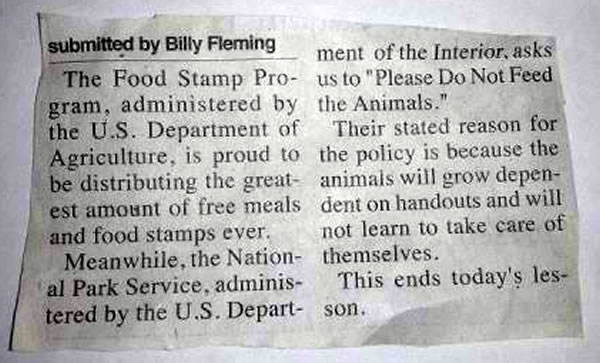
The appearance of this makes me wonder whether it was really printed in some newspaper and then clipped and copied. But maybe I’m too suspicious; it may have come from the Miller County Liberal in Colquitt, Georgia.

It’s a good reminder, regardless of its source.

And, no, the point is not that we’re treating poor people like animals. The point is that all animals, including people, respond to incentives.

For example, I know a woman who worked for years and made good money – over $100,000 per year in her last job. She’s married to man who’s doing very well in his engineering career. (He earns more than she was earning.) Their children are grown. So when she lost her last job, it was a loss of income but couldn’t be considered a hardship by any means. Nonetheless, she collected unemployment compensation while she was eligible just because it was available. (I don’t believe she was actually planning to return to work but I may be wrong about that.)

And another point is that the USDA seems to be in overdrive these days about enrolling as many as possible in its food stamp programs. To me, that looks more like a bureaucracy trying to expand its empire than a compassionate agency taking care of needy people.

Penn Jillette wrote, "Helping poor and suffering people is compassion. Voting for our government to use guns to give money to help poor and suffering people is immoral self-righteous bullying laziness." In other words, people have responsibilities.

So Amen, Mr. Fleming.

Tip o’ the hat to Jeff G.

h1

You lose some, you win some (2)

June 29, 2012

Here’s an interesting article about jury nullification, prompted by a new law in New Hampshire, the Live Free or Die state. (Is that the best state motto or what?)

Jury nullification, like many things, is a two-edged sword. My guess is that O.J. Simpson’s acquittal for the murder of his wife was a case of jury empathy — the flip side of white juries in the Deep South which refused to convict those who assaulted or murdered blacks.

But on the whole, I think it’s good for juries to keep their options in mind. They can judge the law and its application as well as the case against the accused people.

Jury Nullification Law Signed by New Hampshire Governor

June 27, 2012 @ 4:27 PM by Tim Lynch

With all the buzz and anticipation surrounding the final rulings by the U.S. Supreme Court the past week, there has been little attention to an interesting legal development in New Hampshire: On June 18, Governor John Lynch (no relation) signed HB 146 into law and it becomes effective on January 1, 2013. HB 146 concerns “the right of a jury to judge the application of the law in relationship to the facts in controversy.” It’s popularly known as “the jury nullification bill.” In this post, I will try to explain what impact this new law may have in the New Hampshire courts.

By way of background, Cato co-published the most comprehensive book on this subject back in 1998, Jury Nullification: The Evolution of a Doctrine by Clay Conrad. So pick that up if you’re interested in the full legal and historical treatment. If you’re not ready for the book, do check out this book review by University of Tennessee law professor Glenn Reynolds.

For purposes of this post, I am going to sidestep the question of whether or not jury nullification is a good idea. My purpose is not to “make the case for HB 146.” Rather, my purpose is to briefly explain what jury nullification is, provide a very brief history of the law on that subject, and, finally, explain how the recently enacted statute in New Hampshire may alter existing law and practices there.

h1

Heh

June 24, 2012

The Obama Event Registry idea is so sketchy that it has its own Snopes page.

Via Instapundit

Further chuckles: Nick Gillespie has 5 Great Gifts to Send Obama in Lieu of Cash Contributions

h1

You can’t make this stuff up

June 23, 2012

In a theoretical sense, this recent decision by the European Court of Justice strikes me as propagating an injustice because it spreads some peoples’ misfortunes to everyone else. Whatever happened to being responsible for your own problems, the Stiff Upper Lip, and similar attitudes?

But in more practical terms, just think of all those who’ll be gaming the system. File a sick claim during a vacation and cop another month or so of time off. I’m sure there are plenty of doctors who’ll be willing to document the severity of your illness – with a little of the old quid pro quo.

Then think of how little surplus European countries have left in their economies to pay for this type of regulatory nonsense. Here’s an article from the New York Times describing the court’s decision (which manages to ignore the fact that people respond to incentives).

On Vacation and Sick? A Court Says Take Another

BRUSSELS — For most Europeans, almost nothing is more prized than their four to six weeks of guaranteed annual vacation leave. But it was not clear just how sacrosanct that time off was until Thursday, when Europe’s highest court ruled that workers who happened to get sick on vacation were legally entitled to take another vacation.

“The purpose of entitlement to paid annual leave is to enable the worker to rest and enjoy a period of relaxation and leisure,” the Court of Justice of the European Union, based in Luxembourg, ruled in a case involving department store workers in Spain. “The purpose of entitlement to sick leave is different, since it enables a worker to recover from an illness that has caused him to be unfit for work.”

With much of Europe mired in recession, governments struggling to reduce budget deficits and officials trying to combat high unemployment, the ruling is a reminder of just how hard it is to shake up long-established and legally protected labor practices that make it hard to put more people to work and revive sinking economies.

Update: Via Samizdata, I ran across an article in The Telegraph about this decision. It’s titled It’s cruel European judges who are destroying jobs and contains some interesting paragraphs in it. Here are a couple:

[…] Of itself, this will not add much to the unemployment totals. Our government estimates that it could cost British employers around £100 million ($156 million – jhc) a year. Spread throughout the economy, that is an irritation, not a catastrophe. But it is an unnecessary irritation. It sends all the wrong messages. A violation of common-sense, it adds to the job-stroke which is having such serious consequences in most of the EU. It reinforces the impression which many employers have formed over the past few decades: that hiring workers is risky and should be avoided wherever possible.

[…]Since the 1950s, employers’ options have opened up. They can replace men with machines. They can dispense with highly paid and truculent first-world workers and relocate manufacturing to countries where the locals are cheaper, docile and grateful. This creates difficulties. Although the right to work is economic nonsense, any advanced society will wish to run its economy as near as possible to full employment. A few years ago, the US had achieved that, by making it easy for employers to hire and fire. As a result, American workers had far fewer rights than their European equivalents, but anyone who wanted a job could have two of them.


Update: My brother the postmaster writes, "This idea of being able to use sick leave if sick supposedly while on annual leave is not so remote after all, since it’s already in place in the U.S.P.S. union contracts, and is used by a few […] So, I assume it’s also in place for other U.S. government workers."

h1

The funniest thing I’ve seen today

June 22, 2012

On second thought, make that "the funniest thing I’ve seen this week".

(If you don’t get the honey badger reference, see this clip.)