
Matt Ridley writes about the (northern hemisphere) harvest season, both globally and on his own piece of land.
BUMPER HARVESTS RELEASE LAND FOR NATURE
This week’s autumn equinox is traditionally the time for the harvest festival. I have just taken a ride on the combine harvester cutting wheat on my farm. It is such a sophisticated threshing machine that long gone are the days when I could be trusted to take the controls during the lunch break. A screen showed how the GPS was steering it, inch-perfect and hands-free, along the edge of the unharvested crop; another screen gave an instant readout of the yield. It was averaging over five tonnes per acre (or 12 tonnes per hectare) — a record. […]
Last week, my fields were yielding 60 or 70 grains (seeds) of wheat for every grain that had been planted a year before. This would astonish our ancestors. A farmer in England in the 1300s was lucky to get four grains for every grain he planted. One of those four had to be saved for next year’s planting, leaving a precarious three to feed not only his own family but the various chiefs, priests and thieves who fed off him.
The truly surprising thing about this bounty is that not only are yields going up and up, in Britain as in the rest of the world, but that the amount of land required to produce that food is going down; and so is the amount of pesticide and fertiliser. Not just in relative terms, but in absolute terms. […]
At Mark Perry’s Carpe Diem blog, he links Ridley’s article and includes this image.

(Paul Ehrlich, please call your office.)
Update 10/22/15
Here’s a related graph which appeared yesterday at Carpe Diem.
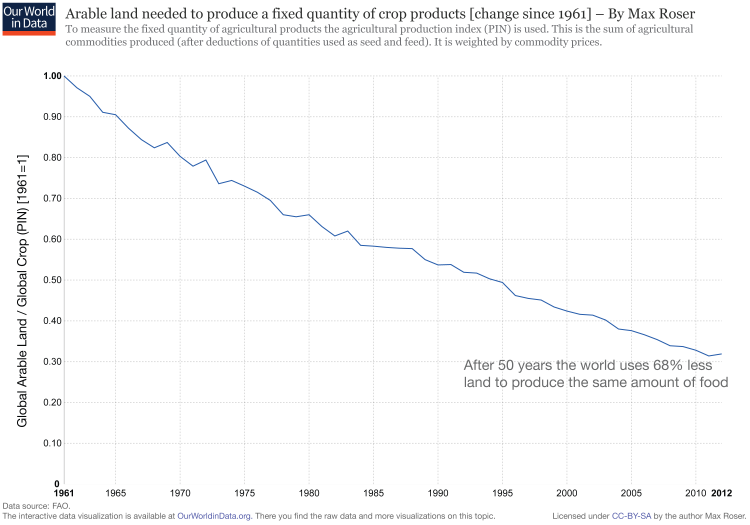
I’m not a farmer but I know a few. My guess is that one big factor driving this trend is the adoption of man-made fertilizers after World War II.
One fellow I know, who in his spare time helps his dad farm, told me that his dad recalls the days before anhydrous ammonia became available. Back then the only choice was to fertilize with manure and supplies of that were limited.

 No Truce With Kings