h1

Your papers, please! (2)

March 2, 2014

Paul sends a link to this article that appeared in an opinion blog at The Dallas Morning News site. The events happened about a year ago but this article was posted last Friday (2/28/14).

Electra’s a small town of about 2700 people that’s west of Wichita Falls and just south of the Oklahoma border.

Roadside adventures with small-town cops in Electra, Texas
By Rodger Jones/Editorial Writer

Here’s a YouTube that the Electra, Texas, convention and visitors bureau probably would like to see disappear from the firmament.

It shows what can happen when cops with a bad attitude come up behind you at night and end up accusing you of the bad attitude.

You can end up driving off with a couple of bogus tickets. Or, if you’re like the guy who produced the video, you can stand your ground and beat them at their own game.

Ask yourself how you would handle something like this. You can imagine these two cops were the overgrown bully-boys who had their way with the underclassmen in the high school locker room. Then someone gave them badges and guns.

The most chilling words you’ll hear in this episode came from the now-former city attorney, Todd Greenwood, who conceded there are hazards of getting caught up in a small town. Especially for outsiders. “Ever hear of the movie Deliverance?” he asked the out-of-towner. Creepy.

Later, Greenwood said: “What’s written in the Constitution is one thing, and the real practice is another, and you’re not in the same kind of protection as you have in Allen and Plano and Richardson and places like that.”

I can’t believe the guy actually said this knowing he was being recorded.

There was a development in this sad affair just this week. The city council declined to renew Greenwood’s contract. I can’t imagine why.

The man who made this video isn’t identified in this Morning News post nor in the post at The Defense Rests which was the Morning News‘ source.

All things considered, I think this man was pretty lucky. I kept waiting for the officers to haul him off to jail for not respecting their authoritah.

h1

A nice piece of work

March 2, 2014

Jason Murray describes & demonstrates a Gauss rifle he designed & built. He posts many of the design and construction details at his Delta V Engineering site. It’s a good write-up of a nicely done piece of engineering.

My younger son and I built a very simple, capacitor-driven Gauss gun for his science fair project some years back. It was on a much more limited scale than this one. We could fire small aluminum foil "bullets" a few yards; they might have knocked a fly out of the air (if we’d been able to hit one).

h1

Be afraid

March 1, 2014

The U.S. government keeps using its forfeiture laws to stack the deck against people it has accused but hasn’t yet convicted. All a prosecutor needs to do to financially cripple a defendant is to convince a grand jury to indict, usually a much easier job than convincing a jury to convict.

The Big, Bad Freeze

Justice for Kerri and Brian Kaley, the Supreme Court held Tuesday, is of the Alice in Wonderland variety: First comes the punishment—the seizure of all their assets—then the trial, and the crime last of all.* “But suppose they never committed the crime?” Alice asks. “It doesn’t matter,” comes the court’s answer, “because a grand jury said so.”

Writing for a six-justice majority in Kaley v. United States, thus concluded Justice Elena Kagan that a criminal defendant indicted by a grand jury has essentially no right to challenge the forfeiture of her assets, even if the defendant needs those very assets to pay lawyers to defend her at trial. In an odd ideological lineup, the dissenters were Chief Justice John Roberts and the more liberal Justices Stephen Breyer and Sonia Sotomayor.

The Kaleys’ saga began more than nine years ago when Kerri, a medical device salesperson, learned that she was under investigation by federal authorities for stealing devices from hospitals. Kerri admits she took some devices and later sold them with Brian’s help, but she says the devices she took were unwanted, outdated models that the hospitals were glad to be rid of—in effect, that she couldn’t steal something that was given to her. (It’s not a crazy argument. In fact, it worked for a co-defendant, who was quickly acquitted by a jury after the government failed to find even a single hospital that claimed ownership of the allegedly stolen goods.)

Since the court didn’t put a stop to this, it looks like it’s going to take an act of Congress.

See also Harvey Silverglate’s piece about this from last fall.

How Prosecutors Rig Trials by Freezing Assets
Is it fair to seize all a defendant owns without showing its criminal source? The Supreme Court will rule.

On Oct. 16, the Supreme Court will hear oral arguments on a claim brought by husband and wife Brian and Kerri Kaley. The Kaleys are asking the high court to answer a serious and hotly contested question in the federal criminal justice system: Does the Constitution allow federal prosecutors to seize or freeze a defendant’s assets before the prosecution has shown at a pretrial hearing that those assets were illegally obtained?


Update (3/8/14)

Ken White at Popehat describes the problem with this decision pretty concisely in this post from Feb. 27th.

The Kaley Forfeiture Decision: What It Looks Like When The Feds Make Their Ham Sandwich

Yesterday, in Kaley v. United States, the United States Supreme Court ruled 6-3 that a criminal defendant has no right to challenge the pretrial freezing of assets based on a forfeiture allegation in a grand jury indictment, even if the criminal defendant needs those very assets to pay his or her attorney of choice.

The question presented was not whether assets can be frozen before trial — it’s old news that they can — or whether they can be frozen even if it deprives the defendant of the ability to pay counsel. The question presented was whether the defendant could ask the judge to review the grand jury’s probable cause finding in the course of challenging the freeze. The Court found that the defendant had no such right, because of the trust we place in the grand jury: […]

Others […] have explained what this means: prosecutors can deprive you of the effective defense of your choice by aggressive use of forfeiture statutes. I have seen it done to my clients.

Rather than tread over the ground well-described by my colleagues in the criminal defense bar, today I’d like to describe something else for you: what a federal grand jury proceeding looks like. From 1995 through 2000, I presented cases of varying complexity to federal grand juries as a federal prosecutor in Los Angeles. That experience did not inspire confidence in the process. Rather, it taught me that the adage that a grand jury will indict a ham sandwich is an understatement. A better description would be that the prosecution can show a grand jury a shit sandwich and they will indict it as ham without looking up from their newspapers. The notion that the Supreme Court relies upon — that the grand jury has a “historical role of protecting individuals from unjust persecution” — is not a polite fiction. A polite fiction would have some grounding in reality. It’s an offensive fiction, an impudent fiction, a fiction that slaps you across the face and calls your mother a dirty bitch.

h1

Privacy today

March 1, 2014

Reason.tv interiews Ladar Levison about his Lavabit service and why he shut it down.

h1

The Snowden revelations continue

March 1, 2014

Glenn Greenwald writes at his new site (The Intercept) about more things he’s discovered in the documents leaked by Edward Snowden. RTWT.

How Covert Agents Infiltrate the Internet to Manipulate, Deceive, and Destroy Reputations

One of the many pressing stories that remains to be told from the Snowden archive is how western intelligence agencies are attempting to manipulate and control online discourse with extreme tactics of deception and reputation-destruction. It’s time to tell a chunk of that story, complete with the relevant documents.

Over the last several weeks, I worked with NBC News to publish a series of articles about “dirty trick” tactics used by GCHQ’s previously secret unit, JTRIG (Joint Threat Research Intelligence Group). These were based on four classified GCHQ documents presented to the NSA and the other three partners in the English-speaking “Five Eyes” alliance. Today, we at the Intercept are publishing another new JTRIG document, in full, entitled “The Art of Deception: Training for Online Covert Operations.”


This seems like just the place for this cartoon. (Click for a larger view at its source.)
5-stages-nsa

h1

Moore on AGW

March 1, 2014

On Wednesday, The Washington Times reported that Patrick Moore made a statement to a Senate committee this week.

Greenpeace co-founder says ‘no scientific proof’ humans cause climate change

A co-founder of Greenpeace told a Senate panel on Tuesday that there is no scientific evidence to back claims that humans are the “dominant cause” of climate change.

Patrick Moore, a Canadian ecologist who was a member of Greenpeace from 1971-86, told members of the Senate Environment and Public Works Committee environmental groups like Greenpeace use faulty computer models and scare tactics in further promoting a political agenda, Fox News reported.

Here’s Mr. Moore’s full statement (in PDF) from the Senate’s site.

Naturally, this caused some reaction on the ‘net. MediaMatters response is:

Who Is Patrick Moore? A Look At The Former Greenpeace Member’s Industry Ties And Climate Denial
Patrick Moore’s Climate Misinformation Is Nothing New

Conservative media are latching on to the climate change denial of Patrick Moore, who has masqueraded as a co-founder of Greenpeace. But Moore has been a spokesman for nuclear power and fossil fuel-intensive industries for more than 20 years, and his denial of climate change — without any expertise in the matter — is nothing new.

And at Watts Up With That, we have:

Confessions of a ‘Greenpeace Dropout’ to the U.S. Senate on climate change

Our friend Dr. Patrick Moore, co-founder of Greenpeace, went before the U.S. Senate yesterday to tell his story as it relates to global warming/climate change. It is well worth your time to read. WUWT readers may recall that since Dr. Moore has decided to speak out against global warming and for Golden Rice, Greenpeace is trying to disappear his status with the organization, much like people were disappeared in Soviet Russia.

I won’t try to argue my view of global warming since I’m no expert. It’s a very complicated topic and not all the experts agree. But I liked John Christy’s statement to the same Senate committee in August of 2012.

Christy and Roy Spencer maintain a dataset of satellite temperature measurements.

h1

Voluntourism

February 25, 2014

Jeff sends a link to Pippa Biddle’s interesting essay about tourist volunteers.

THE PROBLEM WITH LITTLE WHITE GIRLS (AND BOYS): WHY I STOPPED BEING A VOLUNTOURIST

White people aren’t told that the color of their skin is a problem very often. We sail through police check points, don’t garner sideways glances in affluent neighborhoods, and are generally understood to be predispositioned for success based on a physical characteristic (the color of our skin) we have little control over beyond sunscreen and tanning oil.

After six years of working in and traveling through a number of different countries where white people are in the numerical minority, I’ve come to realize that there is one place being white is not only a hindrance, but negative –  most of the developing world.

In high school, I travelled (sic) to Tanzania as part of a school trip. There were 14 white girls, 1 black girl who, to her frustration, was called white by almost everyone we met in Tanzania, and a few teachers/chaperones. $3000 bought us a week at an orphanage, a half built library, and a few pickup soccer games, followed by a week long safari.

Our mission while at the orphanage was to build a library. Turns out that we, a group of highly educated private boarding school students were so bad at the most basic construction work that each night the men had to take down the structurally unsound bricks we had laid and rebuild the structure so that, when we woke up in the morning, we would be unaware of our failure. It is likely that this was a daily ritual. Us mixing cement and laying bricks for 6+ hours, them undoing our work after the sun set, re-laying the bricks, and then acting as if nothing had happened so that the cycle could continue.

Basically, we failed at the sole purpose of our being there. It would have been more cost effective, stimulative of the local economy, and efficient for the orphanage to take our money and hire locals to do the work, but there we were trying to build straight walls without a level. […]

My wife once saw something similar years back when she accompanied one of our sons to Mexico, where he was part of a volunteer team to build a house. He was in the sixth grade at the time, so 10 or 11 years old. The project was to build a small, rectangular building with a pitched roof that was partitioned into two rooms. I believe its floor area was 300 – 400 square feet.

How much do the vast majority of school children know about building roof trusses? Very little, of course. But luckily there were people on hand who could fix the problems due to using unskilled children as carpenters. Since then I’ve always suspected that many of these efforts are frequently the triumph of good intentions over good sense.

Ms. Biddle concludes her essay with these words.

Before you sign up for a volunteer trip anywhere in the world this summer, consider whether you possess the skill set necessary for that trip to be successful. If yes, awesome. If not, it might be a good idea to reconsider your trip. Sadly, taking part in international aid where you aren’t particularly helpful is not benign. It’s detrimental. It slows down positive growth and perpetuates the “white savior” complex that, for hundreds of years, has haunted both the countries we are trying to ‘save’ and our (more recently) own psyches.

h1

Credo

February 23, 2014

I ran across Doug Mataconis’ blog Below The Beltway in late 2009. Apparently he stopped updating it in late 2011. Sometimes it takes me a while to get around to things, but I’d like to say how impressed I was by his blog’s tagline:

I believe in the free speech that liberals used to believe in, the economic freedom that conservatives used to believe in, and the personal freedom that America used to believe in.

How concise! If I were planning to run for office, I’d try to hire Mr. Mataconis to write speeches for me.

h1

The fire next door

February 23, 2014

I’ve been making my way through Ted Carpenter’s book The Fire Next Door. (If you follow that link, you’ll see that Mr. Carpenter is a Senior Fellow at the Cato Institute.)

The premises of the book are that:

(a) the US drug prohibitions are creating chaos in Mexico,
(b) this civil chaos is likely to cross the border into the United States, and
(c) drug prohibition should be repealed to de-fund the violent Mexican drug cartels.

The leaders of the Mexican drug cartels — the "drug lords" — have become wealthy from the black market profits due to prohibition. And they very reasonably have used their wealth to corrupt the Mexican police, Mexican prosecutors, and the Mexican military (when it’s been involved in drug law enforcement). The Spanish phrase Carpenter mentions repeatedly is plata o plomo, meaning "silver or lead". The drug cartels give police and prosecutors the choice of taking a bribe or taking a bullet, in other words.

Carpenter cites one case of a hardy Mexican prosecutor who refused the bribe and has avoided the bullet (so far). But the man had to relocate his family to the US to keep them from becoming pawns in his struggle with the cartels.


It gets worse. While the Mexican government denies it, Carpenter claims that the government has lost control of parts of Mexico where the cartel leaders have become de facto regional governments. Independent news report support Carpenter’s view. Here’s an article about that which appeared in the Wall Street Journal five years ago.

This loss of civil law enforcement has led to the rise of Mexican vigilante groups who fight the drug cartels on their own because the Mexican police don’t support them. Here’s a photo essay that appeared last month at Business Insider.

Intense Photos Of Mexican Vigilantes Battling A Drug Cartel For City Control

Mexico has long suffered blistering violence and crime at the hands of its homegrown drug cartels.

Though the Mexican government has waged war on the cartels, the effort has struggled to go anywhere. More than 90,000 people have died in the ongoing conflict.

Fed up with a corrupt police force that is often in bed with the cartels and a military that has to this point been ineffective, some Mexicans have taken it upon themselves to fight the cartels and protect their families — with an incredible conflict happening this week in the city of Paracuaro. […]

Over the last year, vigilante groups, known as fuerzas autodefensas have sprung up all over Mexico, particularly in the southwestern state of Michoacan, an area plagued by the Knights Templar cartel.

Here’s a picture I ran across recently of a Mexican vigilante (in the adelita tradition). Abuela, ¿qué tal?

Female Mexican vigilante


Yesterday the New York Times reported the arrest of El Chapo at Mazatlan. It’s a good article to get up to speed on the topic, if this is news to you.

El Chapo, Most-Wanted Drug Lord, Is Captured in Mexico

MEXICO CITY — Just before 7 a.m. on Saturday, dozens of soldiers and police officers descended on a condominium tower in Mazatlán, Mexico, a beach resort known as much as a hangout for drug traffickers as for its seafood and surf.

The forces were following yet another tip about the whereabouts of one of the world’s most wanted drug kingpins, Joaquín Guzmán Loera — known as El Chapo, which means “Shorty” — who had eluded such raids for 13 years since escaping from prison, by many accounts in a laundry cart. With an army of guards and lethally enforced loyalty, he reigned over a worldwide, multibillion-dollar drug empire that supplied much of the cocaine and marijuana to the United States despite a widespread, yearslong manhunt by American and Mexican forces. […]

Mexican marines and the police, aided by information from the United States Drug Enforcement Administration, immigration and customs officials and the United States Marshals Service, took him into custody without firing a shot, according to Mexican officials. […]

Mr. Guzmán faces a slew of drug trafficking and organized crime charges in the United States, which had offered $5 million for information leading to his arrest in the hopes of dealing a crippling blow to an organization that is the country’s top provider of illicit drugs.

Mr. Guzmán’s Sinaloa Cartel is considered the largest and most powerful trafficking organization in the world, with a reach as far as Europe and Asia, and has been a main combatant in a spasm of violence that has left tens of thousands dead in Mexico.

“Big strike,” said a Twitter posting by former President Felipe Calderón, who had made cracking down on drug gangs a hallmark of his tenure.

Note the involvement of the U.S. DEA and "American forces". The U.S. has agreements with Mexico to assist in the enforcement of drug prohibition laws. Also note that the DEA wants Mr. Guzmán for breaking U.S. laws.


It will be interesting to see the effects of this arrest. Mr. Carpenter documents in The Fire Next Door that the violence in Mexico usually increases when a drug lord is arrested. This happens because the leadership of a very profitable drug cartel is up for grabs and different factions will fight in the streets to claim it.

Is it not enough that drug prohibition has made war zones out of some of America’s inner cities, has created a whole gangsta sub-culture, and has given us a prison population that dwarfs that of most other countries?

Must we imperil our Central American neighbors with our prohibition policies too?

End the War on Drugs.

This seems like a good place for this video from the Drug Policy Alliance.

h1

The Health Care Special (4)

February 22, 2014

The reason I title these posts about Obamacare as I do is because when it kicked in I wanted to do a parody of Midnight Special about it. But that didn’t pan out.

Luckily, we have this parody of Dolly Parton’s 9 to 5 to fill the gap (from Reason.tv).

h1

Big Brother in the news

February 20, 2014

Here’s an interesting article in the Wall Street Journal by an FCC commissioner who complains about a new FCC initiative.

The FCC Wades Into the Newsroom

News organizations often disagree about what Americans need to know. MSNBC, for example, apparently believes that traffic in Fort Lee, N.J., is the crisis of our time. Fox News, on the other hand, chooses to cover the September 2012 attacks on the U.S. diplomatic compound in Benghazi more heavily than other networks. The American people, for their part, disagree about what they want to watch.

But everyone should agree on this: The government has no place pressuring media organizations into covering certain stories.

Unfortunately, the Federal Communications Commission, where I am a commissioner, does not agree. Last May the FCC proposed an initiative to thrust the federal government into newsrooms across the country. With its “Multi-Market Study of Critical Information Needs,” or CIN, the agency plans to send researchers to grill reporters, editors and station owners about how they decide which stories to run. A field test in Columbia, S.C., is scheduled to begin this spring.

The purpose of the CIN, according to the FCC, is to ferret out information from television and radio broadcasters about “the process by which stories are selected” and how often stations cover “critical information needs,” along with “perceived station bias” and “perceived responsiveness to underserved populations.”

H.T. Paul


Update

FCC throws out plan to question reporters about news coverage

The Federal Communications Commission has backtracked on a plan to ask journalists about news coverage decisions after protest from one of the commission’s members.

FCC Commissioner Ajit Pai, part of the commission’s Republican minority, wrote an op-ed in The Wall Street Journal on February 10 criticizing an FCC study on the news media. […]

Yesterday, FCC Chairman Tom Wheeler told staff to remove the offending questions, a commission statement today said.

h1

What’s going on in Venezuela

February 19, 2014

I’m a little surprised at how many posts I’ve written about Venezuela. It’s not as though I have any special interest in the country, but it’s certainly a textbook example of how things can go wrong under a Socialist government.

I don’t believe that the leaders of Venezuela are all socialists in good faith. I suspect that many of them are just thugs using socialism to legitimize the take-over of their country. It wouldn’t be the first that had happened.

There are peaceful, law-abiding socialist governments after all, so I don’t assume that the violence in Venezuela is solely due to socialism. And there are plenty of fascist tyrannies on the right; the left has no monopoly on civil violence.

But socialist or fascist, they’re all statists of one stripe or another. A leopard may change his politics daily but he never changes his spots.


It has mystified me since I was a teenager why people would give up control of anything else to the social agent which controls the guns — i.e., to a government which controls the police and military.

Why in the world would you trust that supreme armed authority in any country with controlling public media, or controlling an economy, or with managing the health care system? The temptations to corruption are so much stronger when the power is concentrated in the government.

That’s why I think socialist governments tend to encourage strong men and tyrants to take power. As I told a socialist friend of mine a few years ago, "When you go to bed with Karl, you’re likely to wake up with Uncle Joe."

Let’s look at the alternative: is the market always fair and even-handed? Hell no, it’s not. Some will rob you with a six-gun, and some with a fountain pen. Business people are no more angels than bureaucrats are. We’re always dealing with the crooked timber of humanity.

But dealing with a market at least leaves you with more alternatives than dealing with a government. Some particular business may give you ‘the business’, but it won’t send you to prison and it won’t conscript you (or your child) to fight in an unjust war.

h1

Follow the money

February 18, 2014

Here’s an interesting article by Radley Balko, based on a report about a state representative in Minnesota who’s learned an interesting lesson: Follow the money.

RTWT.

The drug war’s profit motive

Terrific reporting here from the Capitol Report, a small publication that covers politics and policy in Minnesota.

Minnesota state Rep. Carly Melin is trying to introduce legislation to legalize medical marijuana in the state, but she’s bumping up against some aggressive opposition from the state’s police agencies and law enforcement organizations, who have united behind a group called the Minnesota Law Enforcement Coalition.
It may at first seem odd that police groups would so vigorously oppose medical pot. These aren’t medical organizations. They have no clear stake in the debate over the drug’s potential therapeutic benefits. According to the article, the police groups say they’re concerned about public safety, but we’ve been living with medical pot for nearly 20 years now, and there’s no empirical data to support the contention that legal medical marijuana brings an increase in crime. If you’re a fan of public choice theory, you might argue that narcotics cops may oppose any move toward legalization because a decrease in the demand for and supply of illegal pot might mean a decrease in need for narcotics cops to police it. And of course there will always be a supply of and trade in other illicit drugs to keep them busy.

So why such strident opposition? Rep. Melin has discovered what drug policy reformers have been arguing for years: It’s about revenue. Police agencies have a strong financial incentive to keep the drug war churning.

h1

Ain’t nobody’s business

February 15, 2014

Here’s one of my favorite songs about practical libertarianism.

Bear in mind that I’m not advocating champagne, cocaine, candy, or liquor. Nor do I advocate questionable choices in automobiles. A pink Cadillac or a ’57 Merc? I’m thinking not. A ’61 Chrysler New Yorker, on the other hand? Now you’re talking; it was not only stylish, it would move. (Photo from Gasoline Girls.)

Anyone who knows me will tell you that I’m hardly a libertine. Though if I choose to be one, well, it ain’t nobody’s business but my own.

And that’s the whole idea in a nutshell. Like the man says.


While I’m on this topic, you might enjoy Rogier Bakel’s Nobody’s Business blog. Rogier named his blog after the late Peter McWilliams’ excellent book Ain’t Nobody’s Business If You Do. (That’s a link to an HTML version. Here’s a PDF version.)

h1

Venezuelan car markets, part 2

February 13, 2014

My last post about Venezuela concerned how the statists running the country were planning to micro-manage the used car market.

Here’s an article in USA Today about what they’ve done to the new car market (via Carpe Diem).

Venezuela car industry slips into idle

CARACAS, Venezuela — Leonardo Hernandez had hoped to buy a new car this year, ending nearly two years of waiting on various lists at different dealerships throughout the country.

Those hopes were dashed last week when Toyota Motor Co. said it would shut down its assembly operations in Venezuela due to the government’s foreign exchange controls that have crippled imports and made it impossible to bring in parts needed to build its vehicles.

The country’s other car manufacturers, including General Motors and Ford, haven’t even started operations this year, while waiting for needed parts to arrive.

“I desperately need a new car for work,” said Hernandez, who works as a salesman. “I have been waiting and waiting, and now this. I have no idea what I am going to do. And I can’t even find spare parts for the old car I have.”

Toyota joins a long list of companies saying they are having to curtail or stop operations in the South American country thanks to the government’s foreign exchange regime, which the late President Hugo Chavez created in 2003 to fight capital outflow.

h1

En la república bananera del norte (2)

February 12, 2014

Here’s an interesting report from Fox News (via Coyote blog).

FIRMS MUST SWEAR OBAMACARE NOT A FACTOR IN FIRINGS

Is the latest delay of ObamaCare regulations politically motivated? Consider what administration officials announcing the new exemption for medium-sized employers had to say about firms that might fire workers to get under the threshold and avoid hugely expensive new requirements of the law. Obama officials made clear in a press briefing that firms would not be allowed to lay off workers to get into the preferred class of those businesses with 50 to 99 employees. How will the feds know what employers were thinking when hiring and firing? Simple. Firms will be required to certify to the IRS – under penalty of perjury – that ObamaCare was not a motivating factor in their staffing decisions. To avoid ObamaCare costs you must swear that you are not trying to avoid ObamaCare costs. You can duck the law, but only if you promise not to say so.

h1

Snowden’s revelations

February 11, 2014

Here’s an interesting compilation at Lawfare. The catalog is pretty lengthy and may surprise you.

Catalog of the Snowden Revelations

This page catalogs various revelations by Edward Snowden, regarding the United States’ surveillance activities.

Each disclosure is assigned to one of the following categories: tools and methods, overseas USG locations from which operations are undertaken, foreign officials and systems that NSA has targeted, encryption that NSA has broken, ISPs or platforms that NSA has penetrated or attempted to penetrate, and identities of cooperating companies and governments.  Each entry includes the date the information was first published.

The page will be updated from time to time and is intended as a resource regarding Snowden and the debate over U.S. surveillance.  Comments and suggestions thus are welcomed, and should be sent to staff.lawfare@gmail.com.

In addition to this page, Lawfare has cataloged and summarized the FISA documents the government has declassified in response to the Snowden controversy in the Wiki Document Library.

h1

Remembering Kelo

February 9, 2014

An interesting retrospective on the Kelo Decision at the weekly Standard:

‘Kelo’ Revisited
Properties were seized and a neighborhood razed in the name of ‘economic development’ that never came

“See that pole with the transformer hanging from it?” Michael Cristofaro asked me. “That was where my family’s home was.”

I looked up at a line of high telephone poles marching diagonally against a blanched winter sky across a vast, empty field​—​90 acres​—​that was entirely uninhabited and looked as though it had always been that way. New London, population 27,000, a rundown onetime whaling port on the Atlantic coast that never recovered after the whaling industry died at the end of the 19th century, is a desolate-looking city. […]

Cristofaro and I were walking through a section of New London called Fort Trumbull, a fist-shaped peninsula jutting out into the Thames. It is the battleground of what must be the most universally loathed Supreme Court ruling of the new millennium, Kelo v. City of New London (2005). The case is named after its lead plaintiff, Susette Kelo, a nurse who had owned a home a few blocks away from the Cristofaro house. The Supreme Court voted 5-4 to uphold a Connecticut Supreme Court ruling that the city of New London and a nonprofit quasi-public entity that the city had set up, then called the New London Development Corporation (NLDC), were entitled to seize, in a process known as eminent domain, the homes and businesses of Kelo, the Cristofaros, and five other nearby property owners in the name of “economic development” that would generate “new jobs and increased revenue,” in the words of since-retired Justice John Paul Stevens, author of the majority opinion.

That is, the city and the NLDC were entitled to condemn and then bulldoze people’s homes solely in order to have something else built on the land that would produce higher property taxes​—​such as the office buildings, luxury condos, five-star hotel, spacious conference center, a “river walk” to a brand-new marina, and high-end retail stores that were part of an elaborate “economic development” plan for Fort Trumbull that the NLDC had launched in 1997. The Constitution’s Fifth Amendment bars governments from taking private property unless the taking is for a “public use.” Historically “public use,” as courts had interpreted it, meant a road, a bridge, a public school, or some other government structure. But in the Kelo decision, the High Court majority declared that “economic development” that would involve using eminent domain to transfer the property of one private owner to a different but more economically ambitious private owner​—​such as a hotel​—​qualified as a public use just as much as, say, a new city library.

h1

Things That Make You Go Hmmm… (2)

February 9, 2014

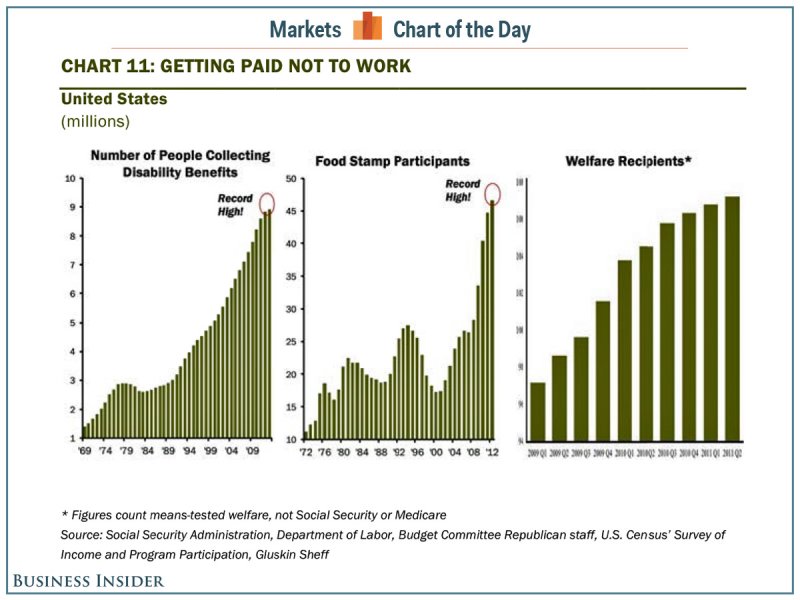
From Business Insider’s "Chart of the Day" post on February 6.

business-insider-disability-welfare-food-stamps

The Stunning Rise Of Disability, Food Stamp And Welfare Benefits

In the wake of the financial crisis and great recession, the U.S. unemployment rate has tumbled precipitously from 10.0% to 6.7% in just four years.

“Only three other times in the past six decades has the unemployment rate fallen this far this fast: in the early 1950s, when growth averaged 6.7% per annum; in the late 1970s when GDP growth averaged 4.8%, and in the mid-1980s when growth averaged 5.2%,” said Gluskin Sheff’s David Rosenberg to the U.S. Senate Budget Committee.

“Today we accomplished this feat with only 2.4% growth which is disturbing because it means that it is not taking much in the way of incremental economic activity to drain valuable resources out of the labor market.”

Much of the decline in the unemployment rate has been due to the drop in the labor force participation rate (LFPR). And the drop in the LFPR has been due to a combination of aging demographics and an expanding group of discouraged workers walking away from the job market.

h1

A real WTF moment

February 9, 2014

I have no idea what went on in this story, but I have to wonder if the CHP officer felt that Mr. Gregoir wasn’t respecting his authoritah.

The story (and video) via The Blaze.

‘Ridiculous’: How a Firefighter Ended Up in Handcuffs While Helping Victims at Scene of Serious Car Accident

While responding to a Tuesday night rollover accident in Chula Vista, Calif., a police officer and firefighter got into a dispute over where the fire engine should park. It ended with the uniformed firefighter in handcuffs.

The California Highway Patrol officer reportedly ordered the firefighter, identified as Jacob Gregoir, to move the fire engine off the center divide or he would be arrested. As he worked the scene and checked the overturned car for more victims, he reportedly told the unidentified officer that he would have to check with his captain.

That’s when the officer decided to detain the firefighter instead.

According to UT San Diego, Gregoir — a fire service veteran of more than 12 years — parked the truck behind an ambulance to provide protection to the emergency responders from oncoming traffic. This is apparently a standard safety procedure fire crews are taught.