h1

The 50 to 1 project

May 5, 2013

Here’s an interesting project at indiegogo to document "the true cost of ‘action’ on climate change" using the IPCC’s own figures.

Topher has raised about 20% of his $130,000 goal with 23 days left.

This project is being administered by the Lord Monckton Foundation (that web site appears to have been launched very recently). Lord Monckton, of course, is the self-described “high priest” of climate skepticism (PDF).

I think this is a good idea and is way over due. It’s easy to wish for everything when you never count the cost of anything.

Tip o’ the hat to sailor Jeff

h1

Unpopular people

May 5, 2013

This is another video by the Australian who goes by Topher. It’s from his ‘Forbidden History’ series and talks about the costs and benefits of freedom of speech – particulary in Australia.

Anyone remember Semmelweis?

In February, I posted another clip from that series which was about taxes.

h1

What he said (2)

May 2, 2013

I lifted this short post from the always-worth-reading Coyote Blog.

Can’t Anyone be Consistent?

I am just floored that Conservatives, who very very recently argued that the act of one bad guy at Newtown should not be used to limit the rights of tens of millions of legal gun owners, are now arguing that the acts of two bad guys (Tsarnaev’s) SHOULD be used to limit the rights of tens of millions of peaceful immigrants.

h1

Probity for thee, but not for me

April 30, 2013

News from Techdirt:

Congress Quickly And Quietly Rolls Back Insider Trading Rules For Itself

In November of 2011, the TV show 60 Minutes did a big expose on insider trading within Congress. While everyone else is subject to basic insider trading rules, it turned out that members of Congress were exempt from the rules. […] Of course, after that report came out and got lots of attention, Congress had to act, and within months they had passed the STOCK Act with overwhelming support in Congress to make insider trading laws that apply to everyone else finally apply to Congress and Congressional staffers as well. […]

Of course, here we are in 2013 and, lo and behold, it is no longer an election year. And apparently some of the details of the ban on insider trading were beginning to chafe Congressional staffers, who found it hard to pad their income with some friendly trades on insider knowledge.

So… with very little fanfare, Congress quietly rolled back a big part of the law late last week. […]

Because the best way to rebuild trust in Congress, apparently, is to roll back the fact that people there need to obey the same laws as everyone else. That won’t lead the public to think that Congress is corrupt. No, not at all.

h1

Sharing the awesome

April 27, 2013

Last fall I bought a new phone to check out Republic Wireless which was doing its beta roll out at the time. Since then, Republic has gone into full production mode and we’ve moved all the phones in our family to Republic.

Why? Well, because…

republic-wireless

The deal Republic offers is commitment-free service which includes all the voice, text and data you want to use. Pretty awesome — it was just the deal I’d been looking for the last couple of years. We reduced our household cellular bill by 50% when we switched to Republic plus we ended up with more services on all the phones.

The only downside to Republic’s deal is that you can only get the service on phones you buy from them. Those phones are Motorola Defy XTs, which are fully-featured Android smartphones. They’ve got good specs and they work great. I haven’t found an Android app that I can’t run on the Defy. But the Defy XT only comes in one size and it doesn’t have all the bells & whistles of a Samsung Galaxy S4 or an iPhone 5.

If you like the idea of full phone service at a great price with no contractual commitment (and you can live without the latest bells & whistles) then Republic’s deal can’t be beat.

Republic is offering incentives for new customer referrals. People I refer get a $19 credit – and so do I.

Check it out.

republic-wireless-2

(For more info about how Republic’s service works, here’s their What’s the catch? page.)

h1

Time for tar and feathers yet?

April 26, 2013

To see the Congress considering exempting itself from the burdens of a law it passed is just adding insult to the injuries imposed on us by the PPACA.

But that’s just what Politico reports.

Lawmakers, aides may get Obamacare exemption

Congressional leaders in both parties are engaged in high-level, confidential talks about exempting lawmakers and Capitol Hill aides from the insurance exchanges they are mandated to join as part of President Barack Obama’s health care overhaul, sources in both parties said.

Read the whole thing and you’ll see that members of Congress aren’t dummies. They can see the costs of PPACA as well as any business person can.

The difference is that the people in Congress weren’t smart enough to vote against PPACA when it came time to vote on it.


Update
Ezra Klein at The Washington Post writes that the Politico article was inaccurate:

No, Congress isn’t trying to exempt itself from Obamacare

There’s a Politico story making the rounds that says that members of Congress are engaged in secret, sensitive negotiations to exempt themselves and their staffs from Obamacare.

Well, they were secret, anyway.

The story has blown up on Twitter. “Unbelievable,” tweets TPM’s Brian Beutler. “Flat out incredible,” says Politico’s Ben White. “Obamacare for thee, but not for me,” snarks Ben Domenech. “Two thumbs way, way down,” says Richard Roeper. (Okay, I made the last one up).

If this sounds unbelievable, it’s because it is. There’s no effort to “exempt” Congress from Obamacare. No matter how this shakes out, Congress will have to follow the law, just like everyone else does.

Based on conversations I’ve had with a number of the staffs involved in these talks, the actual issue here is far less interesting, and far less explosive, than an exemption. Rather, a Republican amendment meant to embarrass Democrats and a too-clever-by-half Democratic response has possibly created a problem in which the federal government can’t make its normal contribution to the insurance premiums of congressional staffers.

h1

Maggie in the House

April 8, 2013

RIP, the Right Honourable the Baroness Thatcher.

h1

Earth Hour revisited

March 21, 2013

Bjørn Lomborg writes about Earth Hour in an article that’s worth your time.

Earth Hour Is a Colossal Waste of Time—and Energy
Plus, it ignores how electricity has been a boon for humanity.

On the evening of March 23, 1.3 billion people will go without light at 8:30—and at 9:30, and at 10:30, and for the rest of the night—just like every other night of the year. With no access to electricity, darkness after sunset is a constant reality for these people.

At the same time, another 1 billion people will participate in “Earth Hour” by turning off their lights from 8:30-9:30.

The organizers say that they are providing a way to demonstrate one’s desire to “do something” about global warming. But the reality is that Earth Hour teaches all the wrong lessens, and it actually increases CO2 emissions. Its vain symbolism reveals exactly what is wrong with today’s feel-good environmentalism.


And here’s an interesting video in a similar vein.

h1

In a nutshell

March 14, 2013

On Tuesday this week, I was reading an article in the Post-Dispatch: Missouri motorcyclists could go helmet-free in August under proposal. State Rep. Delus Johnson (R-St. Joseph) was proposing a "helmet holiday" during the month of August, primarily to avoid discouraging motorcycle tourists from visiting Missouri.

Like 19 other states in the U.S., Missouri requires all motorcycle riders to wear a helmet. The only two states that don’t require any riders to wear helmets are our neighbors, Illinois and Iowa. (The other 29 states require helmets based on the rider’s age.) I remember riding my first motorcycle in Illinois without a helmet. It was fun.

The article piqued my interest since I still ride a bike. It would be nice to ride without a helmet occasionally even though I appreciate the increased risk. There’s always the hope the "helmet holiday" might become year-long.

But what caught my eye in this article was a comment by another state representative. Mike Colona (D-St. Louis) countered: “There is no constitutionally guaranteed right not to wear a helmet.”

There’s the problem in a nutshell. Mr. Colona seems to believe that the Constitution is intended to govern the behavior of citizens. Worse, he seems to think that if it’s not called out in the Constitution, then it can’t be allowed. A sort of "Everything that isn’t forbidden is compulsory" type of system.

Here’s a news flash, Representative: the Constitution is intended to govern the behavior of the government. Back to Civics class, dude.

It was a really lame argument. He’d might as well have said, “There is no constitutionally guaranteed right to jaywalk” for all the sense that makes. There are no constitutional questions regarding the vast majority of state laws.

This is Missouri, Rep. Colona, and you need to show me why the state should be able to regulate its citizens in some way. It won’t do to say that we "have no right" to avoid some regulation.

h1

An interesting bit of local history

March 4, 2013

I’ve read a little about the Battle of Athens (Tennessee) but this is the first time I’ve seen a video about it.

Via Clayton Cramer

h1

And I’m calling BS on that

March 1, 2013

Via Facebook.

sequester-catastrophe-2


The White House is fear-mongering.

Noonan: Obama Is Playing a New Game

Everyone has been wondering how the public will react when the sequester kicks in. The American people are in the position of hostages who’ll have to decide who the hostage-taker is. People will get mad at either the president or the Republicans in Congress. That anger will force one side to rethink or back down. Or maybe the public will get mad at both.

The White House is, as always, confident of its strategy: Scare people as much as possible and let the media take care of the rest. Maybe there will be a lot to report, maybe not, but either way the sobbing child wanting to go to Head Start and the anxious FAA bureaucrat worried about airplane maintenance will be found.


Why we’re doomed.

All Of This Whining About The Sequester Shows Why America Is Doomed

If we can’t even cut federal spending by 2.4 percent without much of the country throwing an absolute hissy fit, then what hope does America have? All of this whining and crying about the sequester is absolutely disgraceful. The truth is that even if the sequester goes into effect, the U.S. government will still take in more money than ever before in 2013 and it will still spend more money than ever before in 2013. So it is a bit disingenuous to call what is about to happen “a spending cut”, but for the sake of argument let’s concede that point. Even if the budget really was being “cut” by 85 billion dollars, that only would only amount to a “cut” of 2.4 percent to federal spending. It would barely make a dent in the federal budget deficit for 2013.

h1

What he said

February 26, 2013

Mencken-on-freedom

Via Maggie’s Farm

h1

Ba da bing, ba da boom

February 24, 2013

I had a funny e-mail yesterday from a former workmate who’s been cruising the eastern U.S. coast aboard s/v Far Niente.

At a bar tonight in the Keys I heard a bartender ask a middle aged Hispanic-looking gentleman if he wanted to run a tab. He replied yes.

“What name should I put it under?” she asked.

“Barack Obama.” Then he added, “That way somebody else will pay for it.”

He got high fives from several patrons who overheard the exchange. I will now use that tactic any time someone asks my name.

h1

Counting the cost

February 21, 2013

A bit long but worth the time.

Via Coyote Blog

h1

Gun control laws

February 15, 2013

Since I’m fairly cynical about politicians in general, all their to-do about gun control in the wake of the Newtown school shootings is just business as usual, IMO. Politicians will exploit any calamity or crisis to pander to voters and/or to keep their names and faces in the media stream.

Feh.

Dan Mitchell has written frequently about the gun control topic and he had a good column yesterday titled Another Honest Liberal Writes about Gun Ownership and Second Amendment Rights.

Like Dan, I find peoples’ faith in gun control laws easily satirized since it seems so amazingly naive. This image is a good example.

gun-laws-smokes-pot

But the best parody of this faith-in-laws attitude is this clip I found at Dan’s site.

.

h1

Labels

February 12, 2013

I try to limit the number of Milton Friedman clips here, lest they overwhelm everything else. (I don’t see many I don’t like, in other words.) This one’s worth making an exception.

h1

Happy Anniversary

February 3, 2013

Here’s the start an op-ed piece by Ryan Ellis, tax policy director at Americans for Tax Reform. There’s some interesting history in it.

The income tax: A century of bigger government

On February 3, 2013, taxpayers will celebrate a very dubious centennial: the 100th anniversary of the Sixteenth Amendment’s ratification. The Sixteenth Amendment gives Congress the power to levy income taxes.

We can derive a couple of lessons from this somber occasion.

First, taxes which are foisted upon us by politicians with the promise that they will only be assessed on “the rich” will eventually fall on much of the population, including the poor.

Second, higher taxes lead to more government spending and even more and higher taxes.

Update (2/4/13). Dan Mitchell chimes in

The 100th Anniversary of the Income Tax…and the Lesson We Should Learn from that Mistake

[…] Let’s not get bogged down in details. The purpose of this post is not to re-hash history, but to instead ask what lessons we can learn from the adoption of the income tax.

The most obvious lesson is that politicians can’t be trusted with additional powers. The first income tax had a top tax rate of just 7 percent and the entire tax code was 400 pages long. Now we have a top tax rate of 39.6 percent (even higher if you include additional levies for Medicare and Obamacare) and the tax code has become a 72,000-page monstrosity.

But the main lesson I want to discuss today is that giving politicians a new source of money inevitably leads to much higher spending.

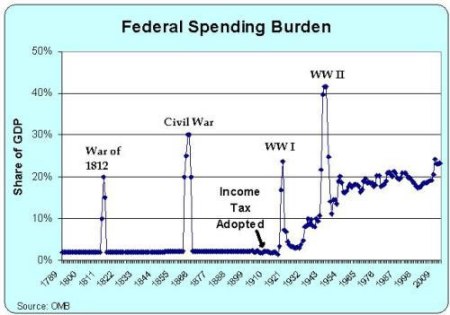
Here’s a chart, based on data from the Office of Management and Budget, showing the burden of federal spending since 1789.

Since OMB only provides aggregate spending data for the 1789-1849 and 1850-190 periods, which would mean completely flat lines on my chart, I took some wild guesses about how much was spent during the War of 1812 and the Civil War in order to make the chart look a bit more realistic.

But that’s not very important. What I want people to notice is that we enjoyed a very tiny federal government for much of our nation’s history. Federal spending would jump during wars, but then it would quickly shrink back to a very modest level – averaging at most 3 percent of economic output.

US-spending-vs-GDP

So what’s the lesson to learn from this data? Well, you’ll notice that the normal pattern of government shrinking back to its proper size after a war came to an end once the income tax was adopted.

h1

Things That Make You Go Hmmm…

January 12, 2013

A fellow I used to work with 25+ years ago sent me a long-time-no-see message a few days before Christmas. It was good to hear from him and we swapped news about people we knew back when.

He and his wife left Missouri for Silicon Valley in the late 1980s. Last year they decided to retire to Tulsa. I asked him, "Why Tulsa?" and his response set me to speculating how his voting choices while living in California had affected his retirement options.

Retiring in California is expensive, so we looked for some place in the Midwest with mild winters […] and Tulsa seemed to be a nice size […]. It is a bit conservative, I raked leaves with my “Oklahomans for Obama” T shirt, the neighbors leave us alone now.

Taxes aren’t the only factor in the cost of living, but here’s Calfornia’s rank in taxes among the 50 states. And that’s not to mention the on-going threat of municipal bankruptcies and the multiple pension crises which are likely to keep California’s tax rates high.

I didn’t ask my old workmate how he’d voted in California. But I’d bet dollars to donuts that he’d voted for the party that’s controlled the state for the last 40 years.

That’s the party that now has a "supermajority" in the California legislature, with plans to revisit Proposition 13. Some of us recall that Proposition 13 in 1978 was hailed as the start of a "national taxpayers’ revolt." We’ll see how long it lasts.

h1

If you want peace, work for justice

December 27, 2012

Here’s Nolan Finley writing in The Detroit News about a note from a reader named Jon Taub. (As a side note, I’d like to know where they can get milk for $2.50/gallon. It’s a dollar more where I live.)

Tax code milking cash cow dry

[…] Taub applies that same formula to a purchase of a gallon of milk, which currently sells for $2.49 at Kroger, to see what would happen.

“If every U.S. taxpayer purchased a gallon of milk, each person would pay $2.49, and the total cost would be 140.5 million times $2.49 — or $349 million.

“Now let’s assume the government treated milk like government services and determined its price the same way it determines tax rates. The pricing would change as follows:

“When the bottom 40 percent of earners buy their milk, they won’t pay a dime for it. In fact, the government would give them $1 in reverse payments for every gallon of milk they purchase. The total cost of providing one gallon of milk to each person in this group would be $196.1 million.

“The cost of providing milk to the remaining 60 percent of the taxpayers would be $209.9 million, bringing the total cost burden of all taxpayers’ milk to $406 million.

“Under our existing tax rates, instead of paying $2.49 a gallon, the top 1 percent of earners would pay 38 percent of the total milk burden or $109.81 for a gallon of milk.” […]

Taub urges everyone to think about that example whenever they hear President Barack Obama talk about tax fairness, as they will incessantly over the next few weeks.

The current tax system is unfair, but not because the wealthy don’t pay enough.

It’s out of whack because it doesn’t acknowledge that the rich are paying more for their government milk than it’s worth so most others can pay less. And instead of saying thank you, we’re milking those cash cows dry.

As we’ve noted here more than once, the US tax code doesn’t tax the rich too lightly — it taxes the everyone else too lightly. I believe most European countries are more equitable in taxing lower income earners, though their tax rates are no more "progressive" than the US tax rates.

That’s not to say that wealthy US citizens can not or do not hire accountants and lawyers (and some times lobbyists) to work the loopholes or to make new loopholes. But what loopholes in tax code indicate is a corrupt government. To be equitable, the income tax code should be across-the-board, simple and without loopholes.

Ask your congressman why it’s not.

h1

From the bottom up

December 22, 2012

I think it would be hard to find a more graphic example of spontaneous order. (That’s not to say there aren’t equally good examples; farm cooperatives come to mind.)