h1

Infinite loop

December 9, 2016

I found this pretty amusing.

Years ago, a partner of mine wrote a very simple BASIC program he called Kneel.

10 GOTO 10

He ran it on a client’s DEC VAX (with admin privilege) and it brought the machine to its figurative knees. In fact, the machine operators had to cycle power on the VAX to recover. That was sort of a big deal because it was a time-share system and all its users were locked out of the system until it had been restarted.

I’m guessing he was pretty bored that day.

h1

What he said (11)

December 9, 2016

John Stossel wrote an op-ed and closed it with this:

I don’t want a “strong leader.” I want a president of this constitutional republic to preside over limited government and leave us free to lead our own lives.

h1

The State is not your friend (2)

December 7, 2016

This interesting article at The Economist comes via Paul B. Everyone knew that travelers’ luggage was being searched, but who knew there was an DEA-funded incentive program?

This stuff won’t stop until the legal theft we call civil asset forfeiture is outlawed and we put an end to the War on Drugs.

Transport employees in America were secretly paid by the government to search travellers’ bags

THERE are many reasons why you might have been stopped at an American transport hub and your bag searched by officials. You might have be chosen at random. Perhaps you matched a profile. Or you could have been flagged by an airline, railroad or security employee who was being secretly paid by the government as a confidential informant to uncover evidence of drug smuggling.

A committee of Congress heard remarkable testimony last week about a long-running programme by the Drug Enforcement Administration. For years, officials from the Department of Justice testified, the DEA has paid millions of dollars to a variety of confidential sources to provide tips on travellers who may be transporting drugs or large sums of money. Those sources include staff at airlines, Amtrak, parcel services and even the Transportation Safety Administration.

The testimony follows a report by the Justice Department that uncovered the DEA programme and detailed its many potential violations. According to that report, airline employees and other informers had an incentive to search more travellers’ bags, since they received payment whenever their actions resulted in DEA seizures of cash or contraband. The best-compensated of these appears to have been a parcel company employee who received more than $1m from the DEA over five years. One airline worker, meanwhile, received $617,676 from 2012 to 2015 for tips that led to confiscations. But the DEA itself profited much more from the programme. That well-paid informant got only about 12% of the amount the agency seized as a result of the his tips. […]

DEA delenda est

h1

Radioactive diamond "batteries"

December 4, 2016

This is an unexpected twist on an old problem based on research done at the University of Bristol (in the UK).

Via NewAtlas

Naturally I have to wonder how scalable this technology is. How much energy can be extracted from one of these diamond generators at a steady rate. Are we talking microwatt-hours, milliwatt-hours, watt-hours, or kilowatt-hours?

And, second, I have to wonder how many’eternal batteries we want out in the wild. How would you ever disable one of these if that were necessary?


Update 12/18/16:

Here’s an AMA session at Reddit about these batteries.

We are physicists from the University of Bristol, ask us anything about our ‘Diamond Battery’ made from nuclear waste & can last for 5k years

H.T. Paul B

h1

Crony-in-chief?

December 4, 2016

Peter Suderman writes an interesting column at Hit & Run about Trump, politics, and free markets.

Yes, We Should Worry About Donald Trump’s Business Conflicts of Interests—and His Whole Approach to the Interaction Between Government and Business

The president-elect was a crony capitalist businessman. Now he’s set to become a crony capitalist politician.

As a real estate developer, Donald Trump made and sought special deals designed to use the power of government to improve his personal bottom line.

The first building project he ever developed, the Grand Hyatt hotel in Manhattan, was completed using a multi-decade tax abatement obtained using his father’s connections. This was not a broad-based tax cut so much as a state-granted subsidy that granted Trump’s project the financial wherewithal to proceed. In 1994, Trump proposed that the city of Bridgeport, Connecticut, become a partner with him on a $350 million theme park project, allowing him to get access to land by declaring a number of businesses as condemned properties. Over the course of his career as a developer, he repeatedly pressured the government to use eminent domain to clear private property owners out of the way, including one instance in 1994 in which he requested that the government kick an Atlantic City widow out of her home in order to replace it with a limousine parking lot. While campaigning for president, he aggressively defended the use of eminent domain, calling it a “wonderful thing,” and describing it as necessary for construction projects that create jobs.

For Trump, this is not merely a business strategy. It amounts to a working theory of how government and the private sector should interact. And it is one that should worry anyone concerned about maintaining a fair and proper division between the state and the private sector. […]

He doesn’t believe that the government’s role is to set clear ground rules and let market competition work things out. […]

Remember all the well-deserved grief Obama took for Solyndra and Fisker?

Meet the new boss, same as the old boss…

h1

How crony capitalism works

December 2, 2016

Kevin Williamson has a good article about how Trump ‘saved’ jobs at a Carrier plant in Indiana. RTWT.

The Economic Stupidity of the Carrier Bailout

One particularly tough and indigestible nugget of talk-radio stupidity afflicting the guts of conservatism is the idea that there is some sort of fundamental difference between bribing a business with tax cuts and bribing it with a wheelbarrow full of cash. The Trump-Pence bailout of Carrier’s operations in Indiana provides an illustrative case. […]

Republicans might have had a little bit of a point in the question of general tax cuts: A tax cut and spending are different things, even if the budgetary effects are exactly the same.

But in the matter of industry-specific or firm-specific tax benefits of the sort extended to Carrier in Indiana, they do not have a leg to stand on. These are straight-up corporate welfare, ethically and fiscally indistinguishable from shipping containers full of $100 bills. […]

For Carrier’s accountant, any pecuniary benefit will do. So far as the bottom line is concerned, a $7 million tax credit is the same as a $7 million check or $7 million in Apple stock or $7 million in gold. It’s all +$7 million on the line where you want it. […]

This is a case of Frédéric Bastiat’s problem of the seen vs. the unseen. The benefits are easy to see, all those sympathetic workers in Indiana. The costs are born by sympathetic workers, too, around the country, and by their families and by their neighbors. But those are widely dispersed, so they are harder to see and do not hit with the same dramatic impact.

But the math is the math is the math. Trump and Pence are trying to sell you a free lunch, the same way the Keynesians and their magical spending multiplier do when they promise that government stimulus programs (Trump is pushing one of those, too) will somehow magically pay for themselves. […]

I suppose the good news for most of us is that the State of Indiana (and its taxpayers) will be the ones picking up the tab for this.

Bastiat’s That Which is Seen, and That Which is Not Seen.

h1

How a market works

December 2, 2016

This is an interesting story that I read on Dan Lewis’s Now I Know list. (Now I Know is worth a look, if you’re not already a subscriber.)

To set the scene: Herbert Dow, founder of Dow Chemical, came up with a new way to refine bromine in 1891. That was the good news; the bad news was that he got into a trade war with an international cartel when he tried to sell his bromine outside the U.S.

Here’s the bulk of Dan’s article, called The Bromine Gambit:

Before Dow came onto the bromine scene, a German government-backed cartel named the Bromkonvention had a monopoly on bromine. As Investopedia explains, the Bromkonvention “sold bromine at a fixed price of 49 cents per pound, but it would implement a predatory pricing strategy quickly, if challenged.” And Dow Chemical posed such a challenge.

Dow Chemical operated independently of the Bromkonvention, which didn’t make the Germans all that happy, but they were willing to coexist so long as Dow kept its bromine sales within the United States. And considering that Dow was selling bromine at 27 cents per pound — about 45% less than what the Bromkonvention priced it at in Europe — the Germans saw Dow as a real threat. So the Bromkonvention made a threat of their own: if Dow entered markets outside the United States, the Bromkonvention promised to use its huge supplies of bromine to force Dow out of business by selling it cheaply — below cost — in the States.

Dow called their bluff, selling bromine to England. And the Bromkonvention retaliated. The cartel began dumping bromine in America, offering it for sale at 15 cents per pound. Dow couldn’t compete, and it didn’t have any other products to make up for the shortfall. This put Dow’s business in jeopardy — in theory at least.

In practice? Something went wrong, at least from the perspective of the Bromkonvention. American demand for bromine went up, as expected, but by leaps and bounds — no matter how much bromine Bromkonvention sold there, it would sell out, and Dow was still able to find customers at its 27 cents/pound price point. Not only did Dow not go out of business, but it expanded. Dow began selling its bromine — still at 27 cents per pound — in Germany itself.

How was this possible? Instead of dropping its price to meet that set by the Bromkonvention, Dow became buyers, as Investors Business Daily (via the Indianapolis Recorder) explains: “[Herbert Henry Dow] had an agent secretly buy up hundreds of thousands of pounds of the cut-rate imported bromine.” And what do you do with that bromine? IBD continues: Dow would then “repackage [the cheap bromine] and export it back to Europe.”

The Bromkonvention, at first, wasn’t sure where the cheap European bromine was coming from; in that interim period, they also continued their price war against Dow and continued to lower the price in the U.S. (ultimately to 10 cents/pound). In the end, there wasn’t a price low enough to force Dow out of business, as Dow was well-enough capitalized to buy up the dumped bromine and arbitrage its way to success. (And besides, the Bromkonvention made it easier and easier by lowering the price.) A century plus later, Dow is still around; the Bromkonvention is long gone.

Dan writes that Dow Chemical had the capital reserves to buy up the "dumped" bromine. But I’ll guess that in this case it wouldn’t have been to hard to find speculators – or banks – willing to loan the money to buy the under-priced bromine.

h1

In that case, let the good times roll

December 1, 2016

Here’s a news item from New Zealand about a biology professor from the University of Arizona. (Mr. McPherson is a professor emeritus at Arizona.)

Humans ‘don’t have 10 years’ left thanks to climate change – scientist

There’s no point trying to fight climate change – we’ll all be dead in the next decade and there’s nothing we can do to stop it, a visiting scientist claims.

Guy McPherson, a biology professor at the University of Arizona, says the human destruction of our own habitat is leading towards the world’s sixth mass extinction.

Instead of fighting, he says we should just embrace it and live life while we can.

“It’s locked down, it’s been locked in for a long time – we’re in the midst of our sixth mass extinction,” he told Paul Henry on Thursday. […]

Where the hell is Julian Simon when we need him?

And check out Professor Curry’s talk that I mentioned recently.

h1

Was the election also a referendum on climate change?

November 27, 2016

A couple of days ago, I watched a video of Judith Curry talking about Climate Science and the Uncertainty Monster. Her presentation is long (and a little dry) but she brings up some interesting points.

One of the slides in Curry’s presentation was a map of state-by-state support for President Obama’s climate change programs. Here’s Curry’s map, captured from the video. (You can find a very similar map at ThinkProgress.)

curry-state-map

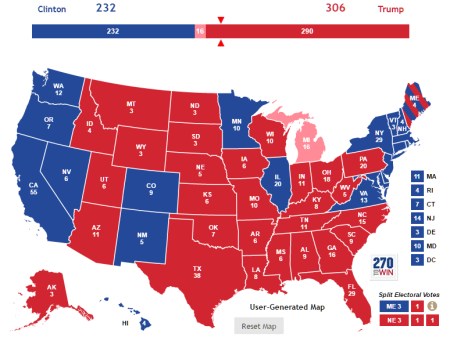
Look familiar? Here’s a map of Electoral College results (via 270toWin.com).

2016-election-results

I was struck by the correlation between the two maps, even though it’s not perfect.

Since the election, I’ve read any amount of commentary along the lines of "Trump’s victory means (fill in the blank)." The collection of opinions I’ve read reminds me of the elephant and the blind men. Everyone’s putting his own interpretation on the Trump elephant and frequently, I suspect, with little knowledge about Trump himself.

But I suppose you could add my interpretation here to that collection because what I’ve gathered from the people I know is that reaction to new Federal regulations under the Obama administration – climate change, among many others – was a factor in Trump’s win.

But back to the maps: It doesn’t surprise me that states whose governors & legislatures support active measures against climate change voted Democrat while those that don’t support those measures voted Republican. Before liberal readers begin buffing their halos as members of the Reality Party, though, it seems to me the Democrat support for action on climate change could have any number of explanations.

And that brings me to an article that John Tierney published in City Journal recently. I found Tierney’s article pretty interesting and you should RTWT. (My emphasis below.)

The Real War on Science
The Left has done far more than the Right to set back progress.

My liberal friends sometimes ask me why I don’t devote more of my science journalism to the sins of the Right. It’s fine to expose pseudoscience on the left, they say, but why aren’t you an equal-opportunity debunker? Why not write about conservatives’ threat to science?

My friends don’t like my answer: because there isn’t much to write about. Conservatives just don’t have that much impact on science. I know that sounds strange to Democrats who decry Republican creationists and call themselves the “party of science.” But I’ve done my homework. I’ve read the Left’s indictments, including Chris Mooney’s bestseller, The Republican War on Science. I finished it with the same question about this war that I had at the outset: Where are the casualties?

Where are the scientists who lost their jobs or their funding? What vital research has been corrupted or suppressed? What scientific debate has been silenced? Yes, the book reveals that Republican creationists exist, but they don’t affect the biologists or anthropologists studying evolution. Yes, George W. Bush refused federal funding for embryonic stem-cell research, but that hardly put a stop to it (and not much changed after Barack Obama reversed the policy). Mooney rails at scientists and politicians who oppose government policies favored by progressives like himself, but if you’re looking for serious damage to the enterprise of science, he offers only three examples. […]

The danger from the Left does not arise from stupidity or dishonesty; those failings are bipartisan. Some surveys show that Republicans, particularly libertarians, are more scientifically literate than Democrats, but there’s plenty of ignorance all around. […]

The first threat is confirmation bias, the well-documented tendency of people to seek out and accept information that confirms their beliefs and prejudices. In a classic study of peer review, 75 psychologists were asked to referee a paper about the mental health of left-wing student activists. Some referees saw a version of the paper showing that the student activists’ mental health was above normal; others saw different data, showing it to be below normal. Sure enough, the more liberal referees were more likely to recommend publishing the paper favorable to the left-wing activists. When the conclusion went the other way, they quickly found problems with its methodology. […]

And that brings us to the second great threat from the Left: its long tradition of mixing science and politics. To conservatives, the fundamental problem with the Left is what Friedrich Hayek called the fatal conceit: the delusion that experts are wise enough to redesign society. Conservatives distrust central planners, preferring to rely on traditional institutions that protect individuals’ “natural rights” against the power of the state. Leftists have much more confidence in experts and the state. Engels argued for “scientific socialism,” a redesign of society supposedly based on the scientific method. […]

(H.T. Jeff G)


Update 11/28/16: Here’s a more recent, post-election, column by Tierney. (My emphasis again.)

Trump and Science

What will a Trump administration mean for scientific research and technology?

The good news is that the next president doesn’t seem all that interested in science
, judging from the little he said about it during the campaign. That makes a welcome contrast with Barack Obama, who cared far too much — in the wrong way. He politicized science to advance his agenda. His scientific appointees in the White House, the Centers for Disease Control, and the Food and Drug Administration were distinguished by their progressive ideology, not the quality of their research. They used junk science—or no science—to justify misbegotten crusades against dietary salt, trans fats, and electronic cigarettes. They cited phony statistics to spread myths about a gender pay gap and a rape crisis on college campuses. Ignoring mainstream climate scientists, they blamed droughts and storms on global warming and then tried to silence critics who pointed out their mistakes. […]

Trump has vowed to ignore the Paris international climate agreement that committed the U.S. to reduce greenhouse emissions. That prospect appalls environmentalists but cheers those of us who consider the agreement an enormously expensive way to achieve very little. Trump’s position poses a financial threat to wind-power producers and other green-energy companies that rely on federal subsidies to survive. […]

h1

An interesting election analysis

November 25, 2016

Here’s was an interesting analysis from FiveThirtyEight.com, especially in light of the results announced by Michigan this week – and the fact that Michigan doesn’t use electronic voting.

Demographics, Not Hacking, Explain The Election Results

According to a report Tuesday in New York Magazine, a group of computer scientists and election lawyers have approached the Hillary Clinton campaign with evidence they believe suggests the election might have been hacked to make it appear that Donald Trump won the Electoral College when Clinton really did. The hacking claim appears to be based on concerns about tampering with electronic voting machines. We’ve looked into the claim — or at least, our best guess of what’s being claimed based on what has been reported — and statistically, it doesn’t check out.

There’s no clear evidence that the voting method used in a county — by machine or by paper — had an effect on the vote. Anyone making allegations of a possible massive electoral hack should provide proof, and we can’t find any. But it’s not even clear the group of computer scientists and election lawyers are making these claims. (More on this in a moment.)

The New York article reports that a group that includes voting-rights attorney John Bonifaz and computer scientist J. Alex Halderman presented findings last week about Wisconsin, Michigan and Pennsylvania to top Clinton campaign officials to try to persuade them to call for a recount. Exactly what those findings were isn’t clear. […]

But in a Medium post on Wednesday, Halderman said the New York article “includes some incorrect numbers” and misrepresented his argument for recounts. He laid out an argument based not on any specific suspicious vote counts but on evidence that voting machines could be hacked, and that using paper ballots as a reference point could help determine if there were hacks. “Examining the physical evidence in these states — even if it finds nothing amiss — will help allay doubt and give voters justified confidence that the results are accurate,” Halderman wrote. […]

I’ll admit that I’ve been pretty curious about how Trump pulled off his victory so I found this pretty interesting because of the rumors about people wanting recounts. I take 538 as fairly reliable non-partisan source – plus if the 538 guys were going to take sides, I doubt they’d take Trump’s.


Update:

Here’s a tweet that cuts to the chase from Nate Silver, editor-in-chief at 538.

It brings up an interesting point that I’ve wondered about. Why in the world did the Democrats nominate a person who was under investigation at the time of the convention? D’oh!

h1

#ExxonKnew in a Texas court

November 24, 2016

Here’s an update from Watts Up With That about the group of attorneys general who have issued subpoenas to ExxonMobil (and others). I first wrote about this last April in Sounds like a conspiracy to me.

Don’t mess with Texas – #ExxonKnew AG’s to be hauled into court

Judge to haul state AGs to Texas for deposition

A federal judge in Texas has ordered the attorney general of Massachusetts to appear for deposition next month in a lawsuit Exxon Mobil Corp. filed as part of an attempt to block investigations into what the company knew about climate change.

U.S. District Judge Ed Kinkeade ruled yesterday that Massachusetts Attorney General Maura Healey (D) and New York Attorney General Eric Schneiderman (D) should appear in Dallas on Dec. 13. The judge will enter a second order regarding Schneiderman’s deposition after he files an answer in the case.

Kinkeade issued the order one day after a telephone status conference with the parties.

It marks the latest victory for the oil giant in an escalating legal and political battle that has come under scrutiny by Republicans on the House Science, Space and Technology Committee, fossil fuel industry advocates and environmental groups. […]

The company alleged in a filing last week that the two attorneys general were “conducting improper and politically motivated investigations of Exxon Mobil in a coordinated effort to silence and intimidate one side of the public policy debate on how to address climate change” (ClimateWire, Nov. 14).

Both attorneys general participated in a news conference this spring, along with former Vice President Al Gore, in which they accused fossil fuel companies of committing fraud by lying about climate change science and announced a multistate effort to hold them accountable (Greenwire, March 29).

Kinkeade issued an order in mid-October suggesting that Healey may have acted in “bad faith” against the company. He pointed to comments made during the spring news conference as cause for “concern.” […]

If you’re not familiar with all this, check ExxonMobil’s statement about this case and the site exxonknew.org.

The parallel I drew in my last post about this – between ‘Big Tobacco’ and ‘Big Oil’ – is explicitly mentioned at ExxonKnew.org.

This case seems to target a single business with deep pockets that’s unpopular with many people. Why aren’t coal companies or electric utilities or commercial airlines or automobile makers included? So ExxonMobil’s claim of "politically motivated investigations" seems like a fair question at this point.

h1

Nice

November 21, 2016

Here’s a clip called Memories of Paintings from Thomas Blanchard. Full screen and high definition are recommended for this one.

The visual compositions have been created out of paint, oil, Oat milk and soap liquid.

If you’re interested in how this was done, see Making of ‘Memories of Paintings’

h1

Coming soon to a country near you?

November 18, 2016

Britain has passed the ‘most extreme surveillance law ever passed in a democracy’
The law forces UK internet providers to store browsing histories — including domains visited — for one year, in case of police investigations.

It’s 2016 going on 1984.

The UK has just passed a massive expansion in surveillance powers, which critics have called “terrifying” and “dangerous”.

The new law, dubbed the “snoopers’ charter”, was introduced by then-home secretary Theresa May in 2012, and took two attempts to get passed into law following breakdowns in the previous coalition government.

Four years and a general election later — May is now prime minister — the bill was finalized and passed on Wednesday by both parliamentary houses.

But civil liberties groups have long criticized the bill, with some arguing that the law will let the UK government “document everything we do online”.

It’s no wonder, because it basically does. […]

H.T. Paul B

What Britain needs is the Fourth and Fifth Amendments. And let’s hope those will protect the U.S. from laws like this.

You’ll need to read the article to learn about the features of this new law (the Investigatory Powers Bill). There’s a lot more to it than just storing your browser’s history.

Who knew that little DARPA project would turn into a gigantic honeypot?

Next up? Making civilian use of encryption illegal.

Since Britain is probably the place with the most CCTV cameras per person I suppose this isn’t too much of a surprise. Britons have been subject to everyday surveillance for years now.

And the Anglosphere has already been surveilling private communications — see Snowden’s documents about the Five Eyes alliance. This British law makes (some of) that surveillance legal, rather than surreptitious.

The only safe assumption is that there is no anonymity or privacy on any network.

Take it, John.

h1

Ain’t nobody got time for that 4th amendment

November 17, 2016

Paul B sends a link to this story – which is surprising, even by current standards.

The bad news is that Matthew Corrigan called the wrong suicide hotline. The D.C. police came to his house, he came out and ‘surrendered’ to them, then the cops broke into his house (without his permission) but found nothing. Five hours later, the police re-entered the house, tossed the place, and charged him with ten weapons and ammunition violations. All this without a warrant and without a compelling reason for either of the two searches.

The good news is that the police officers’ qualified immunity was stripped by the appeals court and Mr. Corrigan’s suit against them can proceed. Good for the DC Circuit Court of Appeals, I say.

But read the whole thing. (My emphasis below.)

Appeals Court To Cops: If You ‘Don’t Have Time’ For ‘Constitutional Bullshit,’ You Don’t Get Immunity

A disabled vet with PTSD accidentally called a suicide prevention hotline when intending to dial the Veterans Crisis Line. Within hours, he was dealing with DC Metro’s finest, dispatched to handle an attempted suicide. This brief quote from the DC Circuit Court of Appeals opinion [PDF] — part of veteran Matthew Corrigan’s first conversation with responding officers — sets the tone for the next several hours of Constitutional violations.

The officer who had asked for his key told him: “I don’t have time to play this constitutional bullshit. We’re going to break down your door. You’re going to have to pay for a new door.” Corrigan Dep. 94:15–18. Corrigan responded, “It looks like I’m paying for a new door, then. I’m not giving you consent to go into my place.” Id. 94:19–21.

This is as much respect as the responding officers had for Corrigan’s Constitutional rights. The rest of the opinion shows how they handled the supposed suicide case with the same level of care. […]

h1

The cost of political correctness?

November 11, 2016

These are a few interesting items I came across in the last two days about how the current atmosphere of political correctness may have affected Tuesday’s election.

What occasionally strikes me is that many organizations, including our government, are so invested in regulating diversity of race, sex, and gender that they’re doing so at the expense of diversity of opinion. The antidote to free speech you don’t like is more free speech, not less. Let speakers open their mouths and show themselves to be fools*.

Likewise, the antidote to those who break laws to harm people (or to damage property) is to prosecute them for those crimes. Allowing your government to increase penalties for hate crimes is just giving it power that it might someday use it against you — when a later set or governors decides to redefine "hate".

Robby Soave writes at Reason (my emphasis):

Trump Won Because Leftist Political Correctness Inspired a Terrifying Backlash
What every liberal who didn’t see this coming needs to understand

Many will say Trump won because he successfully capitalized on blue collar workers’ anxieties about immigration and globalization. Others will say he won because America rejected a deeply unpopular alternative. Still others will say the country is simply racist to its core.

But there’s another major piece of the puzzle, and it would be a profound mistake to overlook it. Overlooking it was largely the problem, in the first place.

Trump won because of a cultural issue that flies under the radar and remains stubbornly difficult to define, but is nevertheless hugely important to a great number of Americans: political correctness.

More specifically, Trump won because he convinced a great number of Americans that he would destroy political correctness. […]


Katherine Timpf at National Review had this to say:

Classes Being Canceled Because Trump Won Is Why Trump Won

So, Donald Trump won the presidential election, and colleges and universities around the country are predictably canceling classes and exams because students are predictably too devastated to be able to do their schoolwork.

It’s everywhere. […]

Reading all of these stories, I really have to wonder: Do any of these people realize that this kind of behavior is exactly why Donald Trump won? The initial appeal of Donald Trump was that he served as a long-awaited contrast to the infantilization and absurd demands for political correctness and "safe spaces" sweeping our society, and the way these people are responding is only reminding Trump voters why they did what they did. […]

The headline of Ms. Timpf’s article reminds me of the headline of Matt Taibbi’s article in Rolling Stone about Brexit: The Reaction to Brexit Is the Reason Brexit Happened.


Here’s Jonathon Pie (British comedian Tom Walker) with a hilarious rant about why he thinks Trump got elected – and why Brexit happened and why the Tories rule England. Mind the volume: the language gets a little salty.

The only comment I’ll add to this monologue is that in addition to being shamed by the dominant media stories of their opponents, potential Trump voters may also have been shamed by things Trump himself said or did. I’m guessing it got a little complicated for some of them.


Jonah Goldberg (also at NR) writes about priorities in the Democrat party:

The party of obsession with diversity forgot about bread-and-butter issues

[…] Liberals want to claim that racism explains it all. That’s a hard claim to square with the fact that a great many of the blue-collar counties that favored Barack Obama — the first black president, in case you hadn’t heard — by double digits also favored Trump by double digits.

The fact that so many liberals went straight to this explanation gives you a sense of why the Democrats lost the white working class in the first place. The Democratic party went crazy for issues that appeal to the new Democratic base: campus leftists, affluent cosmopolitan whites, and racial minorities.

One obvious example is diversity. There’s nothing wrong with placing a high value on racial, sexual, and gender inclusion. But Democrats have earned the reputation of being obsessed with it to the exclusion of bread-and-butter issues.

Moreover, by constantly invoking the primacy of identity politics for minorities and immigrants, they encouraged many whites to see themselves as an aggrieved racial or religious constituency. That genie will be hard to get back into the bottle. […]


*IMO, we’re all ‘Children of Eve’ and I don’t care whether you take that to mean the Evolutionary Eve, the Biblical Eve, or a figurative Eve of Enlightened Self-Interest on a global scale. Treat your cousins well.

h1

Word (2)

November 11, 2016

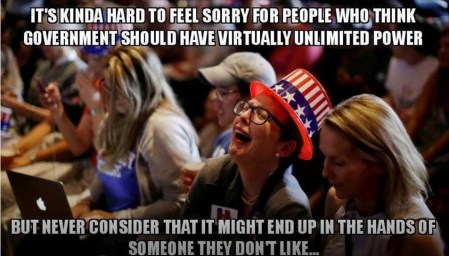
govt-power-someone-unliked

h1

Condescending attitudes (2)

November 10, 2016

Jeff G sends a link to this article at CBS News by Will Rahn, one of CBS’s political correspondents.

The unbearable smugness of the press

The mood in the Washington press corps is bleak, and deservedly so.

It shouldn’t come as a surprise to anyone that, with a few exceptions, we were all tacitly or explicitly #WithHer, which has led to a certain anguish in the face of Donald Trump’s victory. More than that and more importantly, we also missed the story, after having spent months mocking the people who had a better sense of what was going on.

This is all symptomatic of modern journalism’s great moral and intellectual failing: its unbearable smugness. Had Hillary Clinton won, there’s be a winking “we did it” feeling in the press, a sense that we were brave and called Trump a liar and saved the republic.

So much for that. The audience for our glib analysis and contempt for much of the electorate, it turned out, was rather limited. This was particularly true when it came to voters, the ones who turned out by the millions to deliver not only a rebuke to the political system but also the people who cover it. Trump knew what he was doing when he invited his crowds to jeer and hiss the reporters covering him. They hate us, and have for some time.


In a similar vein, here’s an amusing tweet from Dave Rubin:

rubin-media-wrong

h1

Who’d ha’ thought?

November 9, 2016

Like many – probably most – people in the U.S., I was surprised to learn this morning that Mr. Trump had won the election. I have to admit that I’d drunk the Kool-Aid: I believed the polls and the betting sites would predict the election’s outcome.

In fact, I’d wondered about why the odds weren’t more in Clinton’s favor at FiveThirtyEight.com. (Turns out the Huffington Post wondered too.) Now we both know. You could have knocked me over with a feather, as they used to say.

I ran across a lot of interesting reading this morning as journalists and bloggers wrote about their own surprise at the election results. Here’s a sampling (with my emphasis):

Margaret Sullivan in The Washington Post:

The media didn’t want to believe Trump could win. So they looked the other way.

To put it bluntly, the media missed the story. In the end, a huge number of American voters wanted something different. And although these voters shouted and screamed it, most journalists just weren’t listening. They didn’t get it. […]

Journalists — college-educated, urban and, for the most part, liberal — are more likely than ever before to live and work in New York City and Washington, D.C., or on the West Coast. And although we touched down in the big red states for a few days, or interviewed some coal miners or unemployed autoworkers in the Rust Belt, we didn’t take them seriously. Or not seriously enough. […]

(This sort of lends credence to Dana Loesch’s thesis, doesn’t it?)


Bret Stephens in The Wall Street Journal:

2016’s Big Reveal
Donald Trump is a demagogue. Period. The right’s failure to see it is a disgrace.

Someday, maybe, when I’m old and a child asks me what I remember about the awful election of 2016, I’ll say: It was the Big Reveal.

Revealed: That the guiding spirit of the modern conservative movement is neither Burke nor Lincoln. It’s Marx. “These are my principles,” Groucho once cracked, “and if you don’t like them, well, I have others.” Everything Republicans once claimed to advocate — entitlement reform, free trade, standing up to dictators, encouraging the march of freedom around the world — turns out to be negotiable and reversible, depending on Donald Trump’s whims and the furies of his base. […]


Caleb Howe at RedState (a typically Republican political blog):

TRUMPTASTROPHE

[…] So yes, you may consider this election a disaster, and you would be right. But you are wrong if you consider the disaster a surprise. We told you that both options were terrible. We told you that no matter who won, it would suck.

One of them won. It sucks. Nailed it. […]

Also from RedState, something I thought was pretty amusing:

The Canadian Government’s Immigration Site Crashed Tonight


Robby Soave at Reason’s Hit & Run:

Trump Gives Victory Speech, Liberals Rediscover Appeal of Limited Government
Has there ever been a more powerful case for limited government?

There hasn’t been a better case IMO. But I’m hoping, like Robby does, that the Democrats will get the drift this time.


But my favorite is by Sarah Baker, writing at The Liberty Papers:

Election 2016: Thoughts in the Aftermath

1. This is how libertarians feel after every election. We learn to live with it. So will you.

2. I believe in free trade. Trump doesn’t. I’m for a strong First Amendment. He isn’t. I want to reduce the size of government. He wants to make more of it. I think he’s divisive and mean and uniquely unfit to be president. He emboldens an unnerving group of racists, xenophobes and misogynists better relegated to the fringes. And since he will be serving with a Republican-controlled House and Senate, I won’t even get gridlock. […]

Like Ms. Baker, I was disappointed in the lack of gridlock.

And the "group of racists, xenophones and misogynists" she mentions seem to appear more and more frequently in Twitter feeds these days. See Identity Evropa, and Nathan Damigo, and (Trueborn) European Americans. They’re coming out of the woodwork, it seems. No need to "identify" further, folks. We’ve got the idea.


Finally, a little humor.

weiner-death-wish

And Madonna is probably very relieved.


Update 11/10/16:

A tweet from November, 2012 that Trump would probably like to forget:
trump-electoral-college

And Paul B sends a link to a post at Scott Adams’ blog: I Answer Your Questions About Predicting President Trump.

Man, am I glad I didn’t make any bets with Adams. I could be eating serious crow.

h1

Condescending attitudes

November 7, 2016

How many actions do you take that require an ID to complete? It’s a long list, right? Flying on a commercial carrier, cashing a check (even at your own bank), buying tobacco or alcohol, making practically any credit agreement (renting a car, a hotel room, or a house), entering an adult-only nightclub, picking up a prescription, and so on and so forth. I’m sure there are many others.

I’ve never understood the argument that requiring an ID for voting imposes a hardship on people. Voting is one of the few events when I think the state has a valid interest in verifying your identity.

I mean, I get that most people arguing against IDs for voting are making a partisan argument. But, seriously, who doesn’t have an ID already?

And if you do know someone without an ID, why not help them get one? Yes, I mean you – as in you, personally. Enough people being neighborly about this would solve the problem (to the extent there is one) pretty darned quickly.

Vote Yes on Missouri Amendment 6.


Update: (11/9/16): Amendment 6 was passed, 63% to 37%.

h1

Seems like a pretty safe bet

November 7, 2016

unpopular-incompetent-corrupt-low-character

https://twitter.com/joecarter/status/795735910075793409