Capitalism offers no grand vision of the future, for in an open market system the future is shaped not by the imposition of utopian blueprints, but by billions of people pursuing their own preferences.
In the early 80s, I worked at Tucson Electric for an engineer named Rich Ward. Rich had a fine phrase for describing needlessly complicated systems. “Complex and wonderful,” he called them.
The reformed health care system shown in this chart fits Rich’s description pretty well.
(Full version of the Senate’s Joint Economic Committee PDF here — with 10 pages of explanation. Q.E.D.)
Washington, D.C. – Four months after U.S. House Speaker Nancy Pelosi famously declared “We have to pass the bill so you can find out what’s in it,” a congressional panel has released the first chart illustrating the 2,801 page health care law President Obama signed into law in March.
Developed by the Joint Economic Committee minority, led by U.S Senator Sam Brownback of Kansas and Rep. Kevin Brady of Texas, the detailed organization chart displays a bewildering array of new government agencies, regulations and mandates.”
Is ObamaCare constitutional? “If you ask any constitutional law professor whether Congress can do something, the answer is always yes,” says Randy Barnett. But Mr. Barnett, who teaches legal theory at Georgetown, isn’t just any law professor. A self-described “radical libertarian,” he is the author of a 2004 book, “Restoring the Lost Constitution,” that argues for a fundamentally new approach to jurisprudence. […]
“If you’re talking about the regulation of economic activity, the presumption of constitutionality is for all practical purposes irrebuttable,” Mr. Barnett says. […]
“What is the individual mandate?” Mr. Barnett says. “I’ll tell you what the individual mandate, in reality, is. It is a commandeering of the people. . . . Now, is there a rule of law preventing that? No. Why isn’t there a rule of law preventing that? Because it’s never been done before. What’s bothering people about the mandate? This fact. It’s intuitive to them. People don’t even know how to explain it, but there’s something different about this, because it’s a commandeering of the people as a whole. . . . We commandeer people to serve in the military, to serve on juries, and to file a return and pay their taxes. That’s all we commandeer the people to do. This is a new kind of commandeering, and it’s offensive to a lot of people.”
I think Mr. Barnett points puts his finger on the point. The health care bill takes us another step closer to the Everything That’s Not Forbidden Is Compulsory state of affairs. Faced with the prospect of increasing health care costs, the solution proposed is for citizens to surrender a little more autonomy and accept more limits on their choices.
So I was very pleased to learn that Missouri voters had approved Proposition C this week.
ST. LOUIS • Missouri voters on Tuesday overwhelmingly rejected a federal mandate to purchase health insurance, rebuking President Barack Obama’s administration and giving Republicans their first political victory in a national campaign to overturn the controversial health care law passed by Congress in March.
“The citizens of the Show-Me State don’t want Washington involved in their health care decisions,” said Sen. Jane Cunningham, R-Chesterfield, one of the sponsors of the legislation that put Proposition C on the August ballot. She credited a grass-roots campaign involving Tea Party and patriot groups with building support for the anti-Washington proposition.”
I think Senator Cunningham is right that many – maybe a majority of – Missourians don’t want health care that’s managed by bureaucracy. But she overstates the result quite a bit since Proposition C only addressed the individual mandate part of health care reform act and not whether the bill as a whole would apply in Missouri. Further, the Proposition just expresses the Sense of the House. It doesn’t create a new law nor does it oblige the Missouri General Assembly to create such a law.
There was very little electioneering on Proposition C. I didn’t hear anyone advocating against it (or for it). I only saw a few small signs urging Yes votes and those didn’t appear until Election Day. I take this to mean that those who would normally be against it were ignoring it. Nobody was mobilizing the union members to canvas for its defeat, for example. (Such mobilization is common in St. Louis during many elections.)
As if to illustrate the complaint in my About page that all three branches and both major parties are all agents of expanding government, here’s some interesting commentary at National Review Online. (Click the graph to embiggen.)
Sen. Mitch McConnell, the Republican majority leader, sounds like a reasonable guy when he says that Republicans aren’t against extended unemployment benefits, but merely want them offset with spending cuts elsewhere in the budget. In some circles, that’s the very definition of moderation: I’ll go along with your program, but you have to find the savings.
Don’t buy it.
[…]
Check out the spending under your guys, Senator McConnell. Notice how it doesn’t go down? This is why nobody trusts Republicans on spending: because Republicans have not earned anybody’s trust.
This is an interesting speculation about the effect of government spending on economic growth. It’s based on a review of economic opinion and some economic history and comes from the Center for Freedom and Prosperity. Dan Mitchell of the Cato Institute is the narrator; he’s done a whole series of videos arguing for limited government for the CFP. In this one, he summarizes the works of Richard Rahn, a Cato Institute fellow.
I’m always a little leery of giving too much credence to derivative studies like this one appears to be and I don’t consider that this one proves anything. It may not even be good evidence of the point it’s trying to make, since I don’t know what data may have been ignored. For one thing, no mention is made of the nature of government spending – only its overall burden on its economy.
But all that said, I think it’s worth viewing (bad green screen effect and all). It seems to raise a few questions for the anarcho-capitalists as well as for the socialists.
This snippet comes from an editorial in the L.A. Times by Mickey Kaus (of Kausfiles fame). The most interesting thing is that he’s running in the Democratic primary for the U.S. Senate.
This bit is part of his summary but you should read the whole thing. He takes the Democrats to task for their knee-jerk support of government unions. I hope the people in California will vote for him – or at least with someone who shares his common sense attitudes.
As the private economy has faltered, we increasingly have a two-tier economy: If you’re an insider, a unionized government employee, you’re in good shape. Even if you don’t do a very good job, you won’t be fired. Even in hard times, Washington will spend billions in stimulus funds so that you don’t get laid off. You won’t even have to take much of a pay cut. And you can retire like an aristocrat at taxpayer expense. But if you’re an outsider, trying to survive in a world of $10-an-hour jobs, competing with immigrant labor, paying for your own healthcare, forced to send your children to lousy public schools run by unfireable teachers and $100,000-a-year bureaucrats — well, good luck to you. But be sure to vote Democratic.
How in the world did we end up with unionized government workers anyway? Who thought that was good idea – aside from the union members themselves)?
I’m not sure how it happened but I ended up on a mailing list for the British magazine The Spectator last year. Luckily, their messages are infrequent.
Several weeks ago, I got a message which caught my attention. It contained the image and text below.
Tuesday 22 June 2010
Spiralling debt, a City in crisis, and unemployment is on the rise – Britain has faced crises before but is this time different? Are we beyond salvation? Is the really sensible move to pack up and clear off?
FOR the motion:
• Rod Liddle, columnist, The Spectator
• Catherine Mayer, London bureau chief, Time
• David Selbourne, Political philosopher
AGAINST the motion:
• Daniel Hannan, Conservative MEP
• Tristram Hunt, historian
• Bonnie Greer, playwright and author
Join The Spectator debate, chaired by Andrew Neil, at the Royal Geographical Society, 1 Kensington Gore, London SW7 between 6.45pm and 8.30pm.
I know that a debate in Britain is something roughly like a Chautauqua meeting here in the States; an opportunity to hear people talk about, or to discuss with others, a variety of topics. So I expect that this particular debate is something they’d do as much for entertainment as for other reasons.
Nonetheless, I found it a spooky topic. Has it come to this? I wondered.
And, what’s worse, the description of the problems is one that fits the United States all too well. Should we be considering the question too?
When my sons were young boys, I took the time to acquaint them with the U.S. Constitution and with the idea that there are rules and limits for the government’s behavior just as there are rules and limits for individual behavior. By ‘acquaint’, I mean we read the U.S. Constitution aloud and discussed each article and amendment.
But I also was also careful to point out that if the government doesn’t try to make a safety net – and I don’t think it should try to – then someone else needs to that. And that someone else is all of us.
Bad things happen to people that they can’t control. Courage in the face of adversity is admirable but isn’t always enough for survival; sometimes folks need a hand. It can happen to any of us.
I like to live in a society where there’s some "social surplus": one where, if you happen to fall on hard times, other people have the means, the time and the willingness to give you a hand voluntarily.
When I was near to graduating high school Boyd Goldsworthy, my friend’s dad, offered to help with my college tuition. He assumed (rightly) that paying tuition might be a problem for my family. I didn’t accept his offer since I didn’t go straight from high school to university but I’ve always remembered that he made it.
If we’re all living in penury, we can’t lend a hand. If we’re all so focused on ourselves that we don’t pay attention to what’s going on around us, we won’t lend a hand. But it’s a task reasonable people don’t shirk in my view.
I thought James Lileks made a good point once when he said he’d never seen a hospital called "Libertarian General" – which caused me to recall that the two largest and most respected hospitals where I live are St. John’s Mercy and Missouri Baptist.
All that said, you’ll see why I liked this clip from one of Milton Friedman’s speeches at Stanford back in the 70s.
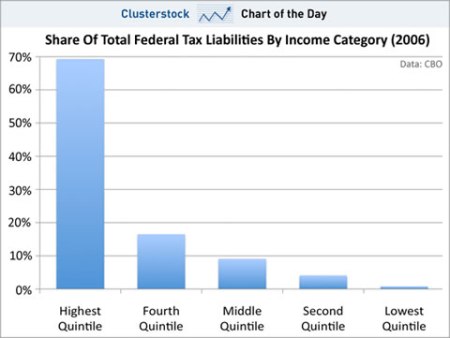
On the day my wife spent preparing our 1040, I came across two articles about who pays federal taxes (via TigerHawk). This chart comes from ClusterStock.
First of all, half of Americans don’t even pay income taxes, but it gets worse. If we look at total federal taxes, 20% of Americans pay 70% of taxes, as shown above. 40% of Americans pay 95% of federal taxes.
And this is from the second article at Yahoo! Finance.
WASHINGTON (AP) — Tax Day is a dreaded deadline for millions, but for nearly half of U.S. households it’s simply somebody else’s problem.
About 47 percent will pay no federal income taxes at all for 2009. Either their incomes were too low, or they qualified for enough credits, deductions and exemptions to eliminate their liability. That’s according to projections by the Tax Policy Center, a Washington research organization.
Are we to the point of bread and circuses yet? Why wouldn’t someone who pays little or no tax vote for those who are good at increasing government spending? Why not?
As they say: If you want peace, work for justice. An equitable tax code would be a good place to start.
PARKERSBURG, W.Va. – The retirement nest egg of an entire generation is stashed away in this small town along the Ohio River: $2.5 trillion in IOUs from the federal government, payable to the Social Security Administration.
It’s time to start cashing them in.
For more than two decades, Social Security collected more money in payroll taxes than it paid out in benefits — billions more each year.
Not anymore. This year, for the first time since the 1980s, when Congress last overhauled Social Security, the retirement program is projected to pay out more in benefits than it collects in taxes — nearly $29 billion more.
Sounds like a good time to start tapping the nest egg. Too bad the federal government already spent that money over the years on other programs, preferring to borrow from Social Security rather than foreign creditors. In return, the Treasury Department issued a stack of IOUs — in the form of Treasury bonds — which are kept in a nondescript office building just down the street from Parkersburg’s municipal offices.
The problem of Social Security holding only IOU’s instead of assets is hardly news. People have been pointing it out for years now. And if – like me – you nurtured some small hope about GWB’s move to reform Social Security, then you’ll be disappointed – but unsurprised – to see that we’re still standing in the middle of tracks while the locomotive bears down on us.
Social Security is only part of the problem. Medicare’s another; state pension funds are still another.
We can’t blame this wreck on the train. Many countries that have similar programs have faced similar crises and solved them: Chile and Australia come to mind. Why can’t we?
So it was a bit of a coincidence that a friend sent me a link to a video at Real Clear Politics yesterday. It’s a clip of Rep. Tom Perriello (D-VA) talking about entitlement spending. In the clip he says, “[…] if you don’t tie our hands, we will keep stealing.” See for yourself.
To hear a member of the majority party say this tells you all you need to know about its being a matter of fact. It’s straight from the horse’s mouth, folks: ain’t no "Republican name calling" going on here. (Not that it would matter; there are plenty of Republicans who supported the status quo that got us in this position.)
I’ve been using a remote access service for a couple of years now and I’ve been so pleased with it that I thought I’d give it a post of its own.
It’s called LogMeIn and it does everything I need and then some. I get remote desktop access, remote file access, remote printing and even remote audio (assuming there’s enough bandwidth to make it tolerable).
One of the nicest things is that you can use it free as long as you like (though you do give up some features in the free version). I did that for the first few months to test drive it, before deciding it was well worth its subscription price.
I use it to get to machines in my home office when I’m at client sites and to get to client machines when I’m at home. I use it to support my neighbor’s computer. It works like VNC or WebEx (and unlike Windows Remote Desktop) because it gives you a session that’s concurrent with the logged in user, if there is one.
Naturally, it reminds me of Citrix‘ software. I’ve always liked Citrix’ stuff and have recommended it to corporate folks several times. I’ve done a couple of Citrix Metaframe deployments and have been very impressed with Citrix’ management software. For organizations that need to publish applications or virtual desktops to large groups, Citrix is hard to beat in my view.
But when I tried Citrix’ GoToMyPC a couple of years ago, I wasn’t too impressed. (As a minor point, I didn’t like the lame name.) After the all-too-brief evaluation period I was granted, I didn’t become a paying customer. Part of the problem was the price included things I didn’t need or want.
That’s about the time I came across LogMeIn and it was the clearly better choice for me. I appreciate that this market changes quickly and maybe things have changed since then, but I’m happy enough with LogMeIn that I don’t want to spend the time to re-evaluate.
I’d say the same thing about using VNC. I’ve used VNC packages in the past and liked them. Most of them are free, so they compare well to LogMeIn in a features per dollar contest. But I like the way LogMeIn manages multiple machines in its web interface and I especially like the security LogMeIn provides through the web portal. Again, maybe there are later-model VNC packages out there which provide those features but I don’t want to spend the time searching them out.
So I’ve been spreading the word about LogMeIn and my friends like it too. One day a friend and I were fooling around with it and got this great infinite series of desktops when I brought up a LogMeIn session on the machine I was working at. (You can do that, as pointless as it is.) This is LogMeIn running in Firefox using its plug-in.
LogMeIn has been developing a whole line of products since I started using their remote access stuff. I don’t know much about those new offerings, but it looks like they’re expanding beyond simple remote access and support software into the VPN and desktop publishing arenas.
Paul sends a link to an op-ed by Margaret Wente in The Globe and Mail. It summarizes some of the more dubious and fraudulent claims made to support the IPCC’s reports on climate change. RTWT.
In 2007, the most comprehensive report to date on global warming, issued by the respected United Nations Intergovernmental Panel on Climate Change, made a shocking claim: The Himalayan glaciers could melt away as soon as 2035.
These glaciers provide the headwaters for Asia’s nine largest rivers and lifelines for the more than one billion people who live downstream. Melting ice and snow would create mass flooding, followed by mass drought. The glacier story was reported around the world. Last December, a spokesman for the World Wildlife Fund, an environmental pressure group, warned, “The deal reached at Copenhagen will have huge ramifications for the lives of hundreds of millions of people who are already highly vulnerable due to widespread poverty.” To dramatize their country’s plight, Nepal’s top politicians strapped on oxygen tanks and held a cabinet meeting on Mount Everest.
But the claim was rubbish, and the world’s top glaciologists knew it. It was based not on rigorously peer-reviewed science but on an anecdotal report by the WWF itself.
One of the lessons I’m taking from Climategate and its aftermath is a growing disbelief in any objectivity at the United Nations. This may not be news to those who follow the U.N. but it seems even more prone to power-hungry factions than the U.S. government. (And that’s a pretty low standard for unbiased policies that actually, y’know, benefit citizens – as opposed to simply expanding government power.)
Until now, I’ve been giving the U.N. the benefit of the doubt. But no more Mr. Nice Guy.
That’s one of Ms. Wente’s points: a cabal in the AGW camp has destroyed a lot more than just confidence in their case for climate change. They’ve damaged everyone’s confidence in finding objectivity among scientists and among people at the United Nations. They’re making a lot of people look like the Boy Who Cried, ‘Wolf!’
I’ll bet there are many people now wondering whether any scientific evidence can be trusted. I wouldn’t be too surprised to find people putting scare quotes around the words scientific evidence.
That would be a very scary thing since we rely on technology to the extent we do.
In my About page, I cited the Bipartisan Campaign Reform Act (aka McCain-Feingold) as an example of how the checks and balances in US government didn’t seem to be working.
But the Supreme Court revisited BCRA (and other laws) this week and it made a liar of me. John Stossel has a good column on the Court’s decision in the Citizens United v. Federal Election Commission case.
The First Amendment is a little stronger now. In a 5-4 decision announced today, the Supreme Court struck down another portion of McCain-Feingold, specifically the ban on corporate and union-funded issue ads in the closing days of an election. Even better, the Supremes also overruled a 20 year old ruling that banned corporate and labor money from funding any political campaign ads.
Finally, the Supreme Court displayed some sanity when interpreting the first Amendment. (Well, five justices, at least.)
I don’t think this means everything will be skittles and beer. I suspect the annoyance level of electioneering ads will go to 11. I’ll also guess that it will make the role of unions in politics more visible, which seems like a good thing to me.
What the decision has done is put some limits on the government’s power. If you haven’t worried about those limits, this clip from the Cato Institute does a good job exploring them. Bear in mind that what was banned was a cable television pay-per-view movie. It wasn’t something you could inadvertently pick up while channel surfing.
The point is not that groups will try to influence elections. We we can take that as a given, like death and taxes. Instead, the question is who decides how much influence is too much: the voters or some federal bureaucrats?
The dismaying reaction of the political left has been its dismay at the Court’s decision. President Obama himself addressed the issue in his weekly address.
WASHINGTON – President Barack Obama on Saturday sharply criticized a Supreme Court decision easing limits on campaign spending by corporations and labor unions, saying he couldn’t “think of anything more devastating to the public interest.” He also suggested the ruling could jeopardize his domestic agenda. […]
Portraying himself as aligned with the people and not special interests, Obama said the decision was unacceptable. […]
He said he has instructed his administration to work with Congress to “fight for the American people” and develop a “forceful bipartisan response” to the decision.
Let’s ignore the fact that the President is urging the Congress to override the Supreme Court on this. Considering the source, I’m not too surprised.
But the idea of the President as "aligned with the people and not special interests" is pretty funny, isn’t it? Here’s the guy who backed the GM bailout, the Chrysler bankruptcy deal, and who recently cut a deal with union leadership during health care reform negotiations — all of which favored union members over every one else.
News flash for you, President Obama: most of "the people" aren’t union members. That makes organized labor a "special interest" – just as any other minority group would be.
How about the President’s Some-Are-More-Equal-Than-Others policies? How are you liking those?
If there’s any group of people in Washington that appears to be in an interest group’s pocket, it’s the President and his advisers. In fact, Paul Howard wrote an article on that very topic for City Journal recently.
The Union Rules
What better to call the White House’s latest handout?
19 January 2010
At the rate that congressional Democrats and the White House are handing out special deals, exemptions, and payoffs in their health-care “reform” legislation, there’s a real danger that pundits will run out of snarky phrases to describe them. So as my own modest effort to help headline writers, I move that we call the $60 billion White House cave-in to the AFL-CIO “The Union Rules.” That phrase would henceforth describe the various union demands that President Obama has agreed to: exempting public and private unions for five years (from 2013 to 2018) from a 40 percent excise tax on high-cost health plans; deducting dental and vision benefits from the excise tax; and negotiating higher thresholds under the excise tax for plans that have a higher number of retirees or older workers, as unions do.
After the surprising election of Scott Brown as senator from Massachusetts (an effort I supported), you can probably find any number of pundits or talk radio hosts to tell you what you want to hear about the event – from either party’s point of view.
But this clip is different and more interesting than some pundit’s commentary. While it is moderated, it’s basically Massachusetts voters talking about how they voted and why they elected Mr. Brown.
Here’s a question for Senator McCaskill, one of our Missouri senators: If the voters in Massachusetts – a Democratic Party stronghold – are steamed about the health care reform bill and want to "send a message to Washington", then what kind of message do you think the voters in Missouri want to send?
Say you’re a world leader and you want your country’s economy to prosper. According to this Clark Medal winner from MIT, there’s a simple solution: start with free elections.
We are the rich, the haves, the developed. And most of the rest — in Africa, South Asia, and South America, the Somalias and Bolivias and Bangladeshes of the world — are the nots. It’s always been this way, a globe divided by wealth and poverty, health and sickness, food and famine, though the extent of inequality across nations today is unprecedented: The average citizen of the United States is ten times as prosperous as the average Guatemalan, more than twenty times as prosperous as the average North Korean, and more than forty times as prosperous as those living in Mali, Ethiopia, Congo, or Sierra Leone.
The question social scientists have unsuccessfully wrestled with for centuries is, Why? But the question they should have been asking is, How? Because inequality is not predetermined. Nations are not like children — they are not born rich or poor. Their governments make them that way.
A few years ago I bought a Roku SoundBridge, a network audio player. At the time, the choice was between the SoundBridge and Slim Device’s SqueezeBox. The SqueezeBox had a couple of more features but I didn’t think they were worth the higher price it commanded. And I liked the Roku’s styling.
It’s a nice little widget to have and we use it all the time. I have a library of ~8,000 MP3 tracks. We hook the SoundBridge up to our Bose Wave Radio and the pair makes a fairly portable, decent-sounding way to play the library. Usually it sits in the kitchen but it’s easy to move to the patio when we have people over. After I had set it up and installed the Firefly audio server on one of my boxes, my sons got into the act and brought up servers on their machines, so now we have several libraries to chose from.
So I was looking to buy another SoundBridge when I visited Roku.com about a month ago. But what I discovered there was a different type of media appliance: Roku network video players.
That was a pleasant surprise. Where we live, we don’t get cable service – and that’s OK because we don’t really want to make monthly payments for TV we’d rarely watch. For the same reason, we don’t use satellite service (though that is available). We mostly watch movies and occasionally watch off-air TV for weather and important news events.
The Roku video players seemed like just the thing for our type of use, so I bought a Roku HD. Most of the major DVD services (Netflix, Blockbuster, and Amazon) are now providing video-on-demand over the Internet so we can get movies without a trip to the video store and without waiting for discs to arrive in the mail. Even better, we don’t have to worry about making sure discs get returned.
The Roku HD was a snap to set up. You hook up the player to your network (we use wireless), you hook it up to your A/V gear, you set up an account with the video service, and you tell the player which service you want to use. The whole process took maybe 10 minutes to get Netflix set up and playing.
The Roku will deliver streaming high-definition video to your system. I use the component video connections because that’s what my older Yamaha receiver supports but the HD also provides HDMI output (as well as composite output). Assuming you have the bandwith — on your LAN and from your ISP — you’re all set for high def movie watching.
I’ve been very happy with the Roku HD and I’d recommend it. I see they’ve lowered the price since I bought mine and you can pick it up directly from Roku for $99.00, shipping included.
The two big improvements I’d like to see to the Roku video players are (1) play DVDs and (2) support audio media as the SoundBridge does.
Not long after I bought the Roku HD, we bought a Samsung Blu-Ray DVD player. When we were shopping for it, I noticed that it also supported video-over-the-network from the same providers the Roku supported.Basically, I got the features of the Roku HD plus a Blu-Ray player for about twice the cost of the Roku.
So one alternative to the Roku player is get a Blu-Ray player with the video-over-the-net feature. Many companies sell them now. Other alternatives are to use a PlayStation, an XBox or a TIVO box since some of those support this feature too.
This seems to be pretty factual and non-partisan. My only question is whether the dollars-per-household numbers are in nominal dollars or are inflation-adjusted.
I don’t know anything about the outfit that produced this (Commonwealth Foundation) but I think it’s very well done.
This is one of the most succinct statements regarding markets vs. government that I’ve heard. It’s hardly new and it’s been widely seen but it bears repeating.
Last night we went to see the film Slumdog Millionaire. My wife was a little taken aback by the depiction of poverty and abuse in India. I’m not sure why or what she expected India to be like. It reminded her of Cairo and I thought that was a pretty fair comparison. They’re both large (> 10 million people) and Cairo has the same striking contrast of hard poverty against cosmopolitan affluence that Mumbai showed in the film.
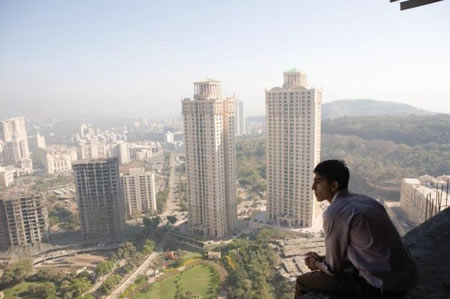
I enjoyed the film quite a bit and I’d recommend it to anyone with a couple of hours to spend. Here’s a shot of the hero, Jamal Malik, looking over the new buildings that have replaced the slum in Mumbai where he grew up.
Jamal Malik, the Slumdog Millionaire
I liked this film because of Jamal’s unflagging determination to find his girl, Latika. They met as children, when he took in her in out of the rain. They were separated after a few years. But he regarded her as his destiny and he never stopped trying to find her again – and to be with her after he did find her – despite all the misadventures of his young life (which included a couple of direct rebuffs from her).
Since he grew up an orphan in India, alone with his brother, he and his brother had to ply a number of low-paying trades and work several scams just to survive. The story of their doings is nicely revealed in flashbacks as the background to Jamal’s success on the game show Who Wants To Be a Millionaire?
The film’s plotting and production values were both outstanding, as was the acting. It deserved the awards it received, I think.
Today I realized that what this movie showed so well was the positive sense of life that Ayn Rand described in her essays and novels. People are not at the mercy of the universe, or their god(s), or their society, or their enemies. We may not always win but we can always choose to try.
Were Ms Rand still alive, I’d bet that she’d like the movie too – and for that particular reason. It had the feel of Hugo’s Les Misérables, a story she admired.
In a word, I found the movie uplifting.
Slumdog Millionaire also reminded me of a quote from Harlan Ellison that I ran across just last week.
My philosophy of life is that the meek shall inherit nothing but debasement, frustration and ignoble deaths; that there is security in personal strength; that you can fight City Hall and win; that any action is better than no action, even if it’s the wrong action; that you never reach glory or self-fulfillment unless you’re willing to risk everything, dare anything, put yourself dead on the line every time; and that once one becomes strong or rich or potent or powerful it is the responsibility of the strong to help the weak become strong.
I’d never have guessed that Mr. Ellison would write something like that; I’m glad I found it.







 No Truce With Kings