Here’s ten minutes of video about an FDA case (that I’d never heard of) against Vascular Solutions. I’ll bet most people haven’t heard about this case.
It’s a little long, but listen to the comments from Vascular Solutions’ employees and the letter that Mr. Root received from a juror after the trial.
Donald Trump crushed it in the Indiana GOP primary last night, winning more than 50 percent of the vote and causing Ted Cruz to drop out. Although John Kasich is still in the race, he has only won one state so far while Trump is less than 200 delegates from securing the nomination.
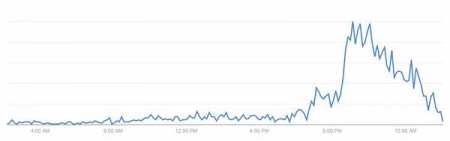
That led to a surge tonight in searches for “Libertarian Party,” as this chart from Google Trends showing searches for “Libertarian Party” over the last 24 hour period:
Libertarians will choose their candidate at their convention in Orlando over Memorial Day weekend. […]
How many “Never Trump” Republicans look at the Libertarian Party instead of supporting Hillary Clinton remains to be seen. Mark Selter, a senior aide to Sen. John McCain (R-Ariz.), the 2008 Republican presidential candidate, has already indicated he’ll be supporting Clinton. Other Republican establishment types may do the same, providing a poignant illustration of how the Trump phenomenon became a thing in the first place.
Almost one in five Americans say they’d consider a third party candidate if the nominees were Donald Trump and Hillary Clinton.
Forget about which major party is the "lesser evil." The choice between the Democratic candidate — whichever socialist-know-it-all that turns out to be — and the likely Republican candidate — a turd called itself a Republican, so the GOP is rallying ’round to polish it — is no choice at all.
It’s Hobson’s Choice is what it is. We’re like people with both an abusive spouse and an abusive boy/girlfriend. The only reasonable option is to avoid both of them.
If any election ever illustrated that U.S. politics tend to be the Coke Party vs. the Pepsi Party, this is the one.
So vote for the least of the evils: Vote Libertarian.
A Libertarian vote helps establish an alternative to Coke or Pepsi. Do it For The Children: does anyone want another 50 years of Donkeys vs. Elephants?
Not being a wide-eyed naïf, I expect that a third-party vote for President will mean that Ms. Clinton will win this election. But I expect she’ll win it anyway. Just check Iowa Electronic Markets or Election Betting Odds.
And here’s how to counter that Clinton presidency (or that Trump presidency): put your time and financial support into seeing that limited government representatives and senators win elections. The downstream elections are just as important as the Presidential election. Check out the Club for Growth. They’re not Libertarians but they’re very practical in their endorsements of low-regulation, low-tax candidates.
Political gridlock can be our friend. So think carefully about your votes for congress members.
Global capitalism isn’t always easy to love. But Vietnam is still in the free-market honeymoon phase.
Roughly 95% of Vietnamese respondents to the Pew Research Center’s spring survey of global attitudes agreed with the following statement: “Most people are better off in a free market economy, even though some people are rich and some are poor.” That was the highest rate of agreement among all the countries where researchers asked the question.
Of course, capitalism is always easier to love during an economic expansion. And Vietnam has had itself quite a boomlet in recent years. The country is steadily making its way up the manufacturing food chain, depending less on churning out low-skill manufactured goods like textiles and shoes to produce more sophisticated products such as smartphones. And foreign capital has poured in, thanks to global companies’ eagerness to tap pools of labor that remain relatively cheap in comparison to fast rising Chinese wages. That all means that standards of living are going up. The IMF expects the economy to expand by 5.6% this year. […]
I recall being in the last few draft lotteries during the Vietnam War. (I never served.) And now the Vietnamese are schooling us – in markets at least.
The encouraging news from Latin America is that the leftist populists who for 15 years undermined the region’s democratic institutions and wrecked its economies are being pushed out — not by coups and juntas, but by democratic and constitutional means. Cristina Fernández de Kirchner of Argentina is already gone, vanquished in a presidential election, and Brazil’s Dilma Rousseff is likely to be impeached in the coming days.
The tipping point is the place where the movement began in the late 1990s: Venezuela, a country of 30 million that despite holding the world’s largest oil reserves has descended into a dystopia where food, medicine, water and electric power are critically scarce. Riots and looting broke out in several blacked-out cities last week, forcing the deployment of troops. A nation that 35 years ago was the richest in Latin America is now appealing to its neighbors for humanitarian deliveries to prevent epidemics and hunger.
The regime that fostered this nightmare, headed by Hugo Chávez until his death in 2013, is on the way out: It cannot survive the economic crisis and mass discontent it has created. The question is whether the change will come relatively peacefully or through an upheaval that could turn Venezuela into a failed state and destabilize much of the region around it. […]
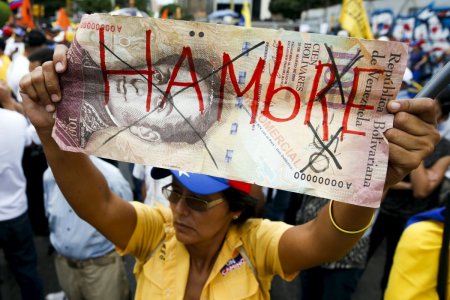
And today I came across a post at Business Insider, featuring this photo. (Hambre means hunger.)
Despite breathless coverage of Venezuela’s vanishing supply of condoms, toilet paper, and beer, perhaps the country’s most debilitating shortage has been that of food, which appears to be a motivating factor for growing antigovernment sentiment.
“I want the recall because I don’t have food,” one woman told the Venezuelan commentary site Contrapunto, referring to a referendum to recall President Nicolas Maduro that has so far reportedly drawn more than a million signatures in support.
“We want out of this agony — there is too much need in the streets,” another woman told Contrapunto. “We have much pressure because there is no food and every day we have to ask ourselves what we are going to eat.”
Government supporters have long pointed proudly to the improvement in eating under socialist leader Hugo Chavez, who used oil income to subsidize food for the poor during his 14 years in office (1999 to 2013) and won UN plaudits for it.
But Reuters notes that Maduro, Chavez’s successor, has faced a collapse in the price of oil, which provides almost all of Venezuela’s foreign income. He has also blamed an opposition-led “economic war,” which critics deride as an excuse.
Living in a severe recession and a dysfunctional state-run economy, poorer families say they sometimes skip meals and rely more on starch foods, Reuters reports.
“We are eating worse than before,” Liliana Tovar, a Caracas resident, told Reuters in late April. “If we eat breakfast, we don’t eat lunch, if we eat lunch, we don’t eat dinner, and if we eat dinner, we don’t eat breakfast.”
As Scott Adams said, "When one person doesn’t understand economics, we call it ignorance. When millions don’t, we call it a political movement."
Here’s a nice picture of Solar Impulse 2 during its flight between Honolulu, Hawaii and Mountain View, California. The flight is part of its circumnavigation of the globe.
The thing that struck me in the article, though, was that this flight took 62.5 hours. If you look up the distance between Hawaii and California, you get (roughly) 2500 miles. That would make the average speed during the flight about 40 MPH.
What type of craft can stay aloft at that slow speed? Was there a continual headwind that added to its airspeed? Or do its long wings just provide incredible lift?
I enjoyed this report from the Ontario Society of Professional Engineers, which is a nice nuts and bolts summary of the electricity challenges facing developed nations in the next 30 years. Here is the slide most people would simply reject out of hand:
The engineers’ report is a year old. If you’re interested in reading it, you can find it here. (It’s a PDF that looks to have been made from a slide deck.)
Here’s an e-mail I got today from Scott Bullock with the Institute for Justice. You gotta love what the IJ does — and they don’t fool around.
Yesterday, IJ won our fastest victory ever. Just hours after we launched our latest civil forfeiture case with an exclusive feature in The Washington Post, the government agreed to drop all charges against our clients and returned every cent that it had wrongfully seized.
This case involves one of the most outrageous forfeiture actions we’ve seen yet. During a routine traffic stop for a broken tail light, the Muskogee, Oklahoma, sheriff’s department seized more than $53,000 from our clients—a church and a Burmese Christian band on tour in the U.S. trying to raise funds for charity. The full Washington Post story is here, and you can find more information about the case, including IJ’s video, on our website.
Law enforcement nationwide continues to use civil forfeiture to steal property and hard-earned cash from innocent owners. But with your support, we were able to act quickly and marshal resources across time zones—and, in this case, continents—to come to their defense. Despite its short duration, this case involved a great deal of work and hustle by IJ attorneys. Indeed, I suspect this is the first time anyone has had to chase down notaries in Burma, rural Thailand, Omaha, and Dallas all on the same day. This victory brings us one step closer to our goal of abolishing forfeiture, and we are grateful to you for making it possible.
My, what a contrast to Merle Haggard’s song Okie from Muskogee. I wonder what Merle (may he rest in peace) would make of this story?
It sounds to me like some of those Okies aren’t doing right and the rest of ’em may not be too free.
Just last night at dinner I was wondering aloud what Apple (and Apple iPhone owners) thought of the FBI’s claims that someone had hacked the phone used by Farook & Malik in San Bernadino. It wasn’t a concern to me since I don’t own an iPhone, but if I did own one I’d be wondering whether (a) the FBI really had hacked the phone and, if so, (b) what that implied about security on my iPhone.
And speak of the Devil… today’s Wall Street Journal ran this article about a newer case. (It’s behind their paywall, of course).
WASHINGTON—The Justice Department on Friday night dropped a court case trying to force Apple Inc. to help authorities open a locked iPhone, adding new uncertainty to the government’s standoff with the technology company over encryption.
In a one-page letter filed with a Brooklyn federal court Friday night, the government said an individual had recently come forward to offer the passcode to the long-locked phone. The filing means that in both of the high-profile cases pitting the Justice Department against Apple, the government first said it couldn’t open the phone, only to suddenly announce it had found a way into the device as the case proceeded in court. […]
The case involves an iPhone 5s that was seized from suspect Jun Feng as part of a 2014 drug investigation in New York. Mr. Feng pleaded guilty last year, but both sides agreed the legal dispute surrounding the phone still needs to be resolved.
After he was arrested, Mr. Feng told agents that he didn’t remember the phone’s passcode, leading investigators eventually to seek Apple’s help. The Wall Street Journal reported last week that Mr. Feng only recently learned his phone had become an issue in a high-stakes legal fight between prosecutors and Apple. Mr. Feng, who has pleaded guilty and is due to be sentenced in the coming weeks, is the one who provided the passcode to investigators, according to people familiar with the matter. […]
Earlier this week, James Comey, the director of the Federal Bureau of Investigation, told a London security conference audience that the government paid more than $1 million for an unidentified third-party to help open the San Bernardino work phone of Syed Rizwan Farook.
Mr. Farook and his wife killed 14 people and wounded 22 in a Dec. 2 shooting rampage at a holiday gathering of county employees, before being killed later that day in a shootout with police.
Earlier this week I ran across this video on Darrell Issa’s Twitter feed.
It makes the point about security on network devices pretty well, I think. The question’s not as simple as people putting their privacy ahead of the common good (as the FBI and politicians would have it). It’s not just about Snapchat and Twitter. It’s about all the data on what have become our personal computers — the bank passwords, or the business data that you don’t want made public, or your Ashley Madison account maybe.
So that makes this an issue about introducing weaknesses in devices on an open network that already has its share of security risks. Anyone work for the OPM? Do you think the Feds should dictate security measures for everyone?
But getting back to what I was wondering about, I couldn’t find that there’d been any answer to that question. Here’s a three-week-old article in the Los Angeles Times.
Apple Inc. refused to give the FBI software the agency desperately wanted. Now Apple is the one that needs the FBI’s assistance.
The FBI announced Monday that it managed to unlock an iPhone 5c belonging to one of the San Bernardino shooters without the help of Apple. And the agency has shown no interest in telling Apple how it skirted the phone’s security features, leaving the tech giant guessing about a vulnerability that could compromise millions of devices.
“One way or another, Apple needs to figure out the details,” said Justin Olsson, product counsel at security software maker AVG Technologies. “The responsible thing for the government to do is privately disclose the vulnerability to Apple so they can continue hardening security on their devices.”
But that’s not how it’s playing out so far. The situation illuminates a process that usually takes place in secret: Governments regularly develop or purchase hacking techniques for law enforcement and counterterrorism efforts, and put them to use without telling affected companies.
I’d be very surprised if Mr. Olsson’s suggestion that the government disclose its method to Apple ever happens.
Update 4/26/16
Well, that easy prediction was quickly confirmed. Here’s more news from today’s Wall Street Journal (and behind its paywall, naturally). My emphasis below.
The FBI is preparing to send a formal notification to the White House in the coming days saying that while the agency bought a hacking tool from a third party to unlock the San Bernardino shooter’s iPhone, officials aren’t familiar with the underlying code that runs it.
The Federal Bureau of Investigation doesn’t plan to tell Apple Inc. how it cracked a San Bernardino, Calif., terrorist’s phone, said people familiar with the matter, leaving the company in the dark on a security vulnerability on some iPhone models.
The FBI knows how to use the phone-hacking tool it bought to open the iPhone 5c but doesn’t specifically knows how it works, allowing the tool to avoid a White House review, the people said, The FBI plans to notify the White House of this conclusion in the coming days, they added.
Any decision to not share details of the vulnerability with Apple is likely to anger privacy advocates who contend the FBI’s approach to encryption weakens data security for many smartphone and computer owners in order to preserve options for federal investigators to open locked devices. […]
And if you believe the FBI’s claim that it "doesn’t specifically know how it works" then please call me about the bridge I have for sale.
While it’s a Federal crime for us to lie to Federal law enforcement agents, it’s not a crime (of any sort) for them to lie to us.
Update 5/19/16
Here’s probably the most persuasive response to the government’s demands for backdoors in phone security. If a government has access, it will be abuse that access sooner or later.
14ymedio, Generation Y, Yoani Sanchez, Washington, 5 March 2016 — When they returned his mobile phone all his contacts had been erased and the card with the photos was gone. Stories like this are repeated among activists who have been detained, over whom an iron vigilance is maintained with the complicity of the Telecommunications Company (ETECSA), the technology arm of repression in Cuba. An entity that should take note of the rebuff Apple has dealt the FBI in the United States, by refusing to access its clients’ data.
For decades, Cuban society has become accustomed to the government’s failing to respect individuals’ private spaces. The state has the power to delve into personal correspondence, to display medical records in front of the cameras, to air private messages on television, and to broadcast phone conversations between critics of the system. In such a framework, intimacy doesn’t exist, one’s personal space has been invaded by power.
People see as “normal” that the phones are tapped and that in the homes of opponents hidden microphones capture even the smallest sigh. It has become common practice for ETECSA to cut off dissidents’ phone service during certain national events or visits from foreign leaders, and to block the reception of messages whose contents upset them. This Orwellian situation has gone on for so long, that few take note any more of the illegality involved and the violation of citizens’ rights it entails.
I came across a couple of encouraging news items recently. First (via Reason), this news from Florida about a new law governing civil asset forfeiture. (My emphasis below.)
Gov. Rick Scott on Friday signed into law another 14 bills from the 2016 Legislative Session. […]
The latest bills include SB 1044, under which law enforcement will have to charge people with a crime before they can seize their money, cars, homes or other property.
State Sen. Jeff Brandes, a St. Petersburg Republican, sponsored the measure, which was supported from both sides of the political spectrum.
It’s designed to prevent abuses of the current law, which doesn’t require an arrest before property is seized, but rather law enforcement’s belief that it was likely used in a crime.
“Today is a major win for liberty in the Sunshine State,” Brandes wrote on his Facebook page Friday.
He credited help from fellow Sens. Aaron Bean and Jeff Clemens, and state Reps. Matt Caldwell and Larry Metz, “as well as the wide range of stakeholders from our law enforcement community to civil libertarian organizations.” […]
Now there’s a thought: make the cops stand up in front of God ‘n’ ever’body and charge some people with some crimes if they think crimes were committed.
Amen, Sen. Brandes. It’s a major win indeed. Thank you, Florida! I hope the other states take a lesson.
But, wait, there’s more! And mirabile dictu, it gets even better. The BBC had an article about the State’s Attorney in St. Clair Co., Illinois (which is the next county east of mine).
In St Clair County, Illinois, the local prosecutor is trying a radical new experiment: admitting his office has charged innocent people with crimes and clearing their names before they spend a day in prison. It’s a unique reform effort as prosecutors around the country face increased scrutiny and diminishing public trust.
Lashonda Moreland’s day had barely begun when the pounding on the front door began. Her husband had already left for work, and she was home with her two children in their second storey apartment in a suburb of St Louis, Missouri.
When a voice barked through the door, Moreland realised the figures outside were police officers.
“He said, ‘You need to open up the door or we’re going to kick it down,'” she recalls. “My kids are scared and they’re crying…I’m upset and I start crying.”
The police arrested Moreland – a 30-year-old home healthcare worker with no criminal history – and she spent the next several days in various jails until she was transferred over the river to St Clair County, Illinois.
“It was scary because I had never been in jail. I never had to be on lockdown,” she says. “I literally cried every day. I was trying to wrap my mind around, ‘Why am I in here?'”
Moreland was accused of shoplifting, evading police and for trying to run down a police officer with her car. […]
All the police had was the licence plate number, which was registered to Lashonda Moreland’s address. When Officer Rutter looked at Moreland’s driver’s licence photo, he immediately identified her as the woman who had tried to run him over.
Moreland didn’t own a Buick, nor did she do her shopping 30 minutes away in a completely different state. She did, however, have a cousin who had registered his maroon Buick LeSabre to her address without telling her. She explained all this to the Fairview Heights police when they first contacted her after the incident, but they didn’t believe her.
Things looked bad for Moreland. She couldn’t prove her alibi and the witness who placed her at the scene was an officer of the law. She was facing up to 11 years in prison.
Instead of getting dragged through a jury trial, something surprising happened. Moreland’s lawyer Kristi Flint told the St Clair County state’s attorney office that her client was innocent. In response, the prosecutor offered Moreland the chance to take a polygraph test. Flint nervously agreed, and Moreland passed. Six months after her arrest, the charges were dropped. Everyone, including the Fairview Heights police department, agrees that Moreland is innocent.
Moreland did not know it at the time, but she was the beneficiary of a new programme created by St Clair County State’s Attorney Brendan Kelly: the Actual Innocence Claim Policy and Protocol. It is a unique, pre-conviction intervention which attempts to prevent the “actually innocent” from going through a trial, taking a plea deal, or ending up in prison.
Actual innocence is a legal concept which means, simply, that a defendant did not commit the crime of which he or she is accused. It is usually invoked when a prison inmate is attempting to appeal his sentence, but Kelly wanted to bring the spirit of the concept to the pre-conviction level.
“That’s distinct from ‘I didn’t get treated fairly’,” says Kelly, a Navy veteran who became the county’s top law enforcement officer in 2010 when he was only 34 years old. “It’s not, ‘Some of the evidence was obtained unlawfully, there was an incorrect ruling by the court, on the trial level some error by the defense’ – no, you actually have the wrong person here…they’re actually innocent.”
Since Kelly implemented the policy two years ago, nine defendants – including Lashonda Moreland – have had their charges dropped before trial. Those cases include a reckless homicide by vehicle, four armed robberies and one murder.
To the best of his knowledge, no other prosecutor in the country is attempting anything quite like it. Even the US Department of Justice has taken an interest in what is happening in St Clair County. […]
Kelly does not think being open to admitting law enforcement mistakes makes him soft on crime. He considers himself an “aggressive” prosecutor who believes in law enforcement and its role in bringing about the precipitous decline in crime in the US since the 1990s. […]
“Your local DA is accountable not to some person who appointed them in DC, or some state capitol somewhere, but is accountable to the people that they serve,” he says. “I think the prosecutor has the ability to be uniquely part of the solution, because again, we’re the one entity whose duty is first and foremost to justice.”
Please note that final paragraph. Here’s a State’s Attorney who gets it. (Of course, a cynic might point out that the State of Illinois, in its parlous financial condition, probably can’t afford too many wrongful conviction settlements.)
The only downside to this story is my surprise that the justice system had to come up with the concept of “Actual Innocence” to distinguish how it handles some suspects as compared to how it’s usually handled suspects.
Need I say more about ‘how it’s usually handled suspects’?
Now Bernie Sanders is trying to abuse trademark law in an attempt to suppress my free speech, in almost the exact way the NSA, DHS, and Hillary Clinton’s Super PAC did.
Yesterday, April 14th, the Bernie Sanders campaign sent a cease and desist letter claiming that I am unlawfully selling my parodies because they used the likeness of the official Bernie Sanders for President logo in this shirt. […]
I’m hoping the Streisand Effect will kick in and teach at least one lawyer a lesson.
This episode only confirms that your first reaction to any lawyer who sends you a demand letter should be to tell him or her to go piss up a rope. Seriously.
I wish I’d known that 20 years ago when an overzealous legal nitwit at CBS tried to shake me down for a domain name (of all things). I let him off for expenses, which in retrospect was being way too easy on him.
And is there anything more ridiculous than a publicly funded agency trying to protect a copyright from the very public it’s supposed so serve? Who owns that copyright, anyway? Shouldn’t it be public property since it was funded with public money?
Why does the NSA even have lawyers to write those obnoxious demand letters?
I found this pretty amusing not only on its face but also because it reminded me of a similar discussion I had in the summer of 2000. At the time, I was managing a small development group in Minneapolis. One of the group members was a fairly hippie cat who wrote Java for the company’s web site. We came to get along fairly well and we spent a few evenings eating pizza (in the office) and discussing his Java and whether it was good object-oriented design.
I recall one day he was telling me about how he disliked American Consumerism (whatever that means) and how cool it would be instead if people could only trade with each other. I asked him if he meant that everyone would be bartering with one another.
No, he told me, it would have to be more flexible than that. So I asked if his "trading" scheme wouldn’t lead to some type of markets. He admitted it would and added that the thought discouraged him. I was a little bemused by that.
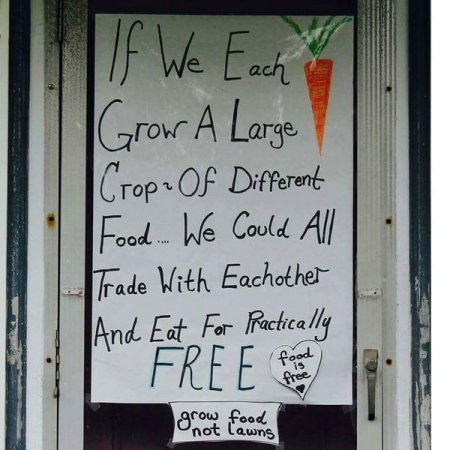
A post from Facebook has been making the rounds, where I came across it by way of my Federalist colleague Scott Lincicome.
Here’s the mind-blowing argument: “If we each grow a large crop of different food, we could all trade with each other and eat for practically free.”
Where to start?
Well, for one thing, growing your own food isn’t exactly “free,” not even “practically free.” As anyone who has his own vegetable garden knows, it requires seeds, fertilizer, irrigation, weeding, protection from insects and birds and animals, and a lot of work. The cost may not all be measured in monetary terms, but it isn’t free. In fact, it’s notoriously easy for a vegetable garden to end up costing more money than it saves, which is why most of us do it just as a hobby. […]
But let’s not pick this apart. Let’s take the idea seriously. Hey, what if we all became small farmers and traded with each other? As they say on the Internet: you’ll never guess what happened next.
Maybe instead of everybody growing the same things, we could all produce what we’re best at and trade with others for what we need. We could come up with a catchy name for this, like “division of labor.” And we would need somewhere to exchange these goods with each other, which we could call a “market.”
Don’t Stop There!
Maybe we could get even more specialized. Some people could devote themselves just to growing young plants in greenhouses in the spring for others to plant when the weather gets warmer. Or they could provide seeds for other people to use, or breed hybrids with better yields or other desirable characteristics.
And maybe some crops would grow better in different areas, or at different seasons. I’ll bet you can’t grow blackberries in the middle of winter, but there are other areas of the country, or of the world, where these things still grow even when they won’t grow in your front yard. Maybe you could trade with people who live in those places.
Still, crops come ripe at different times, so maybe we need a system where I can trade my spring harvest of peas for somebody else’s fall harvest of pumpkins. Maybe we could write this all down on little pieces of paper which we pass between us to make trades. Has anybody ever thought of that? […]
It’s a tough problem to design a replacement for a system which generates an enormous bounty but which still doesn’t give the results you like. It’s an attitude I hear from Senator Sanders when he says things like, "You don’t necessarily need a choice of 23 underarm spray deodorants or of 18 different pairs of sneakers when children are hungry in this country."
I won’t say that children never go hungry or are never poorly nourished but I suspect that when they do (or are), it’s not for lack of food but instead for lack of responsible parents or care-givers.
I’m not sure what the relationship is between "too many" choices in the consumer market and the number of irresponsible parents. I don’t think Sen. Sanders knows that relationship either.
Last week, Megan McArdle wrote about a group of attorneys general and about one in particular, who had served a subpoena to the Competitive Enterprise Institute.
The Competitive Enterprise Institute is getting subpoenaed by the attorney general of the U.S. Virgin Islands to cough up its communications regarding climate change. The scope of the subpoena is quite broad, covering the period from 1997 to 2007, and includes, according to CEI, “a decade’s worth of communications, emails, statements, drafts, and other documents regarding CEI’s work on climate change and energy policy, including private donor information.”
My first reaction to this news was “Um, wut?” CEI has long denied humans’ role in global warming, and I have fairly substantial disagreements with CEI on the issue. However, when last I checked, it was not a criminal matter to disagree with me. It’s a pity, I grant you, but there it is; the law’s the law. […]
Speaking of the law, why on earth is CEI getting subpoenaed? The attorney general, Claude Earl Walker, explains: “We are committed to ensuring a fair and transparent market where consumers can make informed choices about what they buy and from whom. If ExxonMobil has tried to cloud their judgment, we are determined to hold the company accountable.”
That wasn’t much of an explanation. It doesn’t mention any law that ExxonMobil may have broken. It is also borderline delusional, if Walker believes that ExxonMobil’s statements or non-statements about climate change during the period 1997 to 2007 appreciably affected consumer propensity to stop at a Mobil station, rather than tootling down the road to Shell or Chevron, or giving up their car in favor of walking to work.
State attorneys general including Walker held a press conference last week to talk about the investigation of ExxonMobil and explain their theory of the case. And yet, there sort of wasn’t a theory of the case. They spent a lot of time talking about global warming, and how bad it was, and how much they disliked fossil fuel companies. They threw the word “fraud” around a lot. But the more they talked about it, the more it became clear that what they meant by “fraud” was “advocating for policies that the attorneys general disagreed with.” […]
No matter how likely you may think catastrophic global warming might be (and Ms McArdle thinks it more likely than I), I’m hoping you’ll think this move by the group of A.G.s sets a bad precedent. And that’s a point McArdle makes later in her column.
And it’s a bad precedent regardless of your opinion about the CEI. Say that you think the CEI is a tool of greedy oil companies; it’s still true that the antidote to "bad speech" is free speech and not censorship.
Today, I ran across Glenn Reynolds’ column on the same topic. He puts a much finer point on the A.Gs’ actions and press conference.
Federal law makes it a felony “for two or more persons to agree together to injure, threaten, or intimidate a person in any state, territory or district in the free exercise or enjoyment of any right or privilege secured to him/her by the Constitution or the laws of the Unites States, (or because of his/her having exercised the same).”
I wonder if U.S. Virgin Islands Attorney General Claude Walker, or California Attorney General Kamala Harris, or New York Attorney General Eric Schneiderman have read this federal statute. Because what they’re doing looks like a concerted scheme to restrict the First Amendment free speech rights of people they don’t agree with. They should look up 18 U.S.C. Sec. 241, I am sure they each have it somewhere in their offices.
Here’s what’s happened so far. First, Schneiderman and reportedly Harris sought to investigate Exxon in part for making donations to groups and funding research by individuals who think “climate change” is either a hoax, or not a problem to the extent that people like Harris and Schneiderman say it is.
This investigation, which smacks of Wisconsin’s discredited Putin-style legal assault on conservative groups and their contributors, was denounced by the Competitive Enterprise Institute’s Hans Bader as unconstitutional. Bader wrote:
Should government officials be able to cut off donations to groups because they employ people disparaged as “climate change deniers?” … Only a single-issue zealot with ideological blinders and a contempt for the First Amendment would think so. …
The First Amendment has long been interpreted as protecting corporate lobbying and donations, even to groups that allegedly deceive the public about important issues. … So even if being a “climate denier” were a crime (rather than constitutionally protected speech, as it in fact is), a donation to a non-profit that employs such a person would not be.
Nope, but conspiring to deprive “deniers” of their free speech rights would be. […]
But here’s what happened next: After Bader’s critique, Walker, the U.S. Virgin Islands attorney general, subpoenaed the Competitive Enterprise Institute’s donor lists. The purpose of this subpoena is, it seems quite clear, to punish CEI by making people less willing to donate.
This all takes place in the context of an unprecedented meeting by 20 state attorneys general aimed, environmental news site EcoWatch reports, at targeting entities that have “stymied attempts to combat global warming.” You don’t have to be paranoid to see a conspiracy here.
Not everyone believes that the planet is warming; not everyone who thinks that it is warming agrees on how much; not everyone who thinks that it is warming even believes that laws or regulation can make a difference. Yet the goal of these state attorneys general seems to be to treat disagreement as something more or less criminal. That’s wrong. As the Supreme Court wrote in West Virginia Board of Education v. Barnette, “If there is any fixed star in our constitutional constellation, it is that no official, high or petty, can prescribe what shall be orthodox in politics, nationalism, religion, or other matters of opinion.” […]
If there was ever an example of a Chilling Effect, this is one on steroids.
I’ve had my share of minimum-wage or low wage jobs; I’ve even held more than one at a time, years ago. I’ve been nickle & dimed, as Barbara Ehrenreich would call it.
So I’m all for people who work low-skill jobs getting all the pay they can. (For that matter, I’m all for people working any type of job to get all the pay they can.)
But letting the government set minimum wages is effectively saying that those people have no flexibility – they can’t bargain about wages because it becomes unlawful. That’s a nasty handicap if you’re new to the job market, or you’re new to a line of business, or you’re new to a particular area (see below).
I’ve mentioned before that Mark Twain claimed the best way to get the job you want is to go to work for free. When your value becomes apparent, the pay will follow. If it doesn’t become apparent, you’ve learned a lesson. That’s not possible when the law makes such a bargain illegal.
Back in October, The New York Times reported that the law of supply and demand still works. “Yes, Soda Taxes Seem to Cut Soda Drinking,” the newspaper told its readers, relating the results of Mexico’s new tax on sugary beverages. Mexico’s measure imposed a 10 percent tax on soft drinks, and so far has cut consumption from 6 percent to as much as 17 percent among the poorest Mexicans.
The efficacy of the soda tax comes as no great surprise. After all, as the news story noted, “the idea for the soda tax is in some ways modeled on . . . tobacco taxes. . . . A robust literature now exists showing that the resulting higher prices really did push down cigarette sales, particularly among young people.”
The paper’s editorial page soon came out in full cry demanding higher soda taxes for Americans, too. Noting that “a big tax on sugary drinks in Mexico appears to be driving down sales of soda,” the editors urged “lawmakers in the United States to consider comparably stiff taxes.”
Some already have. Soda taxes have become a chic cause in progressive enclaves, from Berkeley and San Francisco to Philadelphia and New York.
But if you want to make liberal heads in those same enclaves explode, dare to suggest that raising the minimum wage might reduce employment.
Thanks to legislation their governors signed Monday, California and New York are hiking their minimums to $15, the target hourly rate of a national campaign by labor activists. Earlier this year The Times encouraged Hillary Clinton to join Bernie Sanders in demanding a $15 minimum for the entire country. “Mrs. Clinton has argued that $15 might be too high for employers in low-wage states, causing them to lay off workers or make fewer hires,” the paper noted, but then argued: “There is no proof for or against that position.”
Sure there isn’t — not if you don’t remember the argument for soda taxes, anyway. […]
In San Francisco and Oakland, Calif., employment growth has been cut in half. In Seattle, job growth has plunged from 4.6 percent to 1.8 percent — even while restaurant hiring rose more than 6 percent for the rest of Washington State.
Sure, you can find studies that purport to show small hikes in the minimum wage don’t hurt jobs. You can find a lot more that say they do. But the more honest advocates for a higher minimum wage acknowledge that it will cost some people their jobs. But some argue that’s no big deal and might even be a feature, not a bug: “What’s so bad about getting rid of crappy jobs?” asks public-policy professor David Howell.
Which is easy to say if the job being gotten rid of isn’t yours.
Brown, traveling to the state’s largest media market to sign the landmark bill, remained hesitant about the economic effect of raising the minimum wage, saying, “Economically, minimum wages may not make sense.”
But he said work is “not just an economic equation,” calling labor “part of living in a moral community.”
“Morally and socially and politically, they (minimum wages) make every sense because it binds the community together and makes sure that parents can take care of their kids in a much more satisfactory way,” Brown said.
In this same vein, here’s an account by Mitch Hall about his job search in Seattle (which I assume happened late last year).
Over the weekend, lawmakers and labor unions in California, the nation’s most populous state, reached a tentative agreement to gradually raise the minimum wage to $15 an hour over the course of the next several years. […]
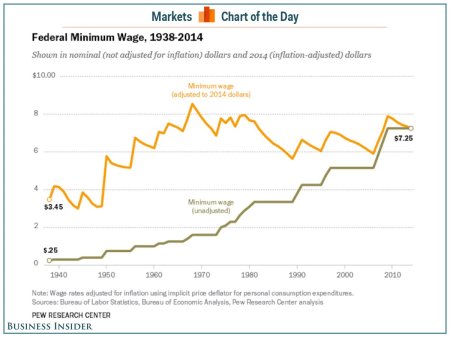
Twenty-nine states have minimum wages that exceed the federally mandated $7.25 per hour. Heading into the 2016 election, the issue remains hotly contested and politically potent, with Republican presidential candidates in fierce opposition to, and Democratic candidates in strong support of, a dramatic increase in the federal minimum wage. […]
My opposition to minimum wage increases comes as a direct result of my own experience searching for jobs as a new resident of Seattle, Washington, a city that currently has one of the highest minimum wages in the nation. In June 2014, the Seattle City Council, composed of just nine members, unanimously voted to increase the city’s base pay to a whopping $15 an hour, to be gradually implemented over the course of several years.
I’ve spent the majority of the last two months stalking online job sites and entire days traversing the various neighborhoods of Seattle.
On January 1, 2016, the newly mandated minimum wage rose to $13 for larger companies (those that have more than 500 employees in the United States), and $10.50 for smaller employers (those with fewer than 500 employees in the United States). On top of this, Washington state law now requires businesses to adhere to this minimum even for tipped workers, a rule that only six other states have on the books.
In December, I found myself needing a break from college, for a variety of reasons. So at the close of last semester, I decided (rather impulsively, as young people are wont to do) to take my spring semester off from the College of William and Mary and move out west to try my luck in Seattle, a place I had only visited once before. […]
Having a combined two years of serving experience and close to five years of total experience in the customer and food services industries (which is literally as much as you can ask for from a 20-year-old college student), I assumed I’d be able to find a restaurant gig in no time. So, after reassuring my parents all would be well in the financial department, I boarded a plane in Philly a few weeks later and made the move.
Yet seven weeks and more than 70 job applications later, I still have yet to land a part-time, minimum wage job. I’ve spent the majority of the last two months stalking online job sites and entire days traversing the various neighborhoods of Seattle, filling out applications and inquiring about job opportunities at any restaurant, coffee shop, retail store, or other service-oriented establishment I can find. […]
At first, I was utterly dumbfounded by my lack of success, and figured only bad luck was to blame. After all, I had been hired at every single one of my past serving jobs within only a day or two of searching and applying. I’d have to find something in Seattle eventually, I thought; I’m young, competent, and college-educated, and serving is by no means a highly skilled occupation that requires degrees or extensive training. I know how to make a good impression with prospective employers, and I already have years of experience in the food services industry. What more could these people want?
Employers, especially in the restaurant and food services industries, are far less willing to take chances on who they hire with so much money on the line.
But soon enough it became clear, through talking with potential employers and local college students also trying to find work, that my failure to land a job was likely due, at least in large part, to Seattle’s absurdly high minimum wage. […]
I think the real problem here is what to do about those who are seemingly stuck in low-skill jobs. I don’t think they’re the majority of people in those jobs, but they’re the chronic cases that seem to motivate the urge to raise minimum wages.
Just eyeballing that graph above, my guess is that maybe a third of the people making minimum wage are heads of households. If I’m right, that’s 33% of 4.7% or 1.6% of the total labor force.
A better approach would be to address directly the needs of the adults stuck in those jobs rather than raising the bar for everyone, children included. Don Boudreaux and Nick Gillespie touch on these points in this interview.
Taking a cue from Governor Brown, is it "moral" to inflict hardships on a large class in order to relieve a small number of those people from other hardships? I’d disagree. I’d say that’s an immoral action by a government based on purely utilitarian grounds (greatest good for the greatest number).
Bear in mind that it’s a different case if particular individuals step up and volunteer for hardships in order to spare their peers or fellow citizens – in that case, the action may be admirable and moral. But when it’s legally compulsory, it’s just so much bullying by legislators.
Update: Now this I can believe. Based on what I read, I think that unions are trying to regain the political power they once exercised; so this explanation seems possible. But dang… it’s gotta sting to be a union member who’s making less than the minimum wage championed by your union. Where’s the brotherhood?
If you thought that the union-backed #FightFor15 movement was really about making sure that all workers earned a living wage—rather than about using the government to enrich progressive interest groups—think again. The Guardian:
Los Angeles city council will hear a proposal on Tuesday to exempt union members from a $15 an hour minimum wage that the unions themselves have spent years fighting for.
The proposal for the exemption was first introduced last year, after the Los Angeles city council passed a bill that would see the city’s minimum wage increase to $15 by 2020. After drawing criticism last year, the proposed amendment was put on hold but is now up for consideration once again.
As it turns out, this practice is not uncommon. The WSJreported last year that at least six municipalities have created special minimum wage carveouts for unions. The logic is straightforward: Kill non-unionized jobs, add more workers to the union rolls, and extract higher fees for union bosses. It’s not a minimum wage hike the labor movement is after, exactly: It’s a penalty on non-union employers, and a payout for modern-day Jimmy Hoffas. Expect unions in California and New York, which recently enacted statewide $15 minimums, to start lobbying legislators for their own sweetheart deals in the near future. […]
Update 2:
Here’s an interesting graph from Business Insider. It explains to some extent how California can get away with its hike in the minimum wage: it’s easy when you have one of the lowest minimum-wage work forces in the country.
Here’s an recent op-ed by Natalie Morales in Flood Magazine that’s both interesting and snarky. I found her advice about clothing amusing, for one thing. It reminds me of the post in January about "North Korea with palm trees."
Editor’s Note: Natalie Morales’ Op-Ed was written before President Obama announced his intention to travel to Cuba and is not in any way intended to be a response to the president’s remarks.
Just last week, I was at my friend Michaela’s house dropping off a bag of stuff I’m sending to my family in Cuba. Her husband, Fred, is visiting Havana and was kind enough to be my courier. Among the things I sent with Fred were two packages of Cuban coffee. Yes, that’s right: I’m sending Cuban coffee to Cuba. It’s absurd and hilarious and I got a real kick out of telling everyone I came across that day about it. This is because Cuban coffee is too expensive for the average Cuban to buy in Cuba. […] I, on the other hand, buy it for three bucks at Target.
Coffee is just one of the things my family in the States sends to my family in Cuba. Usually, monthly, we send money, medicine or syringes for the diabetic aunt (since the hospital doesn’t have any unused disposable ones), baby clothes, adult clothes, shoes, or food (there’s a website for Americans to buy food that is sent to Cuba, but at an absurd upcharge). They cannot survive without our help. For many Cuban-American families all over the States, this is just a regular part of life, another bill to pay each month.
Here’s a terse explanation of why: a doctor, a lawyer, or another similar profession that is considered to be high-earning everywhere else in the world will make about twenty to thirty dollars per month in Cuba. Yet shampoo at the store still costs three dollars. This is because everything is supposed to be rationed out to you, but the reality is that they’re always out of most things, and your designated ration is always meager. […] That’s good ol’ Communism in practice.
Now, knowing this, picture me at any dinner party or Hollywood event or drugstore or press interview or pretty much any situation where someone who considers themselves “cultured” finds out I’m Cuban. I prepare myself for the seemingly unavoidable “Ooh, Cuuuuuba” — as if the country itself were somehow a sexy woman or delicious food — followed by the inevitable, “I have to go there before it’s ruined!” I try to be polite, because I am aware that, oftentimes, people who think they are very thoughtful are the least thoughtful. So I ask, “What do you mean by ruined?” and they always say, “You know, it’s so cool looking! It’s stuck in time! They have all the old cars and stuff… Everything’s gonna change soon!”
So depending on the situation […], I will say some version of this: "What exactly do you think will ruin Cuba? Running water? Available food? Freedom of speech? Uncontrolled media and Internet? Access to proper healthcare? You want to go to Cuba before the buildings get repaired? Before people can actually live off their wages? Or before the oppressive Communist regime is someday overthrown?" […]
If you want to go to Cuba, I want you to go. I do. But can I ask a favor? Be aware of what’s going on there. Try, if you can, to stay in people’s homes — casas particulares — instead of hotels. They’ll take much better care of you, the food will be much better, and you’ll be putting a little less money into Castro’s tourism pocket. When you go, ask the people to tell you what’s really going on… not the version they’re supposed to tell you. […] Also, for God’s sake, please don’t wear a fucking Che t-shirt.
This year, Tax Freedom Day falls on April 24, or 114 days into the year (excluding Leap Day).
Americans will pay $3.3 trillion in federal taxes and $1.6 trillion in state and local taxes, for a total bill of almost $5.0 trillion, or 31 percent of the nation’s income.
Tax Freedom Day is one day earlier than last year, due to slightly lower federal tax collections as a proportion of the economy.
Americans will collectively spend more on taxes in 2016 than they will on food, clothing, and housing combined.
If you include annual federal borrowing, which represents future taxes owed, Tax Freedom Day would occur 16 days later, on May 10.
Tax Freedom Day is a significant date for taxpayers and lawmakers because it represents how long Americans as a whole have to work in order to pay the nation’s tax burden.
What Is Tax Freedom Day?
Tax Freedom Day® is the day when the nation as a whole has earned enough money to pay its total tax bill for the year. Tax Freedom Day takes all federal, state, and local taxes and divides them by the nation’s income. In 2016, Americans will pay $3.34 trillion in federal taxes and $1.64 trillion in state and local taxes, for a total tax bill of $4.99 trillion, or 31 percent of national income. This year, Tax Freedom Day falls on April 24th, or 114 days into the year (excluding Leap Day). […]
This interesting graph accompanies the article.
And don’t get me started on how all this money flowing into the capital still won’t reduce the national debt. They’re spending it as fast as they can print it, I think.
Here’s another graph that comes from a Mercatus Center post about the Congressional Budget Office’s projections for national debt as a percentage of GDP.
It’ll get worse before it gets better… assuming it ever gets better.
I don’t consider myself a Republican, so I haven’t written much about how Donald Trump has managed to piss all over the Republican primary process this year. (That is, aside from mentioning how he torpedoed Rand Paul’s chances. That was reason #1 for me to say #NeverTrump.)
Although Trump’s campaign is the scariest, simplest-minded nonsense I’ve ever heard from a presidential candidate, I didn’t think I had a dog in that fight. And in that vein, it will be interesting to see how the smaller political parties do if Trump is the Republican nominee. He could make it awfully easy for people to vote Libertarian this year.
But I can see the attraction of the There-Ain’t-No-Way-In-Hell movement. Since I sometimes vote Republican when there’s no good Libertarian alternative, my opinion of any Republicans who endorse this bozo suffers. (Lookin’ at you, Gov. Christie.) There’s reason #2.
Finally, I consider Trump to be too much concerned with his personal benefit and too little concerned with the details of how our divided government works (or is supposed to work). Reason #3.
Erick Erickson wrote this at The Resurgent a couple of weeks ago.
I will not vote for Donald Trump for President of the United States even if he is the Republican nominee.
He is an authoritarian blending nationalist and tribal impulses, which historically has never worked out well for the nation that goes in that direction or the people in that nation.
He will not win in November. He will not win because he turns off a large number of Republicans; he turns off women; he turns off hispanic voters; he turns off black voters; and the blue collar voters who support him are not a sufficient base of support to carry him over the finish line. […]
Trump is a liberal who has supported big government, interventionist policies. He defends Planned Parenthood, says he can cut deals in Washington, and believes in a socialist government run healthcare scheme.
At a time when so much is on the line for people of faith and conservatives, Donald Trump believes judges sign bills. He said so himself in the Houston, TX debate, while lying about the jurisprudence of Justice Samuel Alito.
Trump is also a con-artist and the media, which has built his campaign is going to destroy his campaign. After he secures the Republican nomination, the media will trot out every victim and perceived victim of Trump’s actions. All the people hurt by repeated strategic bankruptcies, all the people swindled by Trump University, and anyone who got food poisoning from Trump steaks will be in a 24/7 cavalcade on national television.
By the time the media and Democrats, but I repeat myself, are done with Trump, he will be radioactive.
Donald Trump will not win in November. Period. End of story.
But, on the off chance Satan pulls a grand slam out of hell and Trump were to do it, he would be an authoritarian despot, deeply destructive to the ideals of this nation and the constitutional principles of the republic, and he would destroy the remains of the Republican Party and much of the conservative movement as conservatives whore themselves out to be close to power. […]
Today I ran across this interview with Sen. Rubio and I thought he made his case pretty well. Unfortunately, he didn’t come right out and say that people with hopes for the presidency have a responsibility to speak in a way that demonstrates leadership (i.e., rationally & inclusively rather than divisively). But Rubio did say that candidates can’t "say anything they like," which I took to mean the same thing.
It’s a real pity that Sen. Rubio didn’t declare that he’d never support Trump as the party nominee. It sure looked like he wanted to say that.
Based on an article that Sen. Claire McCaskill wrote last August, it occurred to me late last year that perhaps Ms. Clinton was doing something similar with Donald Trump: that is, she’s scheming to set up a Republican nominee whom she knows she can beat.
The idea made me wonder whether my tinfoil hat was a little too tight, frankly. I usually don’t have much patience for conspiracy theories. But what Sen. McCaskill claims she did for a Senate seat might not be beyond what Ms. Clinton would do for the White House, eh?
Not long after that I came across this post by Mona Charen at National Review. (Maybe her hat was also too tight?)
He couldn’t help the Democrats more if he were trying. Wait, maybe he is…
The dictionary defines “bogeyman” as “an imaginary evil spirit, referred to typically to frighten children.” Hello, Donald Trump. It’s not clear whether he set out intentionally to elect Hillary Clinton, but there is little question that he could not be fulfilling the role of Republican bogeyman to greater effect. […]
From Obamacare to terrorism, from the economy to climate change, and from guns to free speech, progressive policies have proven deeply disappointing when not downright obtuse and dangerous. Clinton promises more of the same while trailing an oil slick of corruption in her wake. And yet swinging into the frame, week in and week out, the orange-maned billionaire bogeyman dominates the discussion.
Hell yes, Republicans are anti-Hispanic bigots, Trump (a lifelong Democrat) is supposed to confirm. Just look at the way he talked about Mexican “rapists” and vowed to build a wall that Mexico will fund.
Hell yes, Republicans want to fight a war on women. Did you hear what Trump said about Megyn Kelly and Carly Fiorina?
Hell yes, Republicans are anti-immigrant, anti-handicapped, anti-Jewish, and anti-Muslim. Line ‘em up and Trump will offend. Not cleverly, mind you, but crudely. Donald Trump is fond of saying that our political leaders are stupid, constantly outmaneuvered at the bargaining table by shrewder Chinese, Mexicans, and Japanese. No one can accuse him of stupidity, provided his goal is to elect Hillary Clinton.[…]
As Mr. Mencken said, "Democracy is the theory that the common people know what they want, and deserve to get it good and hard."
Update
Here’s Randy Barnett talking briefly about Trump and Ted Cruz in the course of a lengthy interview with Nick Gillespie.
Prof. Barnett says exactly what I’ve been thinking: basically, why does anyone trust Trump? As the professor said, "Just listen to what the man says." Because he’ll say anything.
Last week I read Barr Eisler’s novel The God’s Eye View. It was a pretty good novel but I thought one of the best parts was Eisler’s closing notes where he talks about how there is, effectively, no longer much Congressional oversight over security agencies like the NSA.
The representatives and senators who oversee those agencies are often bound by secrecy agreements with those agencies to not discuss what they hear or learn even with other congressmen. In other words, the agencies demand secrecy in the name of national security even from those who should be controlling the agencies’ policies and procedures.
So when Paul sent a link to this column by Radley Balko, it really wasn’t much of a surprise. But, surprised or not, we should all be shocked at what’s happening.
A while back, we noted a report showing that the “sneak-and-peek” provision of the Patriot Act that was alleged to be used only in national security and terrorism investigations has overwhelmingly been used in narcotics cases. Now the New York Times reports that National Security Agency data will be shared with other intelligence agencies like the FBI without first applying any screens for privacy. The ACLU of Massachusetts blog Privacy SOS explains why this is important:
What does this rule change mean for you? In short, domestic law enforcement officials now have access to huge troves of American communications, obtained without warrants, that they can use to put people in cages. FBI agents don’t need to have any “national security” related reason to plug your name, email address, phone number, or other “selector” into the NSA’s gargantuan data trove. They can simply poke around in your private information in the course of totally routine investigations. And if they find something that suggests, say, involvement in illegal drug activity, they can send that information to local or state police. That means information the NSA collects for purposes of so-called “national security” will be used by police to lock up ordinary Americans for routine crimes. And we don’t have to guess who’s going to suffer this unconstitutional indignity the most brutally. It’ll be Black, Brown, poor, immigrant, Muslim, and dissident Americans: the same people who are always targeted by law enforcement for extra “special” attention.
This basically formalizes what was already happening under the radar. We’ve known for a couple of years now that the Drug Enforcement Administration and the IRS were getting information from the NSA. Because that information was obtained without a warrant, the agencies were instructed to engage in “parallel construction” when explaining to courts and defense attorneys how the information had been obtained. If you think parallel construction just sounds like a bureaucratically sterilized way of saying big stinking lie, well, you wouldn’t be alone. And it certainly isn’t the only time that that national security apparatus has let law enforcement agencies benefit from policies that are supposed to be reserved for terrorism investigations in order to get around the Fourth Amendment, then instructed those law enforcement agencies to misdirect, fudge and outright lie about how they obtained incriminating information — see the Stingray debacle. This isn’t just a few rogue agents. The lying has been a matter of policy. We’re now learning that the feds had these agreements with police agencies all over the country, affecting thousands of cases.
Somewhere I have a picture that I took in Amsterdam a long while back (late 80s or early 90s). It was a pic of a large sign on a canal bridge, reading: Abuse of power comes as no surprise.
So don’t be surprised. Be vigilant in defense of your rights instead.
Update
Here’s Edward Snowden talking about the secrecy surrounding surveillance programs during a recent interview. Give it a listen from the 16:30 mark until the 19:05 mark.
How can the people have any voice in a process with the deck stacked like that? I have to conclude that we no longer have a voice in those decisions. It’s the Omniscient State, citizen: love it or leave it.
Venezuela’s Collapse Brings ‘Savage Suffering’ Dying infants, chronic power outages and empty shelves mark the world’s worst-performing economy
CARACAS, Venezuela—In a hospital in the far west of this beleaguered country, the economic crisis took a grim toll in the past week: Six infants died because there wasn’t enough medicine or functioning respirators.
Here in the capital, the crisis has turned ordinary life into an ordeal for nearly everyone. Chronic power outages have prompted the government to begin rationing electricity, darkening shopping malls. Homes and apartments regularly suffer water shortages.
Rosalba Castellano, 74 years old, spent hours this week in what has become a desperate routine for millions: waiting in long lines to buy whatever food is available. She walked away with just two liters of cooking oil.
“I hoped to buy toilet paper, rice, pasta,” she said. “But you can’t find them.” Her only choice will be to hunt for the goods at marked-up prices on the black market. The government, she said, “is putting us through savage suffering.”
The National Assembly, now controlled by the opposition, declared a food emergency on Thursday—an attempt to spur the government of President Nicolás Maduro to, among other things, ease price controls that have created shortages of everything from medicine to meat.
“The people are being left without the ability to feed themselves,” said lawmaker Omar Barboza.
Inflation in this oil-rich country is expected to hit a world’s-worst 700% this year, according to the International Monetary Fund. The economy shrank by 10% last year and is expected to decline another 8% this year, according to the IMF, the worst performance in the world. And there is no end in sight. […]
It’s no secret that I backed Rand Paul’s presidential campaign (both here and financially). So naturally I was disappointed when he decided to end his campaign last week while I was traveling for business.
Not that I need another reason to despise Donald Trump, but I’ll add this one to the pile anyway. Thanks, Donald.
I think Nick Gillespie nails in it in this column, and that includes the parts about Rand trying to pass himself off as a conservative. Gillespie writes:
The short version of what went wrong is neither complicated nor difficult to explain.
Donald Trump happened, bending virtually all the light to him like a black hole for most of the past six months or more. […]
His [Rand’s] campaign was lackluster at times or, even worse, a conservative repudiation of the “libertarian-ish” tendencies that had earned him sobriquets such as “the most interesting man in the Senate” and “the most interesting man in politics.”
The guy whose 13-hour filibuster forced President Obama to promise not to drone-kill American citizens drinking coffee at Starbucks and who said the GOP needed to be “white, we need to be brown, we need to be black, we need to be with tattoos, without tattoos, with pony tails, without pony tails, with beards, without” rarely hesitated to jump on the anti-Planned Parenthood and anti-Syrian refugee bandwagons along with all the other GOP candidates.
I don’t regard a conservative as someone who necessarily wants to conserve liberty. Some want to conserve American political heritage; others just want to conserve their idea of a “good social order.” I’m with the first; the others can take a hike.
That’s why I talk, write, and vote libertarian: I don’t trust conservatives (as a group) to maintain liberty in any consistent, principled sense. And I was disappointed when Rand jumped on the very bandwagons that Gillespie mentions.
But to paraphrase an old saying in the software business: good marketing beats good principles any day.
All that said, I still think Rand was the best choice for those of us who want liberty to be conserved and expanded. So I liked Rand’s farewell video last week.








 No Truce With Kings