Archive for the ‘US government’ Category

h1

Bill of Rights Day

December 15, 2011

Here’s Cato’s quick review of the current state of affairs.

And if you think Mr. Lynch is too pessimistic, see this: Indefinite Military Detention Measure Passes On Bill Of Rights Day.

Five will get you ten that some U.S. citizen will be indefinitely detained by the military – right here in the "homeland" – within the next 5 years. Any takers?

h1

What if?

December 5, 2011

Andrew Napolitano, host of Fox’s Freedom Watch talk show, wrote an essay for Taki’s magazine. I don’t watch Freedom Watch (since I don’t watch television) but I enjoy the clips of it I see on YouTube. I think the Judge is a bit of a firebrand – which will become evident if you read the whole essay – but I also think that may be a good attitude these days.

Here’s the first paragraph to whet your appetite:

What if the Constitution No Longer Applied?

What if the whole purpose of the Constitution was to limit the government? What if Congress’s enumerated powers in the Constitution no longer limited Congress, but were actually used as justification to extend Congress’s authority over every realm of human life? What if the president, meant to be an equal to Congress, has become a democratically elected, term-limited monarch? What if the president assumed everything he did was legal just because he’s the president? What if he could interrupt your regularly scheduled radio and TV programming for a special message from him? What if he could declare war on his own? What if he could read your emails and texts without a search warrant? What if he could kill you without warning?

h1

So maybe I’m not delusional

August 13, 2011

It’s always amazed me that anyone tries to make a Constitutional argument for the individual mandate – the requirement to buy health insurance – portion of the Patient Protection and Affordable Care Act. I’ve mentioned earlier that Radley Balko nailed that angle pretty well.

So it’s reassuring to hear a(nother) federal court agree that Congress doesn’t have the authority to pass such a law.

Appeals Court Strikes Down ObamaCare’s Individual Mandate, Calls It “a wholly novel and potentially unbounded assertion of congressional authority.”

Posted on August 12, 2011, 1:35PM | Peter Suderman

No, Congress can’t just decree that individuals must buy a private product, even if the market has unique properties. To do so would be more than unprecedented; it would be an unconstitutional overreach. That’s the gist of what an 11th Circuit appeals court said today when it ruled in favor of 26 state governments by saying that the federal requirement to purchase health insurance contained in last year’s health care overhaul is unconstitutional. From the ruling:

The individual mandate exceeds Congress’s enumerated commerce power and is unconstitutional. This economic mandate represents a wholly novel and potentially unbounded assertion of congressional authority: the ability to compel Americans to purchase an expensive health insurance product they have elected not to buy, and to make them re-purchase that insurance product every month for their entire lives. We have not found any generally applicable, judicially enforceable limiting principle that would permit us to uphold the mandate without obliterating the boundaries inherent in the system of enumerated congressional powers. “Uniqueness” is not a constitutional principle in any antecedent Supreme Court decision.

However, the panel, made up of two Democratic appointees and one GOP-appointed judge, did overturn lower court Judge Roger Vinson’s decision to invalidate the entire law, preferring to strike only the mandate and related provisions.

It will be interesting to see whether the Supreme Court agrees with this circuit court. Decisions on the matter have gone both ways in different courts.

h1

We know tyranny when we smell it

July 24, 2011

There are two news items in this post, both of them about city governments that are attempting to limit their citizens’ freedoms – in one way or another.

#1: A couple of weeks ago, Reason ran an article (one of several) about the Washington, D.C. Taxi Commission and a meeting it had to discuss a new requirement for taxi drivers in the city to have permits called ‘medallions’. (Medallion licensing is used in New York City, Chicago and Boston, for example.)

The whole thing seems to stink to me, since medallions aren’t currently required and I don’t know of any problems arising from the lack of them. It sounds to me like a cartel is attempting to capture the taxi business in D.C. But maybe I’m wrong about that; I don’t live in D.C. and I don’t know anything its taxi market.

What makes me suspicious, though, is this. Click the link in this quote to see a video of a reporter being arrested for recording a public meeting.

And the commission is so wary of scrutiny that when reporter Pete Tucker snapped a photo on his cellphone at a recent public meeting he was dragged out and arrested.

Reason.tv Producer Jim Epstein captured Tucker’s arrest on his mobile phone. Later, Epstein was also arrested after resisting attempts by the taxi commission and us park police to confiscate his camera phone. When Tucker was arrested, cab drivers, stormed out of the meeting in protest.

This clip of D.C. taxi drivers protesting the meeting was produced by Reason.TV. One of the cabbies is spot on: "We know tyranny when we smell it. And we are not going to take this stinking smell again."


#2: Paul sent a link to this news report from Gould, Arkansas, where the city council wants to ban a group it doesn’t approve of. But wait, there’s more: it also wants to require any group in the city to get its approval before holding meetings. What color is the sky on their planet?

The mayor of Gould nails it: “This is America. […] And in America you just can’t vote and violate peoples’ constitutional rights.”

h1

You lose some; you win some

July 23, 2011

There was some good news recently about a local free speech case. This quote is from the Post-Dispatch’s article about the decision.

Appeals court backs man in fight over St. Louis eminent domain sign

ST. LOUIS • A federal appeals court on Wednesday struck down at least part of St. Louis’ sign ordinance and ruled that a St. Louis man had the right to protest eminent domain with a two-story mural on the side of an apartment building near Soulard.

Jim Roos commissioned the two-story painted mural, roughly 360 square feet in size, that proclaims “End Eminent Domain Abuse” inside a red circle with a slash to protest the government’s taking of private land, but the city ordered him to remove it in 2007, saying it violated city sign regulations prohibiting signs in that area larger than 30 square feet.

I’ve see the sign in this picture many times, while headed north on I-55 into Illinois. It’s hard to miss. And it’s good to hear it will be around for a while.

h1

Your papers, please!

May 7, 2011

A week ago today I was returning from a two-day trip to central Mississippi. I left a spot southeast of Yazoo City about 8:30 PM and drove directly back to St. Louis.

I was relying on my GPS system and it directed me to take US 49E to get to I-55, so I was driving toward Greenwood, MS on that route. It looked like pretty rural country, as well as I could make it out in the dark. That’s when I came upon a traffic checkpoint in what seemed like the middle of nowhere. There were two police cruisers on each shoulder and four (as I recall) officers standing in the middle of the road. I couldn’t see anything else nearby.

I was a little surprised by this, since it was such an isolated area. But it’s not the first time I’ve run across that. The cops in Wayland, Missouri, a little bitty place near the Iowa border, used to run "seat belt checkpoints" 10 years ago. They only ran them on the holiday weekends: Independence Day, Labor Day and so on. I suppose they got the maximum traffic and number of DWI busts on those days.

When I stopped, the Mississippi highway patrolmen did the usual: flashed their lights inside the car to see what was visible and chatted me up for a few minutes. What bothers me about the stop, though, is they asked for my driver’s license. I showed it to them… but I was sorely tempted to ask why I should. I was obviously sober and was complying with Mississippi’s seat belt law. There were no burned-out lights on my car. In short, there was no visible reason to suspect me of breaking any laws, so what’s with requiring me to show identification?

But I was eager to get home (which didn’t happen until 4 AM Sunday) and I wasn’t familiar with Mississippi state law. For all I knew, arguing with them about it would have meant spending the night in a county lock-up just to find out that they did have the legal right to demand my ID. The Supreme Court has upheld state laws to conduct checkpoints, after all.

Still, I wasn’t happy that I didn’t challenge them on it. What is this "Papers, please!" nonsense?

Today I was trying to find out if I have to put with this stuff in the future. That’s when I came across this interesting article at KSWB, the Fox TV affiliate in San Diego. Police at a sobriety checkpoint in Escondido broke out the window on a man’s car because he refused to roll it down and show them his driver’s license.

Here’s the video that accompanies the article.

Seeing this, I’m thinking that what I did in Mississippi was the practical choice. Nonetheless, it doesn’t sit well. And I’m reminded of my father-in-law saying, "If you don’t defend your rights, you don’t have any."

h1

Money for nothin’

February 20, 2011

Part of our retirement plan is rental property. We’re not retired yet but my wife and I own two single-family homes that we’ve been renting for 20+ years. In fact, we’ve been planning to buy some more rental property, given the current buyer’s market in real estate. But that plan may be on hold for a while.

In one of our rental houses, the tenants are a couple, the couple’s two young children, and the wife’s mother. Recently the wife called and told us that (a) her younger daughter’s blood test showed an slighlty elevated lead level and (b) that a county inspector had come to the check the house (without our knowledge) and would be sending us a list of "lead violations" that we’d be required to have remediated.

Naturally we weren’t pleased to learn about this. And we were surprised by it, too. Our older son spent his first two years in that house with us and we never had a problem with lead in his blood. Other tenants have lived there with young children with no problems to our knowledge.

The house was built in the 1940s, so it’s no surprise that it has lead-based paint beneath the latex paint that’s been applied over time. It’s comparable in age to most of the houses in its neighborhood and my estimate is that at least 75% of the other houses in the neighborhood have lead-based paint in them as well. So, lucky us.

It took a week before the county’s letter arrived at our home. And then it was another week before we could meet with the inspector – and an unexpected case worker who accompanied her. According to the case worker, any time a child’s blood tests above the limit, the county "invites itself" into the child’s home to inspect the property. I was struck by the "invites itself" euphemism for what amounts to a no-notice property inspection. But evidently that’s the law – or the regulation, I suppose.

The county inspector is requiring quite a bit of work: replacement of all the windows and the front entry door. She also specified enough work on the other two exterior doors and the interior doors and the door jambs that it will be cheaper to replace them rather than to remove the old paint and keep them. Finally, most of the interior trim (casing) for the windows & doors as well as the baseboard must be painted with an "lead encapsulating" paint.

In short, I expect it will be a $10 – $12,000 project. It’s not great news. But we’re looking on the bright side: we don’t want to be party to making a little girl ill. And the house will be much improved by having new windows and exterior doors. (The other work is unnecessary, IMO, but is the cost of doing business in a bureaucrat-regulated polity.)

All this is required in order for us to continue renting the house. Further, there’s the threat of heavy fines ($1,000 per day per violation – we had 12 violations) and imprisonment for failure to remediate the items on the inspector’s list of violations in a timely manner.

What particularly irks me is that the state and county require the work to be done by a licensed lead remediation contractor. So even though it’s all simple enough that we could do it ourselves, and take the necessary precautions while doing it, we’re not allowed to.


There are a few other things that we find unsettling about this process.

First is the severity of the threatened penalties. Who knew that landlords were such scofflaws that they need to be threatened so? Imprisonment for what amounts to a code violation? WTF?

It’s not as though the county doesn’t know where our house is, after all. And we can’t take the house on the lam with us.


Second, there’s an amazing lack of concern about causality here; there’s no scientific rigor at all. The threshold for lead poisoning is a level of 10 micrograms per deciliter of whole blood. The child’s blood test showed 15 mg/dl – just over the threshold, relative to the scale that’s used (which runs up to 50 – 60 mg/dl).

Missouri state regulation specifies that there have to be two tests, at least 3 months apart, with elevated lead levels. That’s a good way to avoid reacting to a spurious test result. But St. Louis County regulation isn’t that reasonable: a single test with an elevated result will trigger a "self invited" inspection. And if any lead paint is detected in the house, it’s immediately assumed to be the proximate cause of the problem. Q.E.D.

The county inspector told us that she’d tested the water and she’d used a "wipe test" to check for lead in dust in the house. Both of those were negative, she said. Nonetheless, there was lead paint (under newer paint) and that’s a problem that must be corrected post-haste.

Sources other than the primary residence are ignored. The little girl frequently stays with her aunt while her parents are both working. But the county won’t be interested in looking at her aunt’s house until we perform the remediation on our house. Then – if the lead level in the child’s blood is still elevated – that’s when they’ll look for other potential causes.

In short, the problem might be caused by something in a different place where the child regularly spends time, but that makes no difference to what we’re required to do.


But the third point is the one I find particularly disappointing. It’s the "free money" attitude of most of the people involved. When we met with the county inspector she urged us to apply for funding for this work and gave us a flyer describing a source. I didn’t read it myself but my wife told me that it works like this.

If the tenant’s personal income qualifies (i.e., is low enough) then the property owner can get funding for remediating the lead. What kind of sense does that make? The only thing I can think is that they don’t want landlords to raise the rent as a result of the expenses being imposed on them.

But the funding isn’t a grant; it’s a loan. When the house is sold, the loan must be repaid. In other words, we could get "free money" to finance this work (or part of it) at the cost of a lien on hour house. Thanks but no thanks.

Naturally, the contractors we’ve talked to know all about this. After we describe the work to them, they all tell us, "You know, you can get ‘free money’ to do this."

What is it with all these people? Isn’t believing in "free money" sort of like believing in the Easter Bunny? Don’t they realize where that money comes from?

I understand that any particular individual may feel like he’s getting over on the system when the "free money" he gets is more than a year or two’s tax bill. But don’t they understand that this isn’t the only "free money" deal going on? There are probably thousands of programs in the United States that are funded by government grants — that is, that pass out "free money".

Our taxes have to pay for all of those programs. So a one-time "free money" benefit is probably no benefit at all – relative to having long-term lower taxes by eliminating all those give-aways.


h1

End drug prohibition now

January 23, 2011

Judge Jim Gray gives several good reasons to. Judge Gray wrote Why Our Drug Laws Have Failed: A Judicial Indictment Of War On Drugs.

Reason.tv posted this clip last March (2010) – but it bears repeating until this thoughtless prohibition is ended.

The 18th amendment didn’t work and was repealed.

The War on Drugs doesn’t work and should be repealed.

How many times do we have to keep making the same mistake?

h1

Not quite the DMV

January 9, 2011

I’ve seen a couple of mentions lately about Pennsylvania’s state-owned-and-operated liquor stores. "Like prisoners in a gulag," is how a NYT article describes liquor shoppers in Pennsylvania.

I can believe the gulag part, even though I’ve never been in a Pennsylvania liquor store. I thought that kind of store had disappeared years ago but I guess I’m not too surprised Pennsylvania still has them. My impression is that alcohol control laws in the northeastern US are a little weird. A lot of different laws, a lot of different taxes, and a lot of states in a small area passing all those laws and taxes.

I recall a visit to my wife’s cousins in Massachusetts once. One of our outings was a not-too-long drive to Connecticut to buy beer and wine. I think that trip was due to lower taxes. I remember that the Connecticut stores were conveniently located just barely over the state line. I could’ve thrown a rock back into Massachusetts.

The Pennsylvania stories reminded me of my year-long stint in Iowa in 1974 & 1975. I worked CATV construction then and I’d gone to Des Moines to work on the system being built there. At that time in Iowa, you could buy beer (and maybe wine) at any gas station or grocery. But if you wanted liquor, you could only buy that at state-operated liquor stores.

I visited an Iowa State liquor store once to buy a fifth of whiskey as a gift for a friend’s father. This would have been in December, 1974 and it was sort of like a trip to the DMV.

As I recall, the store’s very plain entry admitted you to an anteroom. A counter stretching across the width of the store separated this anteroom from the shelves of liquor in the rear. And here’s how you bought your bottle of hooch.

You went to the right side of the counter and told state employee #1 what you wanted; he marked items on a check list. Then he passed that list along to state employee #2, who fetched your order from the shelves in back. (There was more than one person filling this role, IIRC.) #2 gave it to state employee #3, who packaged it for you. Finally the package was handed to state employee #4, at the left side of the counter, and he took your payment and rang the sale on the register.

Only after the sale was concluded did you actually get to touch or look at what you’d bought. If you didn’t know exactly what you wanted when you walked in, I suppose you were out of luck.

There were four people doing what one person would do in any sensible, privately operated store. They were all middle-aged, or older, men and naturally none of them was in any particular hurry. It all paid the same, eh?

And of course, it had the same take-a-number system that many DMVs and post offices use to insure first-come, first-served customer handling.

It was one of the oddest things I’d seen in my young life and I remember thinking, ‘What is this? The Iowa Full Employment Center?’ Since I couldn’t imagine what business the State of Iowa had running retail stores, what I took away was another lesson in limited government.

Even though Iowa doesn’t run state-operated stores any longer, it’s still one of the 19 states which hold monopolies on liquor sales.

Luckily, I’m in the next state south and its alcohol control laws are very liberal.

h1

The end of a boondoggle?

November 24, 2010

Early this week, I came across a Reuters report in which Al Gore called ethanol policy ‘not a good idea’. The thing that struck me was that he pretty much admitted pandering to farmers by voting for ethanol subsidies. (Thanks for ‘fessing up, Al. Better late than never, I suppose.)

Today I found this interesting post by Jonathan Adler at the Volokh Conspiracy on the topic. Maybe there’s hope we’ll be rid of this boondoggle.

The End of Ethanol?

Maybe it’s the new mood in Congress. Maybe the stars are aligned. Whatever the cause, opposition to ethanol subsidies is cropping up in some unusual places — and just in time, as ethanol tax credits are set to expire in a few weeks. […]

Meanwhile, on the other end of the political spectrum, Senators Tom Coburn (R-OK) and Jim DeMint (R-SC) are taking aim at ethanol subsidies as yet another special-interest energy policy boondoggle that should be opposed by free-marketeers and environmental activists alike. […]

As Jonathan Zasloff notes, the ethanol issue also presents Republicans with an opportunity to show how less government intervention can be better for the environment.

Ethanol is a lose-lose proposition any way you slice it: it costs a big chunk of money, it’s horrible for the environment, and it does nothing but enrich special interests. It’s particularly bad on the climate, because the amount of emissions requiring to produce a liter of ethanol is actually more than just using gasoline. Kudos to Senators Coburn and DeMint for pushing this.

Go get ’em, Senators!

h1

A liberal calls for less government

November 21, 2010

Here’s an interesting opinion piece from The Washington Post that’s worth your time to read.

Strangling innovation with red tape
By Morris Panner
Friday, November 19, 2010

As a Democrat whose politics are undeniably liberal on social issues, I lamented the outcome of the midterm elections. But as an entrepreneur with two software start-ups under my belt, I couldn’t help but celebrate – and more than a little. As the fall campaigns wore on, I had found myself listening closely to the Tea Party, nursing the hope that its message would push both major parties to change the way they do business.

To understand my motivation, pick up the November issue of Washingtonian magazine. The annual Salary Survey notes on Page 81 that top trade association leaders (industry lobbyists) make multimillion-dollar salaries to “keep tabs on what the federal government was doing or might do.”

These outsize earnings are symptomatic of a disease that is slowly killing the American economy. We are creating so much regulation – over tax policy, health care, financial activity – that smart people have figured out that they can get rich faster and more easily by manipulating rules on behalf of existing corporations than by creating net new activity and wealth. Gamesmanship pays better than entrepreneurship.

h1

It’s the $64,000 question

October 17, 2010

I dislike re-posting other people’s blog posts in their entirety. But there are exceptions to every rule and Radley Balko hits the nail squarely on the head in this post from October 7:

Just So I Have This Right…

….a federal judge has just ruled that the federal government can force me to purchase a product from a private company, under the argument that my not purchasing that product affects interstate commerce.

For those of you who support this ruling: Under an interpretation of the Commerce Clause that says the federal government can regulate inactivity, can you name anything at all that the feds wouldn’t have the power to regulate?

And if you can’t (and let’s face it, you can’t), why was the Constitution written in the first place? As I understand it, the whole point was to lay out a defined set of federal powers, divided among the three branches, with the understanding that the powers not specifically enumerated in the document are retained by the states and the people.

But if that set of powers includes everything you do (see Wickard and Raich), and everything you don’t do (what Obamacare proponents are advocating here), what’s the point in having a Constitution at all?

Indeed. Why do we pretend we have a government based on principle when everyone (seemingly) ignores those principles?

Justice Thomas raised this same point in his dissent on the Raich case:

Respondents Diane Monson and Angel Raich use marijuana that has never been bought or sold, that has never crossed state lines, and that has had no demonstrable effect on the national market for marijuana. If Congress can regulate this under the Commerce Clause, then it can regulate virtually anything and the Federal Government is no longer one of limited and enumerated powers.

h1

Complex and wonderful

August 8, 2010

In the early 80s, I worked at Tucson Electric for an engineer named Rich Ward. Rich had a fine phrase for describing needlessly complicated systems. “Complex and wonderful,” he called them.

The reformed health care system shown in this chart fits Rich’s description pretty well.

(Full version of the Senate’s Joint Economic Committee PDF herewith 10 pages of explanation. Q.E.D.)

UPDATED CHART SHOWS OBAMACARE’S BEWILDERING COMPLEXITY

Washington, D.C. – Four months after U.S. House Speaker Nancy Pelosi famously declared “We have to pass the bill so you can find out what’s in it,” a congressional panel has released the first chart illustrating the 2,801 page health care law President Obama signed into law in March.

Developed by the Joint Economic Committee minority, led by U.S Senator Sam Brownback of Kansas and Rep. Kevin Brady of Texas, the detailed organization chart displays a bewildering array of new government agencies, regulations and mandates.”

Res ipsa loquitur.

h1

Salus populi suprema lex esto

August 7, 2010

Recently I came across James Taranto’s interview of Randy Barnett about health care reform.

A Commandeering of the People

Is ObamaCare constitutional? “If you ask any constitutional law professor whether Congress can do something, the answer is always yes,” says Randy Barnett. But Mr. Barnett, who teaches legal theory at Georgetown, isn’t just any law professor. A self-described “radical libertarian,” he is the author of a 2004 book, “Restoring the Lost Constitution,” that argues for a fundamentally new approach to jurisprudence. […]

“If you’re talking about the regulation of economic activity, the presumption of constitutionality is for all practical purposes irrebuttable,” Mr. Barnett says. […]

“What is the individual mandate?” Mr. Barnett says. “I’ll tell you what the individual mandate, in reality, is. It is a commandeering of the people. . . . Now, is there a rule of law preventing that? No. Why isn’t there a rule of law preventing that? Because it’s never been done before. What’s bothering people about the mandate? This fact. It’s intuitive to them. People don’t even know how to explain it, but there’s something different about this, because it’s a commandeering of the people as a whole. . . . We commandeer people to serve in the military, to serve on juries, and to file a return and pay their taxes. That’s all we commandeer the people to do. This is a new kind of commandeering, and it’s offensive to a lot of people.”

I think Mr. Barnett points puts his finger on the point. The health care bill takes us another step closer to the Everything That’s Not Forbidden Is Compulsory state of affairs. Faced with the prospect of increasing health care costs, the solution proposed is for citizens to surrender a little more autonomy and accept more limits on their choices.


So I was very pleased to learn that Missouri voters had approved Proposition C this week.

Prop C passes overwhelmingly

ST. LOUIS • Missouri voters on Tuesday overwhelmingly rejected a federal mandate to purchase health insurance, rebuking President Barack Obama’s administration and giving Republicans their first political victory in a national campaign to overturn the controversial health care law passed by Congress in March.

“The citizens of the Show-Me State don’t want Washington involved in their health care decisions,” said Sen. Jane Cunningham, R-Chesterfield, one of the sponsors of the legislation that put Proposition C on the August ballot. She credited a grass-roots campaign involving Tea Party and patriot groups with building support for the anti-Washington proposition.”

The overwhelming margin the proposition passed by was good to see. I don’t know if it means much politically, though. The White House says it has ‘no legal significance’.

I think Senator Cunningham is right that many – maybe a majority of – Missourians don’t want health care that’s managed by bureaucracy. But she overstates the result quite a bit since Proposition C only addressed the individual mandate part of health care reform act and not whether the bill as a whole would apply in Missouri. Further, the Proposition just expresses the Sense of the House. It doesn’t create a new law nor does it oblige the Missouri General Assembly to create such a law.

There was very little electioneering on Proposition C. I didn’t hear anyone advocating against it (or for it). I only saw a few small signs urging Yes votes and those didn’t appear until Election Day. I take this to mean that those who would normally be against it were ignoring it. Nobody was mobilizing the union members to canvas for its defeat, for example. (Such mobilization is common in St. Louis during many elections.)

And there’s already speculation that the Federal government will sue the state to block any implementation of this proposition; that is, to block in the courts any Missouri law which overrides the individual mandate provision.

Nonetheless I thought it was great news that there’s a large number of people here who resent the overbearing power of the Federal government.

Maybe the Tenth Amendment will get a little more respect now. (See also Ninth and Tenth Amendment Society.)

h1

The Rahn curve

July 24, 2010

This is an interesting speculation about the effect of government spending on economic growth. It’s based on a review of economic opinion and some economic history and comes from the Center for Freedom and Prosperity. Dan Mitchell of the Cato Institute is the narrator; he’s done a whole series of videos arguing for limited government for the CFP. In this one, he summarizes the works of Richard Rahn, a Cato Institute fellow.

I’m always a little leery of giving too much credence to derivative studies like this one appears to be and I don’t consider that this one proves anything. It may not even be good evidence of the point it’s trying to make, since I don’t know what data may have been ignored. For one thing, no mention is made of the nature of government spending – only its overall burden on its economy.

But all that said, I think it’s worth viewing (bad green screen effect and all). It seems to raise a few questions for the anarcho-capitalists as well as for the socialists.

h1

Good job, Mr. Kaus

May 3, 2010

This snippet comes from an editorial in the L.A. Times by Mickey Kaus (of Kausfiles fame). The most interesting thing is that he’s running in the Democratic primary for the U.S. Senate.

This bit is part of his summary but you should read the whole thing. He takes the Democrats to task for their knee-jerk support of government unions. I hope the people in California will vote for him – or at least with someone who shares his common sense attitudes.

As the private economy has faltered, we increasingly have a two-tier economy: If you’re an insider, a unionized government employee, you’re in good shape. Even if you don’t do a very good job, you won’t be fired. Even in hard times, Washington will spend billions in stimulus funds so that you don’t get laid off. You won’t even have to take much of a pay cut. And you can retire like an aristocrat at taxpayer expense. But if you’re an outsider, trying to survive in a world of $10-an-hour jobs, competing with immigrant labor, paying for your own healthcare, forced to send your children to lousy public schools run by unfireable teachers and $100,000-a-year bureaucrats — well, good luck to you. But be sure to vote Democratic.

How in the world did we end up with unionized government workers anyway? Who thought that was good idea – aside from the union members themselves)?

h1

People have responsibilities

April 18, 2010

When my sons were young boys, I took the time to acquaint them with the U.S. Constitution and with the idea that there are rules and limits for the government’s behavior just as there are rules and limits for individual behavior. By ‘acquaint’, I mean we read the U.S. Constitution aloud and discussed each article and amendment.

But I also was also careful to point out that if the government doesn’t try to make a safety net – and I don’t think it should try to – then someone else needs to that. And that someone else is all of us.

Bad things happen to people that they can’t control. Courage in the face of adversity is admirable but isn’t always enough for survival; sometimes folks need a hand. It can happen to any of us.

I like to live in a society where there’s some "social surplus": one where, if you happen to fall on hard times, other people have the means, the time and the willingness to give you a hand voluntarily.

When I was near to graduating high school Boyd Goldsworthy, my friend’s dad, offered to help with my college tuition. He assumed (rightly) that paying tuition might be a problem for my family. I didn’t accept his offer since I didn’t go straight from high school to university but I’ve always remembered that he made it.

If we’re all living in penury, we can’t lend a hand. If we’re all so focused on ourselves that we don’t pay attention to what’s going on around us, we won’t lend a hand. But it’s a task reasonable people don’t shirk in my view.

I thought James Lileks made a good point once when he said he’d never seen a hospital called "Libertarian General" – which caused me to recall that the two largest and most respected hospitals where I live are St. John’s Mercy and Missouri Baptist.

All that said, you’ll see why I liked this clip from one of Milton Friedman’s speeches at Stanford back in the 70s.

h1

Social injustice

April 10, 2010

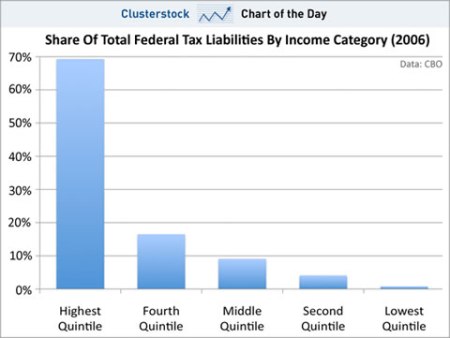
On the day my wife spent preparing our 1040, I came across two articles about who pays federal taxes (via TigerHawk). This chart comes from ClusterStock.

Taxes by quintile (ClusterStock)

The accompanying article begins:

Here’s why government spending is really out of control.

First of all, half of Americans don’t even pay income taxes, but it gets worse. If we look at total federal taxes, 20% of Americans pay 70% of taxes, as shown above. 40% of Americans pay 95% of federal taxes.

And this is from the second article at Yahoo! Finance.

Nearly half of US households escape fed income tax

WASHINGTON (AP) — Tax Day is a dreaded deadline for millions, but for nearly half of U.S. households it’s simply somebody else’s problem.

About 47 percent will pay no federal income taxes at all for 2009. Either their incomes were too low, or they qualified for enough credits, deductions and exemptions to eliminate their liability. That’s according to projections by the Tax Policy Center, a Washington research organization.

Are we to the point of bread and circuses yet? Why wouldn’t someone who pays little or no tax vote for those who are good at increasing government spending? Why not?

As they say: If you want peace, work for justice. An equitable tax code would be a good place to start.

h1

BCRA revisited

January 24, 2010

In my About page, I cited the Bipartisan Campaign Reform Act (aka McCain-Feingold) as an example of how the checks and balances in US government didn’t seem to be working.

But the Supreme Court revisited BCRA (and other laws) this week and it made a liar of me. John Stossel has a good column on the Court’s decision in the Citizens United v. Federal Election Commission case.

A Victory for Free Speech

The First Amendment is a little stronger now. In a 5-4 decision announced today, the Supreme Court struck down another portion of McCain-Feingold, specifically the ban on corporate and union-funded issue ads in the closing days of an election. Even better, the Supremes also overruled a 20 year old ruling that banned corporate and labor money from funding any political campaign ads.

Finally, the Supreme Court displayed some sanity when interpreting the first Amendment. (Well, five justices, at least.)

I don’t think this means everything will be skittles and beer. I suspect the annoyance level of electioneering ads will go to 11. I’ll also guess that it will make the role of unions in politics more visible, which seems like a good thing to me.

What the decision has done is put some limits on the government’s power. If you haven’t worried about those limits, this clip from the Cato Institute does a good job exploring them. Bear in mind that what was banned was a cable television pay-per-view movie. It wasn’t something you could inadvertently pick up while channel surfing.

The point is not that groups will try to influence elections. We we can take that as a given, like death and taxes. Instead, the question is who decides how much influence is too much: the voters or some federal bureaucrats?

The dismaying reaction of the political left has been its dismay at the Court’s decision. President Obama himself addressed the issue in his weekly address.

President Blasts Supreme Court Over Citizens United Decision

DARLENE SUPERVILLE, Associated Press

WASHINGTON – President Barack Obama on Saturday sharply criticized a Supreme Court decision easing limits on campaign spending by corporations and labor unions, saying he couldn’t “think of anything more devastating to the public interest.” He also suggested the ruling could jeopardize his domestic agenda. […]

Portraying himself as aligned with the people and not special interests, Obama said the decision was unacceptable. […]

He said he has instructed his administration to work with Congress to “fight for the American people” and develop a “forceful bipartisan response” to the decision.

Let’s ignore the fact that the President is urging the Congress to override the Supreme Court on this. Considering the source, I’m not too surprised.

But the idea of the President as "aligned with the people and not special interests" is pretty funny, isn’t it? Here’s the guy who backed the GM bailout, the Chrysler bankruptcy deal, and who recently cut a deal with union leadership during health care reform negotiations — all of which favored union members over every one else.

News flash for you, President Obama: most of "the people" aren’t union members. That makes organized labor a "special interest" – just as any other minority group would be.

How about the President’s Some-Are-More-Equal-Than-Others policies? How are you liking those?

If there’s any group of people in Washington that appears to be in an interest group’s pocket, it’s the President and his advisers. In fact, Paul Howard wrote an article on that very topic for City Journal recently.

The Union Rules
What better to call the White House’s latest handout?
19 January 2010

At the rate that congressional Democrats and the White House are handing out special deals, exemptions, and payoffs in their health-care “reform” legislation, there’s a real danger that pundits will run out of snarky phrases to describe them. So as my own modest effort to help headline writers, I move that we call the $60 billion White House cave-in to the AFL-CIO “The Union Rules.” That phrase would henceforth describe the various union demands that President Obama has agreed to: exempting public and private unions for five years (from 2013 to 2018) from a 40 percent excise tax on high-cost health plans; deducting dental and vision benefits from the excise tax; and negotiating higher thresholds under the excise tax for plans that have a higher number of retirees or older workers, as unions do.